


Topper's Solved these Questions
REST AND MOTION : KINEMATICS
HC VERMA|Exercise Objective -1|13 VideosREST AND MOTION : KINEMATICS
HC VERMA|Exercise Objective -2|10 VideosREST AND MOTION : KINEMATICS
HC VERMA|Exercise worked out Examples|20 VideosPHYSICS AND MATHEMATICS
HC VERMA|Exercise Exercises|34 VideosROTATIONAL MECHANICS
HC VERMA|Exercise Exercises|86 Videos
Similar Questions
Explore conceptually related problems
HC VERMA-REST AND MOTION : KINEMATICS-Question for short Answer
- Galileo was punished by the Church for teaching that the sum is statio...
Text Solution
|
- When a particle moves with constant velocity, its average velocity, it...
Text Solution
|
- A car travels at a speed of 60 km/hr due north and the other at a spee...
Text Solution
|
- A ball is thrown vertically upward at a speed of 10 m/s. When it has r...
Text Solution
|
- The velocity of a particle is towards west at an instant. Its accelera...
Text Solution
|
- Which element has smallest size?
Text Solution
|
- A particle at rest starts moving in a horizontal straight line with un...
Text Solution
|
- Taking little amount of alcohol is good to health. Do you agree with t...
Text Solution
|
- A food packet is dropped from a plane going at an altitude of 100 m. W...
Text Solution
|
- Give examples where a. the velocity of a particle is zero but its acce...
Text Solution
|
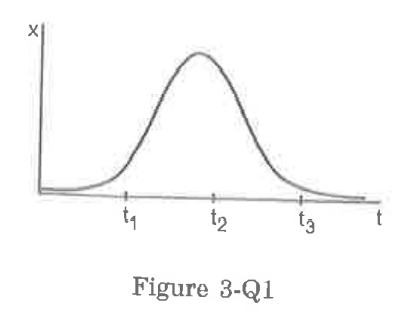
- Figure shows the x coordinate of a particle as a function of time. Fin...
Text Solution
|
- A player hits a baseball at some angle. The ball goes high up in space...
Text Solution
|
- The increase in the speed of a car is proportional to the additional p...
Text Solution
|
- A man moving in rain holds his umbrella inclined to the vertical even ...
Text Solution
|