Home
Class 11
PHYSICS
A block A of mass m is tied to a fixed p...

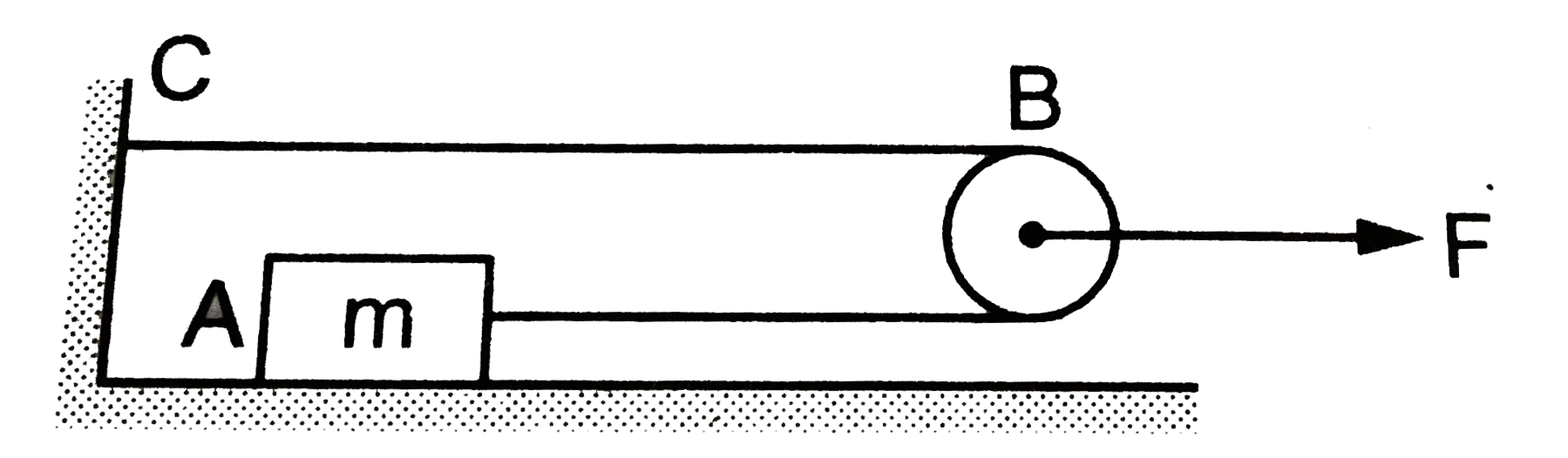
A block A of mass m is tied to a fixed point C on a horizontal table through a string passing round a massless smooth pulley B. A force F is applied by the experimenter to the pulley. Show that if the pulley is displaced by a distance x the block will be displaced by 2x. Find the acceleration of the block and the pulley.

Text Solution

Verified by Experts

Suppose the pulley is displaced to B and the block to A. The length of the string is `CB+BA` and is also equal to `CB+BB'+B'B+BA'`. Hence,`CB+BA'+A'A=CB+BB'+B'B+BA'` or, A'A=2BB`.


The displacement of A is therefore, twice the displacement of B in any given time interval. Differentiating twice, we find that the acceleration of A is twice the acceleration of B.
To find the acceleration of the block we will need the tension in the string. That can be obtained by considering the pulley as the system.
The forces acting on the pulley are
i. F towards right by the experimenter,
ii T towards let by the portion BC of the string and
iii. T towards left by the portion BA of the string.
The vertical forces, if any, add to zero as there is no vertical motion.
As the mass of the pulley is zero. the equation of motion is
`F - 2T = 0` giving `T =F / 2`
Now consider the block as the system. The only horizontal force acting on the block is the tension T towards right. The acceleration of the block is therefore, `a=T/m=F/(2m)`. The acceleration of the pulley is `a/2=F/(4m)`
Promotional Banner

Topper's Solved these Questions

  • NEWTON'S LAWS OF MOTION

    HC VERMA|Exercise Questions for short Answer|17 Videos
  • NEWTON'S LAWS OF MOTION

    HC VERMA|Exercise Objective -1|14 Videos
  • NEWTON'S LAWS OF MOTION

    HC VERMA|Exercise Exercises|42 Videos
  • LAWS OF THERMODYNAMICS

    HC VERMA|Exercise Short Answer|14 Videos
  • PHYSICS AND MATHEMATICS

    HC VERMA|Exercise Exercises|34 Videos

Similar Questions

Explore conceptually related problems

The pulleys in figure are identical, each having a radius R and moment of inertia I. Find the acceleration of the block M.

A constant force F=m_2g/s is applied on the block of mass m_1 as shown in figure. The string and the pulley are light and the surface of the table is smooth. Find the acceleration of m_1

A block of mass M is pulled on a smooth horizontal table by a string making an angle theta with the horizontal as shown in figure. If the acceleration of the block is a , find the force applied by the string and by the table N on the block.

Figure shows two blocks of masses m and M connected by a string passing over a pulley. The horizontal table over which the mass m slides is smooth. The pulley has a radius r and moment of inertia I about its axis and it can freely rotate about this axis. Find the acceleration of the mass M assuming that the string does not slip on the pulley.

A small block of mass m is kept on a bigger block of mass M which is attached to a vertical spring of spring constant k as shown in the figure. The system oscilates verticaly. a.Find the resultant force on the smaller block when it is displaced through a distance x above its equilibrium position. b. find the normal force on the smaller blok at this position. When is this force smallest smaller block at this position. When is this force smallest in magnitude? c. What can be the maximum amplitude with which the two blocks may oscillate together?

A smooth ring A of mass m can slide on a fixed horizontal rod. A string tied to the ring passes over a fixed pulley B and carries a block C of mass M(=2m) as shown in figure. At an instant the string between the ring and the pulley makes an angle theta with the rod. a. Show that, if the ring slides with a speed v, the block descends with speed v cos theta , b. With what acceleration will the ring starts moving if the system is released from rest with theta= 30^0

A block of mass M is hanging over a smooth and light pulley through a light string. The other end of the string is pulled by a constant force F. The kinetic energy of the block increases by 20J in 1s.

The descending pulley shown in figure has a radius 20 cm and moment of inertia 0.20 kg-m^2. The fixed pulley is light and the horizontal plane frictionless. Find the acceleration of the block if its mass is 1.0 kg.

A block of mass 2 kg placed on a long frictionless horizontal table is pulled horizontally by a constant foerce F. It is found to move 10 m in the first two seconds. Find the magnitude of F.

A block A of mass m_1 rests on a horizontal table . A light string connected to it passes over a frictionless pulley at the edge of table and from its other end another block B of mass m_2 is suspended . The coefficient of kinetic friction between the block and the table is mu . When the block A is sliding on the table the tension in the string is :

