Home
Class 11
PHYSICS
A smooth ring A of mass m can slide on a...

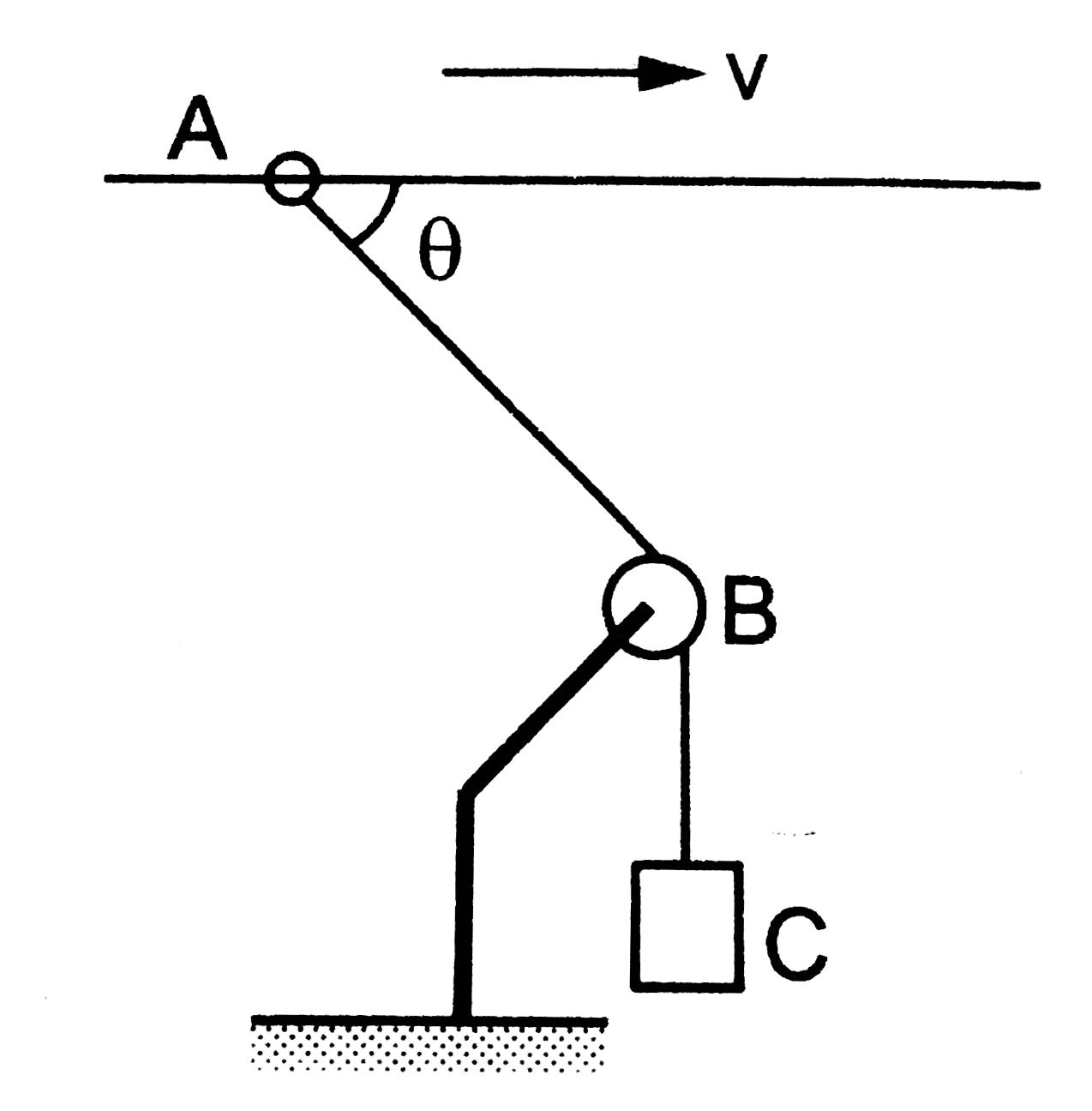
A smooth ring A of mass m can slide on a fixed horizontal rod. A string tied to the ring passes over a fixed pulley B and carries a block C of mass `M(=2m)` as shown in figure. At an instant the string between the ring and the pulley makes an angle `theta` with the rod. a. Show that, if the ring slides with a speed v, the block descends with speed `v cos theta`, b. With what acceleration will the ring starts moving if the system is released from rest with `theta= 30^0`

Text Solution

Verified by Experts
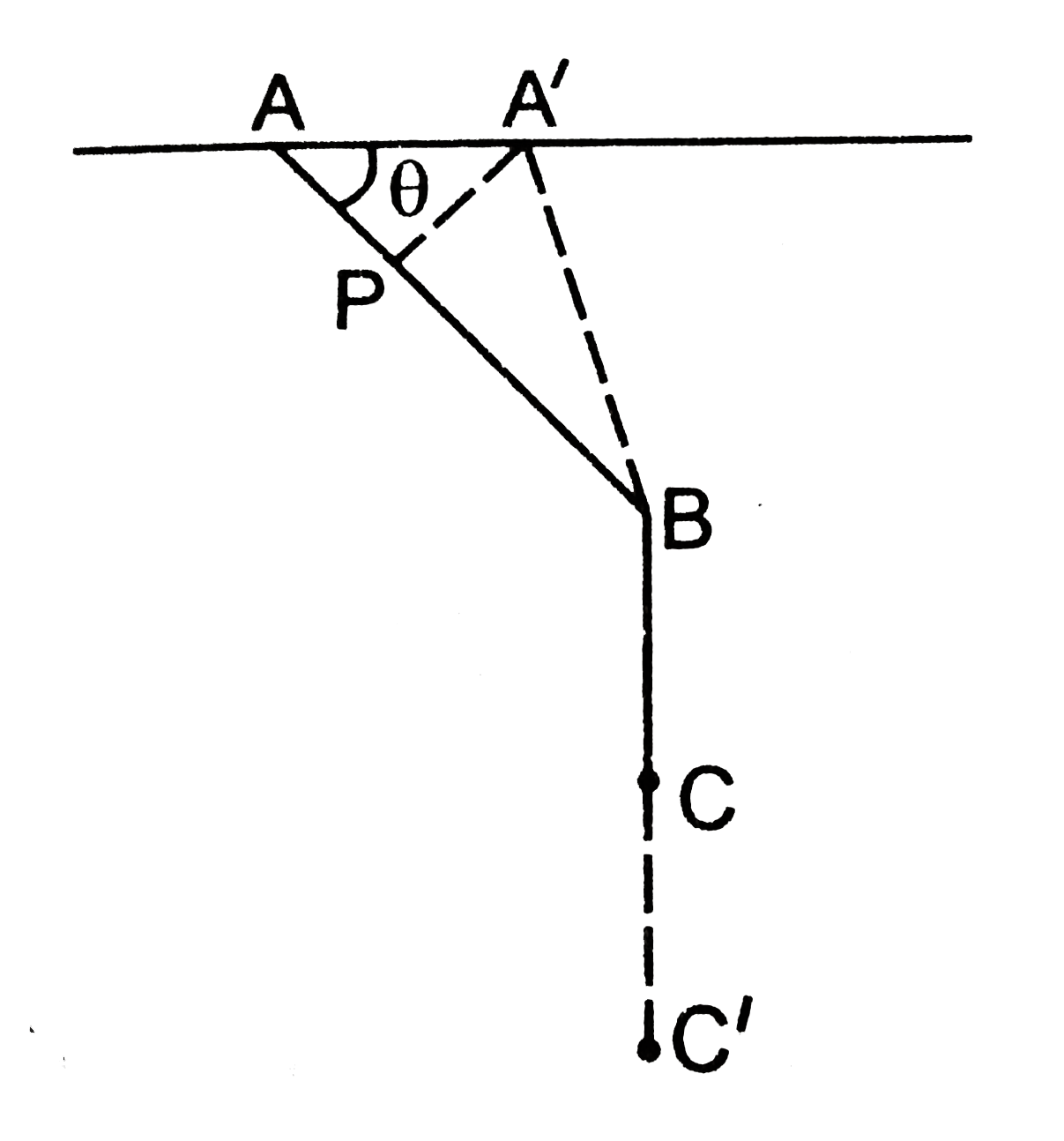
a. Suppose in a small time interva `/_\t` the ring is displaced from A to A' and the block from C to C'. Drop a perpendicular A'P from A' to AB. For small displacement `A'B~~PB`. Since the length of the string is costant, we have

`AB+BC=A'B+BC'`
or `AP+PB+BC=A'B+BC'`
`or, AP=BC'-BC=CC' (as A'B~~PB)`
or, `AA'costheta=CC`
or, `(AA'costheta)/(/_\t)=(CC')/(/_\t)`
or, (velocity of the ring ) `cos theta =` (velocity of the block).
b. If the intial acceleration of te ring is a that of the block will be `a cos theta.` Let T be the tensioin in the string at this instant.Consider the block as the system. The forces acting on the block are
i. Mg downward due to the earth and
T upwared due to the string
The equation of motion of the block is
`Mg-T=Macostheta` ............i
Now consider teh ring as the system . The forces onthe ring are
i. Mg downward due to gravity
b. N upward due to the rod,
T along the string due to teh string.
Taking components along the rod, the equation of motin of the ring is
`Tcosthera =ma`............ii
From i and ii
`Mg=ma/(costheta)=Ma cos theta `
`a=(M g cos theta)/(m+M cos^2 theta)`
putting `theta= 30^0, M=2m ad g=9.8 m/s^2, therefore
`a=6.78 m/s^2`
Promotional Banner

Topper's Solved these Questions

  • NEWTON'S LAWS OF MOTION

    HC VERMA|Exercise Questions for short Answer|17 Videos
  • NEWTON'S LAWS OF MOTION

    HC VERMA|Exercise Objective -1|14 Videos
  • NEWTON'S LAWS OF MOTION

    HC VERMA|Exercise Exercises|42 Videos
  • LAWS OF THERMODYNAMICS

    HC VERMA|Exercise Short Answer|14 Videos
  • PHYSICS AND MATHEMATICS

    HC VERMA|Exercise Exercises|34 Videos

Similar Questions

Explore conceptually related problems

find the acceleration of the block of mass M in the situation shown in figure. All the surfaces are frictionless and the pulleys and the string are light.

A constant force F=m_2g/s is applied on the block of mass m_1 as shown in figure. The string and the pulley are light and the surface of the table is smooth. Find the acceleration of m_1

A block A of mass m_1 rests on a horizontal table . A light string connected to it passes over a frictionless pulley at the edge of table and from its other end another block B of mass m_2 is suspended . The coefficient of kinetic friction between the block and the table is mu . When the block A is sliding on the table the tension in the string is :

A uniform rod of length L rests against a smooth roller as shown in figure. Find the friction coefficient between the ground and the lower end if the minimum angle that rod can make with the horizontal is theta .

Consider the situation shown in figure. All the surfaces are frictions and the string and the pulley are light. Find the magnitude of the acceleration of the two blocks.

A light string passing over a smooth light pulley connects two blocks of masses m_1 and m_2 (vertically). If the acceleration of the system is g/8 then the ratio of the masses is

Three blocks of masses m_1, m_2 and m_3 are connected as shown in the figure. All the surfaces are frictionless and the string and the pulleys are light. Find the acceleration of m_1

A block of mass M is pulled on a smooth horizontal table by a string making an angle theta with the horizontal as shown in figure. If the acceleration of the block is a , find the force applied by the string and by the table N on the block.

A block of mass m slides down a smooth vertical circular track. During the motion, the block is in

A block A of mass m is tied to a fixed point C on a horizontal table through a string passing round a massless smooth pulley B. A force F is applied by the experimenter to the pulley. Show that if the pulley is displaced by a distance x the block will be displaced by 2x. Find the acceleration of the block and the pulley.

