Home
Class 11
PHYSICS
Three blocks of masses m1, m2 and m3 are...

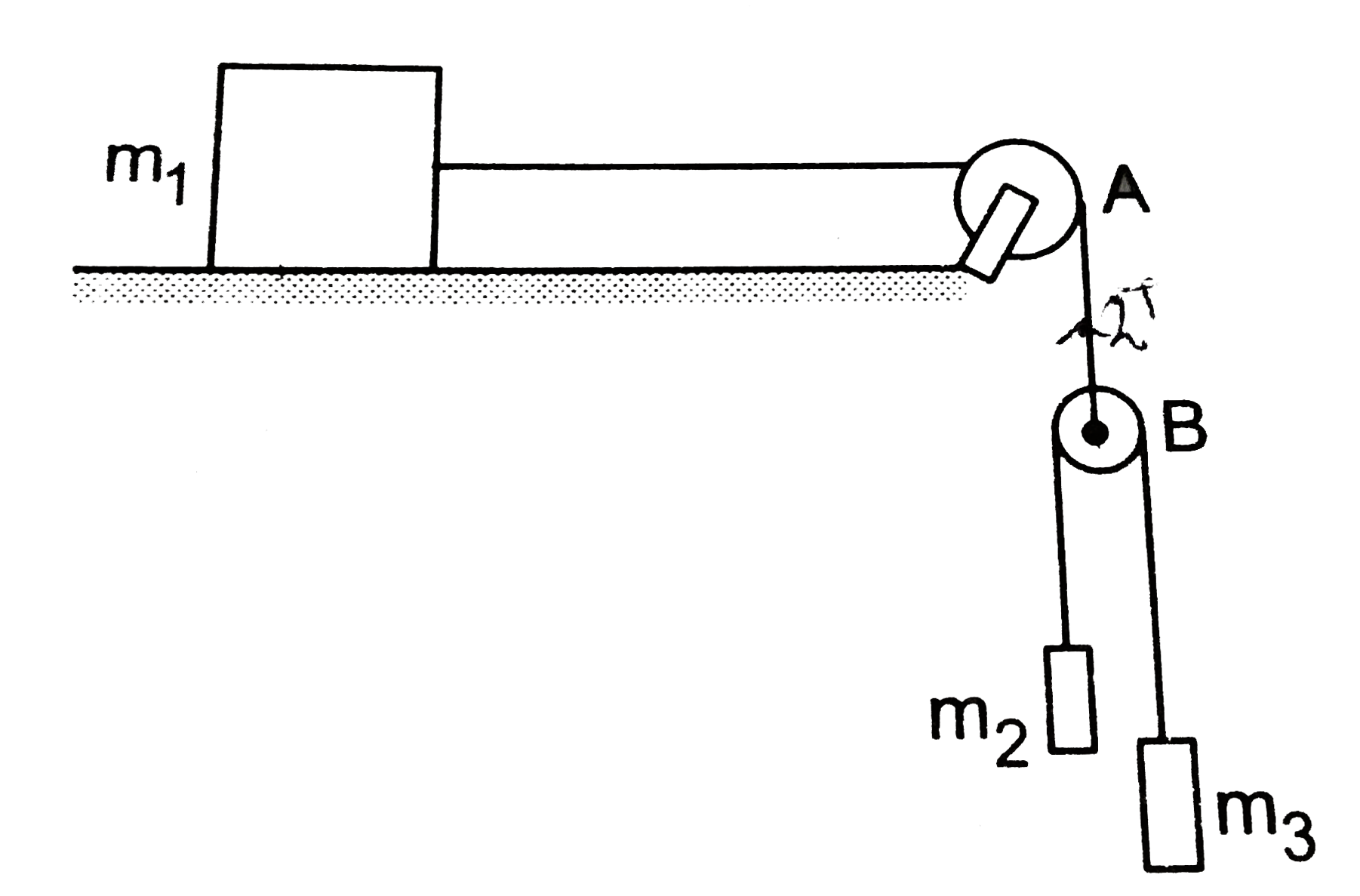
Three blocks of masses `m_1, m_2 and m_3` are connected as shown in the figure. All the surfaces are frictionless and the string and the pulleys are light. Find the acceleration of `m_1`

Text Solution

Verified by Experts
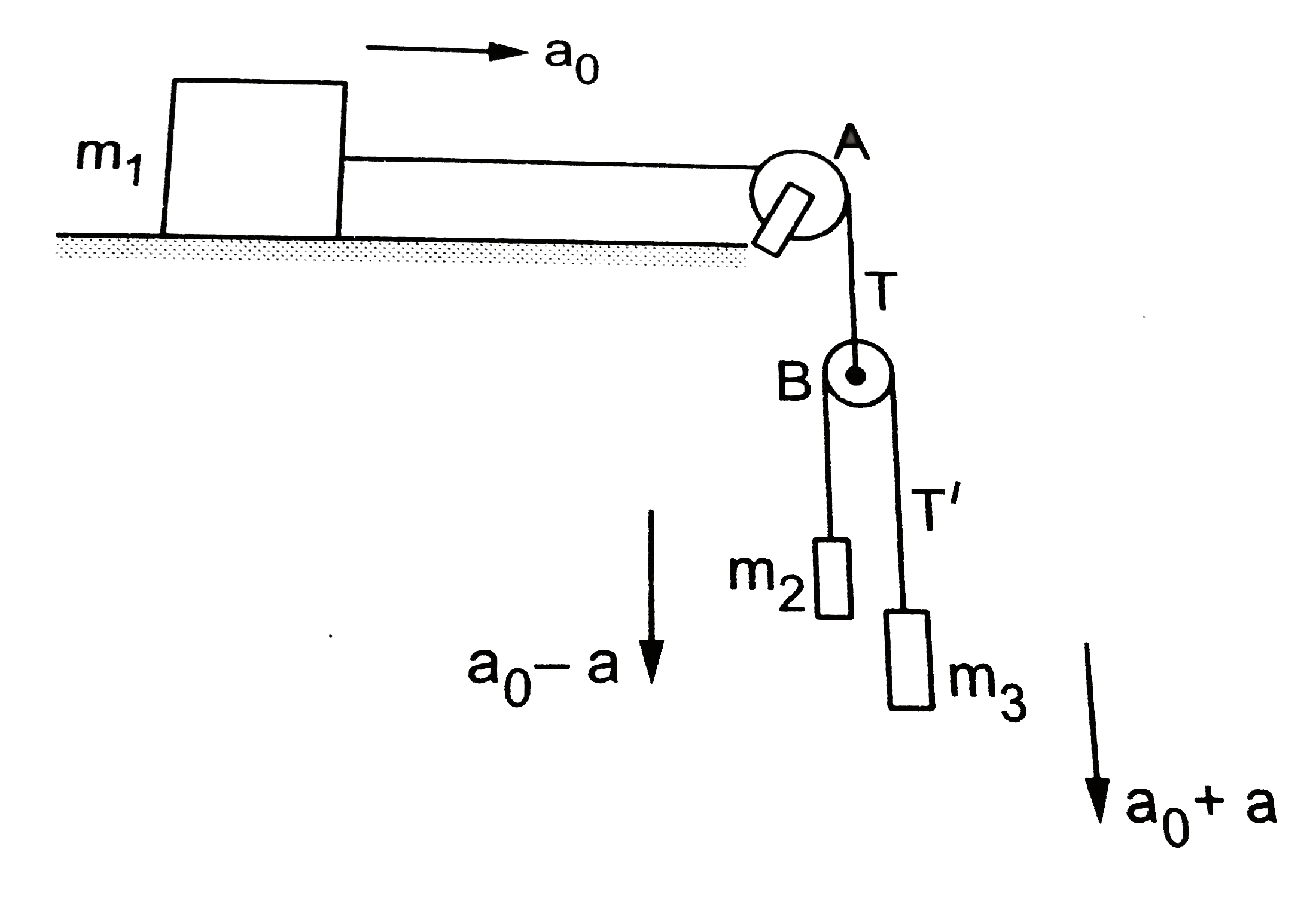
Suppose the acceleration of `n_q1` is `a_0` towards right. That will also be the downward acceleration of the pulley B because the string connecting `m_1 and m_3` has a constant length. This implies tht the decrease i the separation between `m_2 and ` B equals the increase in teh separation between `m_3 and B.` So, the upward acceleeration of `m_2` wiht respect to B equals the downward acceleration of `m_3` with respect of B. Let this acceleration be `a`
The acceleration of `m_2` with respect to the ground `=a_0-a` (downward) and the acceleration of `m_3` with respect to the ground `=a_0+a` (downward).
These accelerations will be used in Newton's laws. Let the tension be T in the upper string and T' in the lower string. consider the motion of the pulley B.

The forces on this light pulley are ltbr. a. T upward by the upper sting and
2T' downwards by thelower string.
As the mass of the pulley is negligible,
` 2T'-T=0`
giving `T-=T/2`............i
Motion `m_1`
THe acceleration is `a_0` in the horizontal direction. The forces on `m_1` are
a. T by the string (horizontal)
b. `m_1` g by theearth (verticlaly downwards) and
N by the table (verrtically upwards).
IN the horizontal direction the equation
`T=m_1a_0`
Motion of `m_2`: acceleration is `a_0-a` in the fownward direction. Teh forces on `m_2` are
a. `m_2g` downward by teh earth and
`T'=T/2` upward by teh string.
Thus, `m_2g-T/2=m_2(a_0+a)`...........iii
Moton of `m_3`= The aceeleration is `(a_0+a)` downward. The forces on `m_3` are
a. `m_3g` downward by the earth and
b. T'=T/2 upward by the string. thus,
`m_3g-T/2=m_3(a_0+0)`...........iv.
We want to calculate `a_0` so we shall elimiN/Ate T and a from ii, iii, and iv.
Putting T from ii in and iii and iv,
`a_0-a=(m_2-mI_1a_0/2)/m_2=g-(m_1a_0)/(2m_2)`
and `a_0+a+(m_3g-m-1a_0/2)/M_3 =g-(m_1 a_0)/(2m_3`
Adding `2a_0=2g-(m_1a_0)/2(1/m_2+1/m_3)`
`a_0=g-(m_1a_0)/4 (1/m_2+1/m_3)`
or, `a_0[1+m_1/4(1/m-2+1/m_3)]=g`
`or, a_0=g/(1+ m_1/4(1/m_2+1/m_3))`
Promotional Banner

Topper's Solved these Questions

  • NEWTON'S LAWS OF MOTION

    HC VERMA|Exercise Questions for short Answer|17 Videos
  • NEWTON'S LAWS OF MOTION

    HC VERMA|Exercise Objective -1|14 Videos
  • NEWTON'S LAWS OF MOTION

    HC VERMA|Exercise Exercises|42 Videos
  • LAWS OF THERMODYNAMICS

    HC VERMA|Exercise Short Answer|14 Videos
  • PHYSICS AND MATHEMATICS

    HC VERMA|Exercise Exercises|34 Videos

Similar Questions

Explore conceptually related problems

Consider the situation shown in figure. All the surfaces are frictions and the string and the pulley are light. Find the magnitude of the acceleration of the two blocks.

find the acceleration of the block of mass M in the situation shown in figure. All the surfaces are frictionless and the pulleys and the string are light.

The string the spring and the puley shown in figure are light. Find the time period of the mass m.

Find the mass M of the hanging block in figure which will prevent the smaller block from sliping over the triangular blcok. All the surfaces are frictions and the strings and the pulleys are light.

A block of mass M is placed on the top of a bigger block of mass 10 M as shown in figure. All the surfaces are frictionless. The system is released from rest, then the distance moved by the bigger block at the instant the smaller block reaches the ground :

Figure shows a small block of mass m which is started with a speed v on the horizontal part of the bigger block of mas m placed on a horizontal floor. The curved part of the surface shown is semicircular. All the surfaces are frictionless. Find the speed of the bigger block when the smaller block reaches the point A of the surface.

A block of mass m slides along a frictionless surface as shown in the figure. If it is releases from rest from A what is its speed at B?

A constant force F=m_2g/s is applied on the block of mass m_1 as shown in figure. The string and the pulley are light and the surface of the table is smooth. Find the acceleration of m_1

Three blocks with masses m, 2m, 3m. are connected by strings , as shown in the figure. After an upward forced is applied bn block m, the masses move upward at constant speed v. What is the net force on the block of mass 2m? ( g is the acceleration due to gravity). .

