Home
Class 11
PHYSICS
All the surfaces shown in figure are ass...

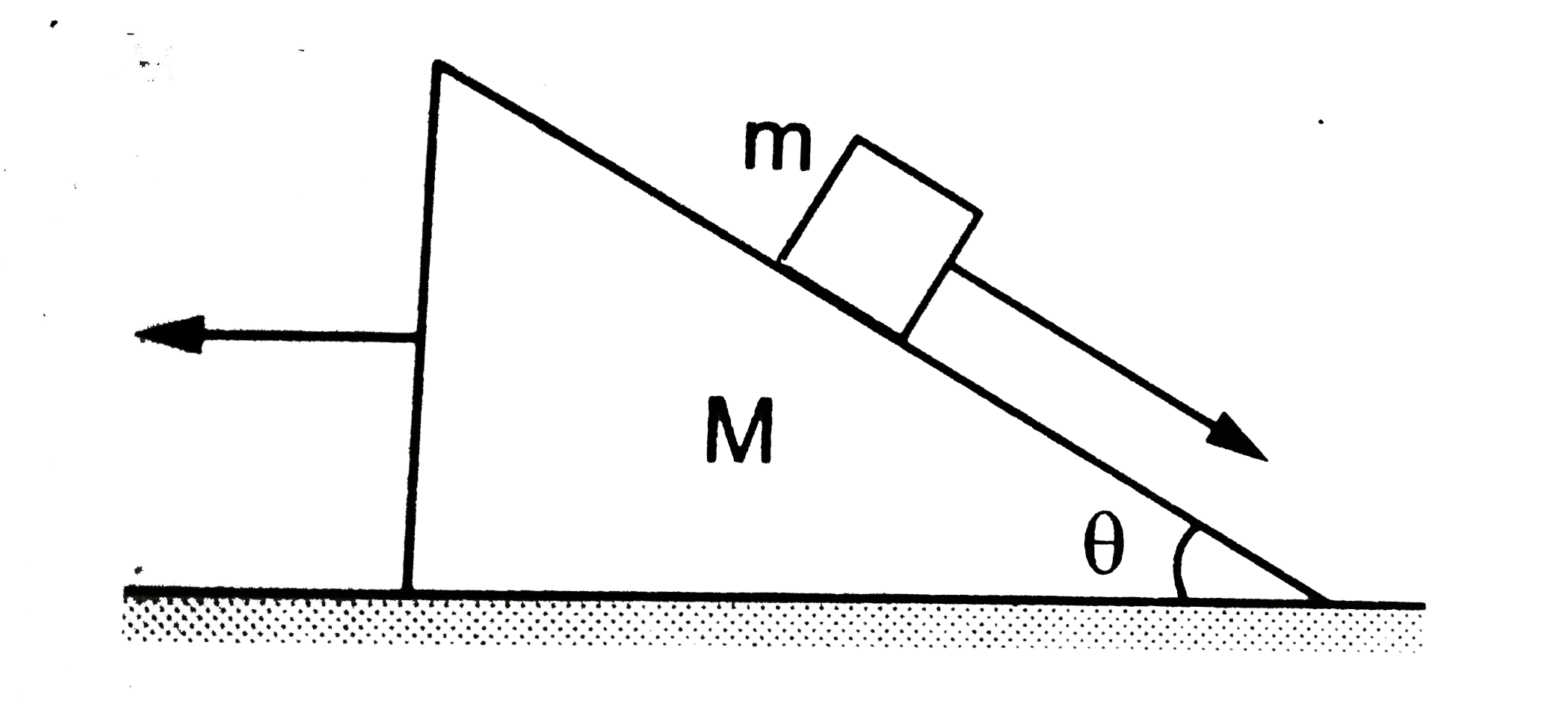
All the surfaces shown in figure are assumed to be frictionless. The block of mass m slides on the prism which in turn slides backward on the horizontal surface. Find the acceleration of the smaller block with respect to the prism.

Text Solution

Verified by Experts
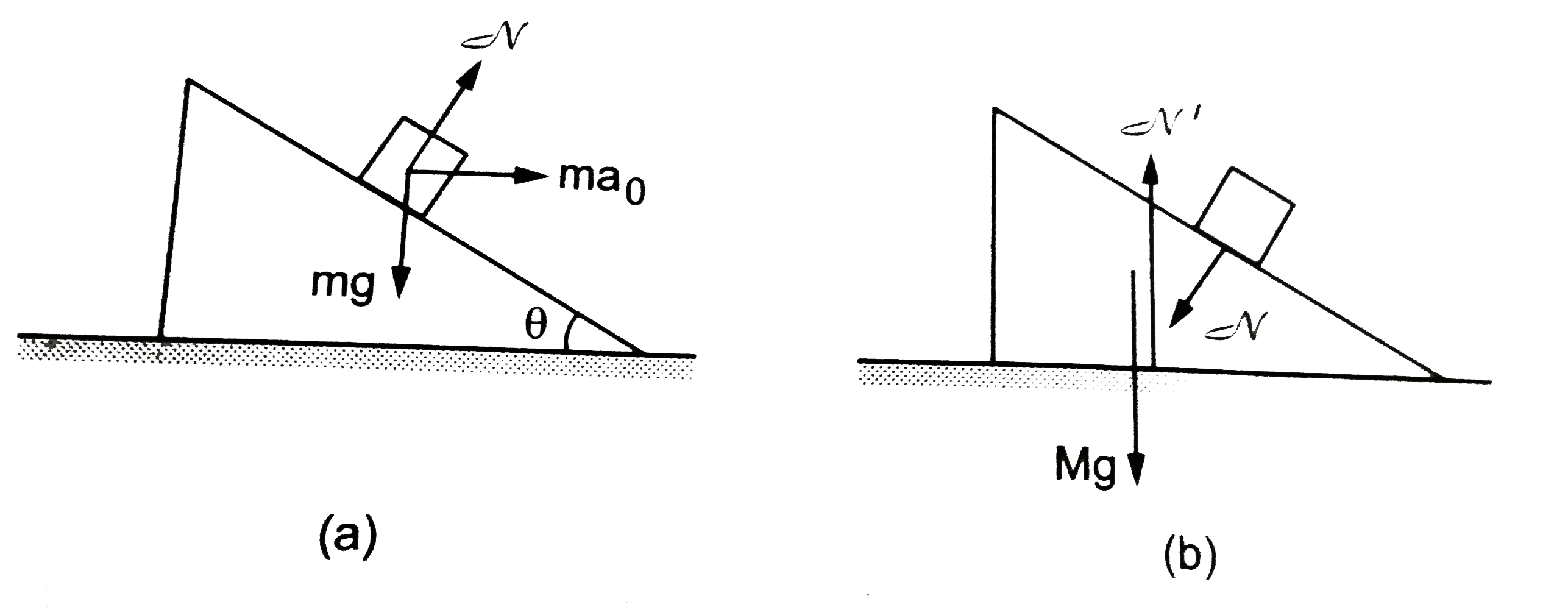
Let the acceleration of the prism be `a_0` in the backward direction. Consider the motion of the smaller block fro the frame of the prism.
The force on the block are

i. N normal force,
mg downward (gravity)
`ma_0` forward (psuedo)`

The block slides down the plane. components of the forces parallel to the incline give
`ma_0costheta+mg sintheta=ma`
or, `a=a_0costheta+g sin theta` .........i
Components of teh force perpendicular to the incline give
`N +ma_0sintheta=mg costheta` .........ii
Non consider the motion of the prism from the lab frame. No pseudo force isneeded as the frame used is inertial. The forces are ure 16 b
i. Mg downward,
ii. N normal to the incline (by the block)
`N upward (by the horizontal surface).
Horizontal components give,
`N sintheta=Ma_0 or, N Ma_0/sintheta` ..............iii
Putting in ii.
`(Ma_0)/(sintheta)+ma_0 sintheta=costheta`
or, `a_0 = (mg sinthetacostheta)/(M+msin^2theta)`
From i. `a=(mg sintheta cos^2theta)/(M+msin^2theta)+g sintheta`
`=((M+m)g sintheta)/(M+m sin^2 theta)`
Promotional Banner

Topper's Solved these Questions

  • NEWTON'S LAWS OF MOTION

    HC VERMA|Exercise Questions for short Answer|17 Videos
  • NEWTON'S LAWS OF MOTION

    HC VERMA|Exercise Objective -1|14 Videos
  • NEWTON'S LAWS OF MOTION

    HC VERMA|Exercise Exercises|42 Videos
  • LAWS OF THERMODYNAMICS

    HC VERMA|Exercise Short Answer|14 Videos
  • PHYSICS AND MATHEMATICS

    HC VERMA|Exercise Exercises|34 Videos

Similar Questions

Explore conceptually related problems

A block of mass m slides down a smooth vertical circular track. During the motion, the block is in

Find the acceleration of the blocks A and B in the this situations shown in figure.

All the surfaces shown in figure are frictionless. The mass of the car is M, that of the block is mk and the spring has spring constant. Initialy the car and the block are at rest and the spring is stretched through a length x_0 when the system is released. a. Find the amplitude of the simple harmonic motion of the blocks and of the car as seen from the road. b. Find the time periods of the two simple harmonic motions.

A block of mass m slides down the plane inclined at an angle 60^@ with an acceleration g/2. Find the co-efficient of kinetic friction.

Two blocks of mass 2 kg and 5 kg are connected by an ideal string passing over a pulley. The block of mass 2 kg is free to slide on a surface inclined at an angle of 30^@ with the horizontal whereas 5 kg block hangs freely. Find the acceleration of the system and the tension in the string.

The descending pulley shown in figure has a radius 20 cm and moment of inertia 0.20 kg-m^2. The fixed pulley is light and the horizontal plane frictionless. Find the acceleration of the block if its mass is 1.0 kg.

The track shown in figure is frictionless. The block B of mass 2 m is lying at rest and the block A of mass m is placed along the track with some speed. The collision between A and B is perfectly elastic. With what velocity should the block A be started to get the sleeping man awakened ?

