Home
Class 11
PHYSICS
A block of 2 kg is suspended from the ce...

A block of 2 kg is suspended from the ceiling through a massless spring of spring constant k=100 N/m. What is the elongation of the spring? If another 1 kg is added to the block, what would be the further elongation?

Text Solution

Verified by Experts
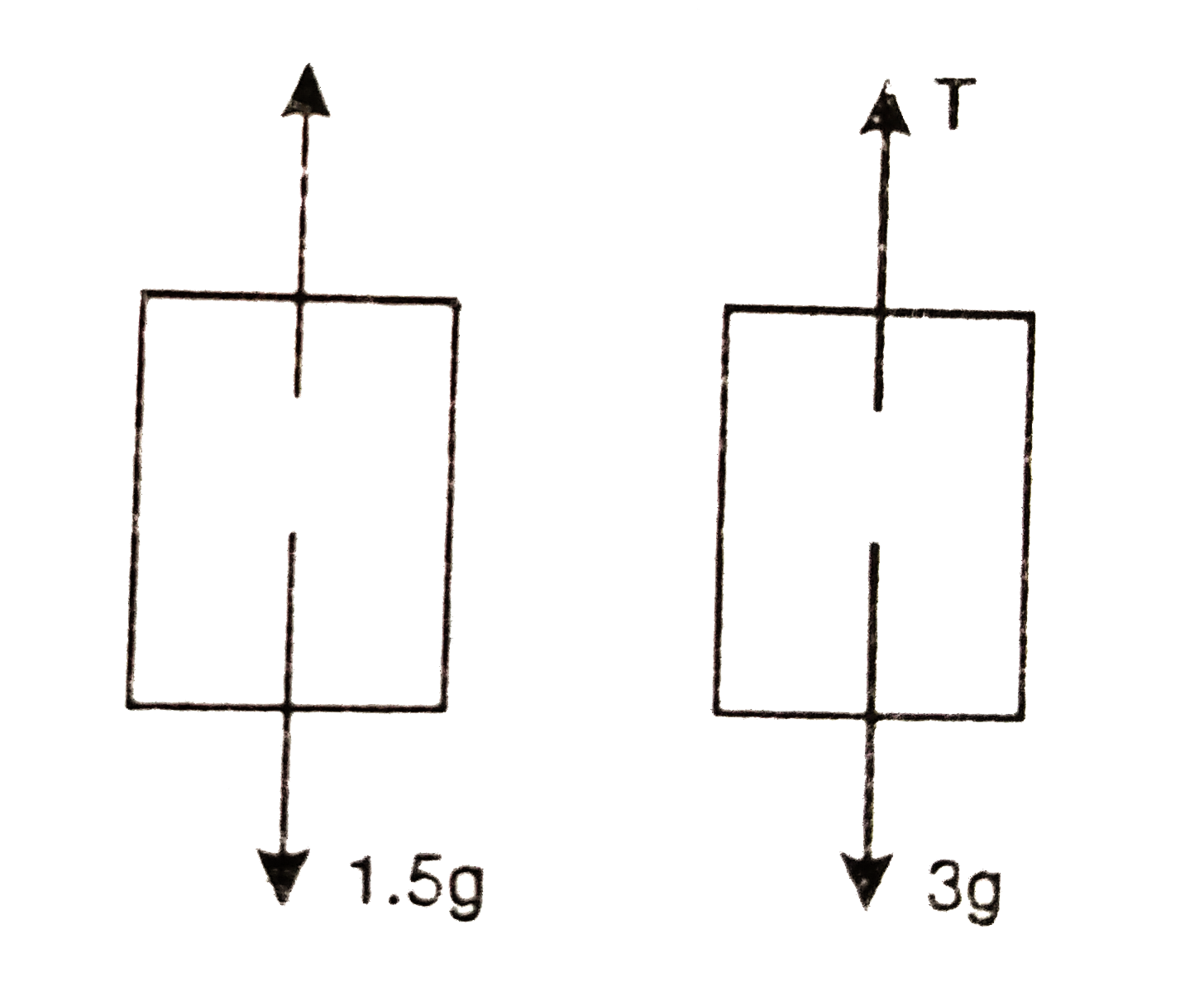
Let the acceleration of the 3 kg mass reltive to the elevator is a in the downward direction.
From the free body diagram,
`T-1.5g- 1.5 (g/10)+3a=0`
and T-3g-3(g/10)+3a=0`
`rarr T= 1.5g+1.5g+1.5(g/10)+1.5a`………..i
and `T=3 g+3(g/10)+3a=0`......ii

Now equation i xx2
6g+3(g/10)+3a=2T`
Equation ii xx1
`3g+3(g/10)+3a=T`
Substracting the above two equations, we get,
`T=6a`
Putting T=6a in equation ii. we get,
`6a=3g+(g/10)-3a`
`rarr 9a=(33g)/10` ltbr `rarr 9=((9.8)33)/10 = 32.34`
` rarr a= 32.34/9 = 3.59`
`:. T=6a= 6xx3.59 = 21.55N`.
`:. T_1 = 2T=2xx21.55=43.1N`
`:. Mass= Weight/g`
` = 43.1/9.8 = 4.39 ~~ 4.4 kg.`
Promotional Banner

Topper's Solved these Questions

  • NEWTON'S LAWS OF MOTION

    HC VERMA|Exercise Objective -2|8 Videos
  • LAWS OF THERMODYNAMICS

    HC VERMA|Exercise Short Answer|14 Videos
  • PHYSICS AND MATHEMATICS

    HC VERMA|Exercise Exercises|34 Videos

Similar Questions

Explore conceptually related problems

A block of mass 10 kg is suspended throug two light spring balances as shown in figure

A block of mass m is suspended from the ceiling of a stationary standig elevator through a spring of spring constant k. Suddenly, the cable breaks and the elevator starts falling freely. Show that the bklock now executes a simple harmonic motion of amplitude mg/k in the elevator

A block of mass m is connect to another block of mass M by a massless spring of spring constant k. The blocks are kept on a smooth horizontal plane. Initially the blocks are at rest and the spring is unsrtretched when a constnt force F starts acting on the block of mass M to pull it. Find the maximum extension of the spring.

Two identically charged particles are fastened to the two ends of a spring of spring constant 100 N m ^(-1) , find the extension In the length of the spring. Assume that the extension is small as compared to the natural length . Justify this assumption after you solve the problem.

A block of mass m is suspended through a spring of spring constant k and is in equilibrium. A sharp blow gives the block an initial downward velocity v. How far below the equilibrium position, the block comes to an instantaneous rest?

A block of mass 4 kg is suspended through two light spring balances A and B. Then A and B will read respectively .

A block of mass m hangs from a vertical spring of spring constant k. If it is displaced from its equilibrium position, find the time period of oscillations.

A wooden block of mass 0.5 kg and density 800 kgm^-3 is fastened to the free end of a vertical spring of spring constant 50 Nm^-1 fixed at the bottom. If the entire system is completely immersed in water, find a. the elongation (or compression) of the spring in equilibrium and b. the time period of vertical oscillations of the block when it is slightly depressed and released.

Figure shows a smooth track, a part of which is a circle of radius R. As block of mass m is pushed against a spring of spring constant k fixed at the left end and is then released. Find the initial compression of the spring so that the block presses the track with a force mg when it reaches the point P, where the radius of the track is horizontal.

HC VERMA-NEWTON'S LAWS OF MOTION-Exercises
  1. A person is standing on a weighing machine placed on the floor of an e...

    Text Solution

    |

  2. Find the reading of th spring balance shown in figure. The elevator is...

    Text Solution

    |

  3. A block of 2 kg is suspended from the ceiling through a massless sprin...

    Text Solution

    |

  4. Suppose the ceiling in the previous problem is that the elevator which...

    Text Solution

    |

  5. The force of buoyancy exerted by the atmosphere on a balloon is B in t...

    Text Solution

    |

  6. An empty plastic box of mass m is found to accelerate up at the rate o...

    Text Solution

    |

  7. A force vecF=vecvxxvecA is exerted on a particle in addition to the fo...

    Text Solution

    |

  8. In a simple Atwood machine, two unequal masses m1 and m2 are connected...

    Text Solution

    |

  9. In a simple Atwood machine, two unequal masses m1 and m2 are connected...

    Text Solution

    |

  10. Figure shows a uniform rod of length 30 cm having a mass of 3.0 kg. Th...

    Text Solution

    |

  11. Consider the situation shown in figure. All the surfaces are frictions...

    Text Solution

    |

  12. A constant force F=m2g/s is applied on the block of mass m1 as shown i...

    Text Solution

    |

  13. In figure m1=5 kg, m2=2kg and F=1N. Find the acceleration of either bl...

    Text Solution

    |

  14. Let m1=1 kg, m2=2kg and m3=3kg is figure. Find the acceleration of m1,...

    Text Solution

    |

  15. In the previous problem, suppose m2=2.0kg and m3=3.0 kg. What should b...

    Text Solution

    |

  16. Calculate the tension in the string shown in figure. The pulley and th...

    Text Solution

    |

  17. Consider4 the situation shown in figure. Bothe the pulleys and the str...

    Text Solution

    |

  18. find the acceleration of the block of mass M in the situation shown in...

    Text Solution

    |

  19. Find the mass M of the hanging block in figure which will prevent the ...

    Text Solution

    |

  20. Find the acceleration of the blocks A and B in the this situations sho...

    Text Solution

    |

