Home
Class 11
PHYSICS
Find the mass M of the hanging block in ...

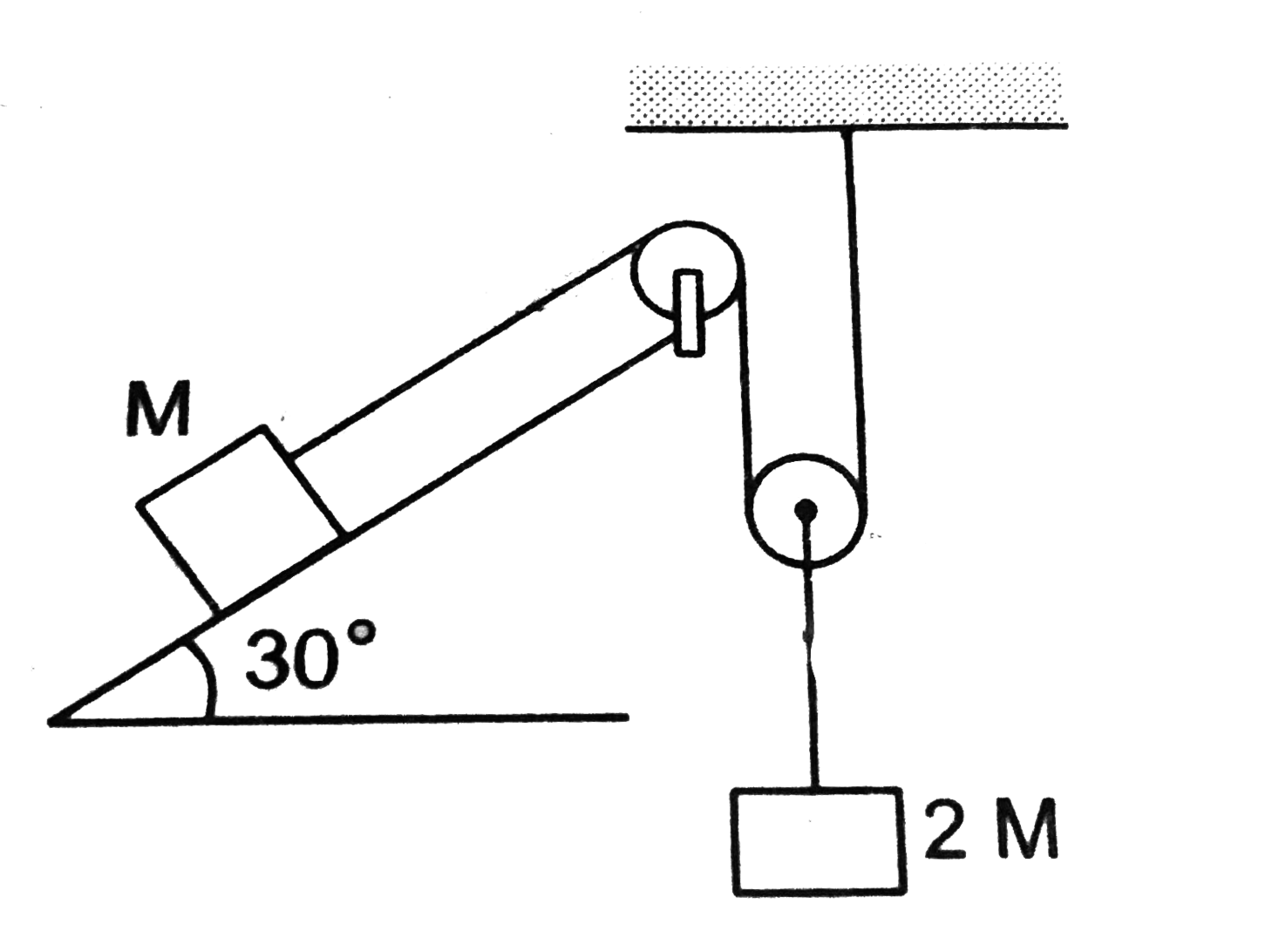
Find the mass M of the hanging block in figure which will prevent the smaller block from sliping over the triangular blcok. All the surfaces are frictions and the strings and the pulleys are light.

Text Solution

Verified by Experts
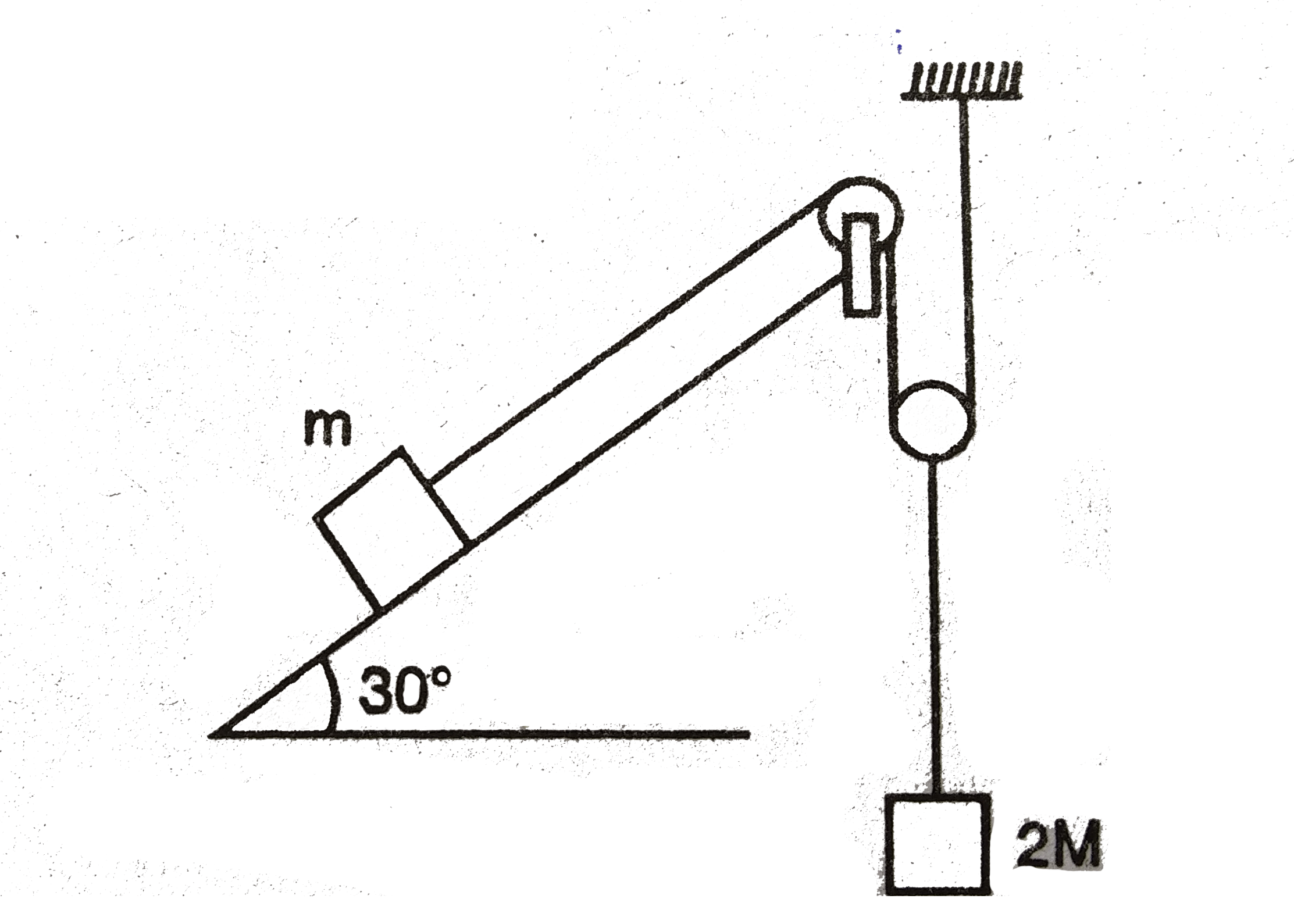

`2Ma+mg sin theta - T=0`
`rarr T= 2Ma+Mg sin theta ` ….i.
`Now 2T+2Ma-2Mg=0`
From equation i. `
`2(2Ma+Mg sin theta)+2Ma-2Mg=0`
` rarr 4Ma +2Mg sin theta + 2Ma- 2Mg = 0`
` rarr 6Ma + 2Mg sin 30^0 +2Mg=0`
` 6Ma=Mg`
`rarr as= g/6`
Hence acceleration of mas,
` M=2a=2xx g/6 `
` =g/3 up the plane.
Promotional Banner

Topper's Solved these Questions

  • NEWTON'S LAWS OF MOTION

    HC VERMA|Exercise Objective -2|8 Videos
  • LAWS OF THERMODYNAMICS

    HC VERMA|Exercise Short Answer|14 Videos
  • PHYSICS AND MATHEMATICS

    HC VERMA|Exercise Exercises|34 Videos

Similar Questions

Explore conceptually related problems

find the acceleration of the block of mass M in the situation shown in figure. All the surfaces are frictionless and the pulleys and the string are light.

Three blocks of masses m_1, m_2 and m_3 are connected as shown in the figure. All the surfaces are frictionless and the string and the pulleys are light. Find the acceleration of m_1

Consider the situation shown in figure. All the surfaces are frictions and the string and the pulley are light. Find the magnitude of the acceleration of the two blocks.

Figure shows a uniform rod of length 30 cm having a mass of 3.0 kg. The strings shown in the figure are pulled by constant forces of 20 N and 32N. Find the force exerted by the 20 cm part of the rod on the 10 cm part. All the surfaces are smooth and the strings and the pulleys are light.

Consider4 the situation shown in figure. Bothe the pulleys and the string are light and all the surfaces are friction less. a. Find the acceleration of the mass M. b. Find the tension in the string c. Calculate the force exerted by the clamp on the pulley A in the figure.

Figure shows a small body of mass m placed over a larger mass M whose surface is horizontal near the smaller mass and gradually curves to become verticle. The smaller mass is pushed on the longer on at a speed v and the system is left to itself. Assume thast all the surfaces are frictionless. a. find teh speed of the larger block when the smaller block is sliding on the vertical part. b. find the speed of the smaller mass when it breaks off the larger mas at height h. c. find the maximum height (from the ground) that the smaller mass seconds. d show that the smaller mass will again land on the bigger one. Find the distane traversed by the bigger block during the time when the smaller block was in its flight under gravity.

The coefficient of static friction between the block of 2 kg and the table shown in figurwe is mu_s=0.2 What should be the maximum value of m so tht the blocks do not move? Take g=10 m/s^2. The string and the pulley are light and smooth.

Consider the stituation shown in figure. The elevator is going up with an acceleration of 2.00 ms^-2 and the focal length of the mirror is 12.0 cm. All the surfaces are smooth and the pulley is light. The mass-pulley system is released from rest (with respect to the elevator) at t=0 when the distance of B from the mirror is 42.0 cm. Find the distance between the image of the block B and the mirror at t=0.200 s. Take g=10 ms^-2

Figure shows a small block of mass m which is started with a speed v on the horizontal part of the bigger block of mas m placed on a horizontal floor. The curved part of the surface shown is semicircular. All the surfaces are frictionless. Find the speed of the bigger block when the smaller block reaches the point A of the surface.

HC VERMA-NEWTON'S LAWS OF MOTION-Exercises
  1. Figure shows a uniform rod of length 30 cm having a mass of 3.0 kg. Th...

    Text Solution

    |

  2. Consider the situation shown in figure. All the surfaces are frictions...

    Text Solution

    |

  3. A constant force F=m2g/s is applied on the block of mass m1 as shown i...

    Text Solution

    |

  4. In figure m1=5 kg, m2=2kg and F=1N. Find the acceleration of either bl...

    Text Solution

    |

  5. Let m1=1 kg, m2=2kg and m3=3kg is figure. Find the acceleration of m1,...

    Text Solution

    |

  6. In the previous problem, suppose m2=2.0kg and m3=3.0 kg. What should b...

    Text Solution

    |

  7. Calculate the tension in the string shown in figure. The pulley and th...

    Text Solution

    |

  8. Consider4 the situation shown in figure. Bothe the pulleys and the str...

    Text Solution

    |

  9. find the acceleration of the block of mass M in the situation shown in...

    Text Solution

    |

  10. Find the mass M of the hanging block in figure which will prevent the ...

    Text Solution

    |

  11. Find the acceleration of the blocks A and B in the this situations sho...

    Text Solution

    |

  12. Find the acceleration of the 500 g block in figure.

    Text Solution

    |

  13. A monkey a mass 15 kg is climbing on a rope with one end fixed to the ...

    Text Solution

    |

  14. A Monkey is Climbing on a Rope that Goes Over a Smooth Light Pulley an...

    Text Solution

    |

  15. A Monkey is Climbing on a Rope that Goes Over a Smooth Light Pulley an...

    Text Solution

    |

  16. A monkey A (mass = 5 kg) is climbing up a rope tied to a rigid support...

    Text Solution

    |

  17. Figure shows a man of mass 60 kg standing on a light weighting machine...

    Text Solution

    |

  18. A block A can slide on a frictionless incline of angle theta and lengt...

    Text Solution

    |

  19. A car is speeding up on a horizontal road with an acceleration a. Cons...

    Text Solution

    |

  20. a block is kept on the floor of an elevator at rest. The elevator star...

    Text Solution

    |

