Home
Class 11
PHYSICS
Two identical cylindrical vessel with th...

Two identical cylindrical vessel with their bases at the same level each contain a liquid of density `rho`. The height of the liquid in one vessel is `h_(1)` and in the other is `h_(2)` the area of either base is A. What is the work done by gravity is equalising the levels when the two vessels are connected?

Text Solution

Verified by Experts
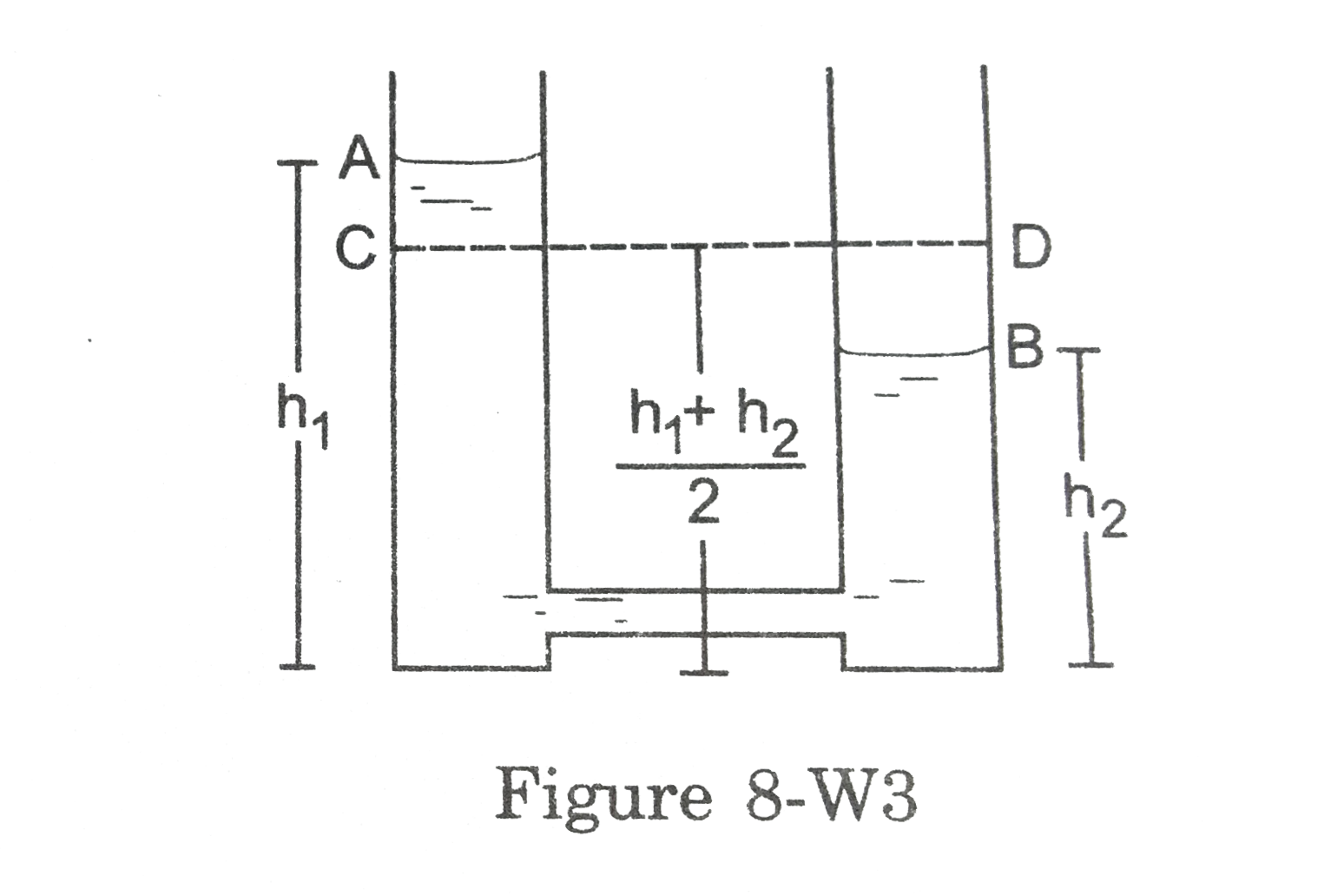
Since the total volume of the water is constant, the height in each vessel after interconnection will be `(h_1+h_2)/2`. The level in the left vessel shown in the ure, drops form A to C and that in the right vessel rises from B to D. Effectively, the water in the part AC has dropped down to DB.

The mass of this volume of water is
`m=rhoA(h_1-(h_1+h_2)/2)`
`rho A((h_1-h_2)/2)`
The height descended by this waster is `AC=(h_1-h_2)/2`. The work done by the force of gravity during this process is therefore,
`rhoA((h_1-h_2)/2)^2g`.
Promotional Banner

Topper's Solved these Questions

  • WORK AND ENERGY

    HC VERMA|Exercise Question for Short Answer|17 Videos
  • WORK AND ENERGY

    HC VERMA|Exercise Objective -1|10 Videos
  • WORK AND ENERGY

    HC VERMA|Exercise Exercises|64 Videos
  • WAVE MOTION AND WAVES ON A STRING

    HC VERMA|Exercise Exercises|57 Videos

Similar Questions

Explore conceptually related problems

Water level is maintained ina cylindrical vessel up to a fixed height H. The vessel is kept on a horizontal plane. At what height above the bottom should a hole be made in the vessel so that the water stream coming out of the hole strikes the horizontal plane at the greatest distance from the vessel.

An adiabatic vessel of total volume V is divided into two equal parts by a conducting separator. The separator is fixed in this position. The part on the left contains one mole of an ideal gas (U=1.5 nRT) and the part on the right contains two moles of the same gas. initially, the pressure on each side is p. the system is left for sufficient time so that a steady state is reached. find (a) the work done by the gas in the left part during the process, (b) the temperature on the two sides in the beginning, (c ) the final common temperature reached by the gases, (d) the heat given to the gas in the right part and (e) the increase in the internal energy of the gas in the left part.

Two closed vessels of equal volune contain air at 105kPa, 300K and are connected through a narrow tube. If one of the vessels is mow maintained at 300K and the other at 400K, what will be the pressure in the vessels?

Water and mercury are filled in two cylindrical vessels up to same height. Both vessels have a hole in the wall near the bottom. The velocity of water and mercury coming out of the holes are v_1 and v_2 respectively. Then

Equal mass of three liquids are kept in three identical cylindrical vessels A, B and C. the densities are rho_A, rho_B, rho_C with rho_Altrho_Bltrho_C . The force on the base will be

Figure shows two rigid vessels A and B, each of volume 200 cm ^(3) containg an ideal gas (C_v = 12.5 JK ^(-1) mol^(-1)) . The vessels are connected to a manometer tube containing mercury. The pressure in both the vessels is 75 cm mercury and the temperature is 300k. (a) (5-0 J) of heat is supplied to the gas in the vessels.(b) (10 J) to the gas in the vessels B. Assuming no appreciable transfer of heat from A to B calculate the dufference in the heights of mercury in the two sides of the manometer. Gas constant (R = 8.3 JK^(-1) mol^(-1))

A cylindrical piece of cork of density of base area A and height h floats in a liquid of density p_(l) . The cork is depressed slightly and then released. Show that the cork oscillates up and down simple harmonically with a period T=2pisqrt((hp)/(p_(1)g)) where p is the density of cork. (Ignore damping due to viscosity of the liquid).

In a constant volume gas thermometer, the pressure of the working gas is measured by the difference in the levels of mercury in the two arms of a U-tube connected to the gas at one end. When the bulb is placed at the room temperature 27.0^0 C , the mercury column in the arm open to atmosphere stands 5.00 cm above the level of mercury in the other arm. When the bulb is placed in a hot liquid, the difference of mercury levels becomes 45.0 cm . Calculate the temperature of the liquid. (Atmospheric pressure = 75.0cm of mercury).

Figure shows two vessels with adiabatic walls, one containing 0.1 g of helium (gamma =1.67 , M = 4 g mol^(-1)) and the other containing some amount of hydrogen (gamma = 1.4, M = 2 g mol^(-1)) . Initially , the temperatures of the two gases are equal. The gases electrically heated for some time during which equal amounts of heat are given to the gases. It is found that the temperatures rise through the same amount in the two vessels. Calculate the mass of hydrogen.

Take three different colour sheets , place one over the other and draw a triangle on the top sheet. Cut the sheets to get triangles of different colour which are identical. Mark the vertices and the angles as shown. Place the interior angles angle1,angle2 and angle3 on a straight line, adjacent to each other, without leaving any gap. What can you say about the total measure of the three angles angle1,angle2 and angle3 ? Can you use the same figure to explain the ''Exterior angle property'' of a triangle ? If a side of a triangle is stretched, the exterior angle so formed is equal to the sum of the two remote interior angles.

