Home
Class 11
PHYSICS
The descending pulley shown in figure ha...

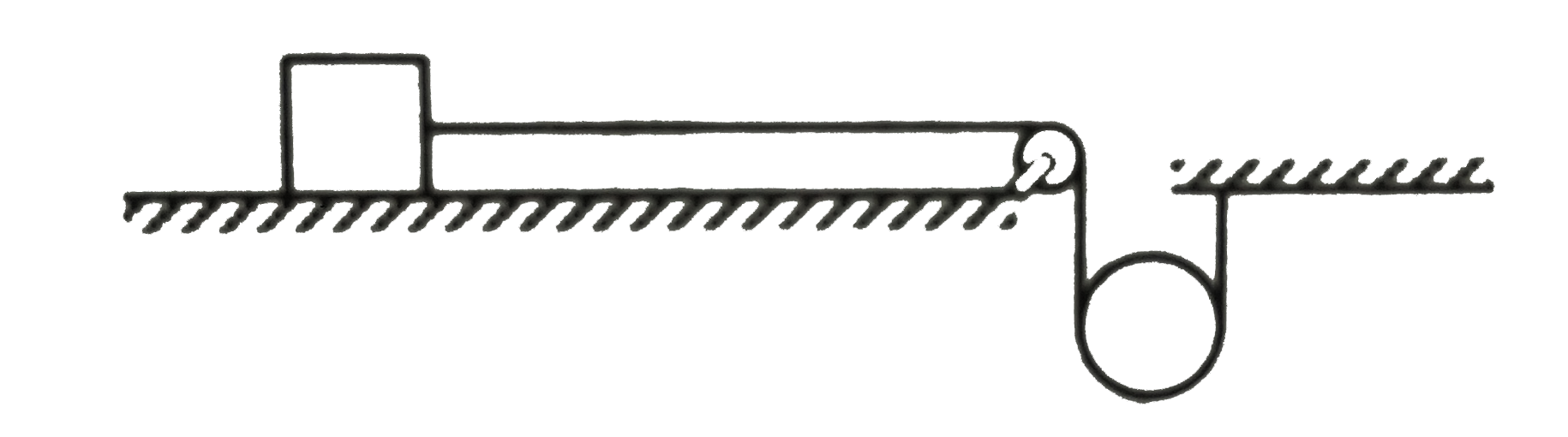
The descending pulley shown in figure has a radius 20 cm and moment of inertia 0.20 kg-m^2. The fixed pulley is light and the horizontal plane frictionless. Find the acceleration of the block if its mass is 1.0 kg.

Text Solution

Verified by Experts

The correct Answer is:
A, B

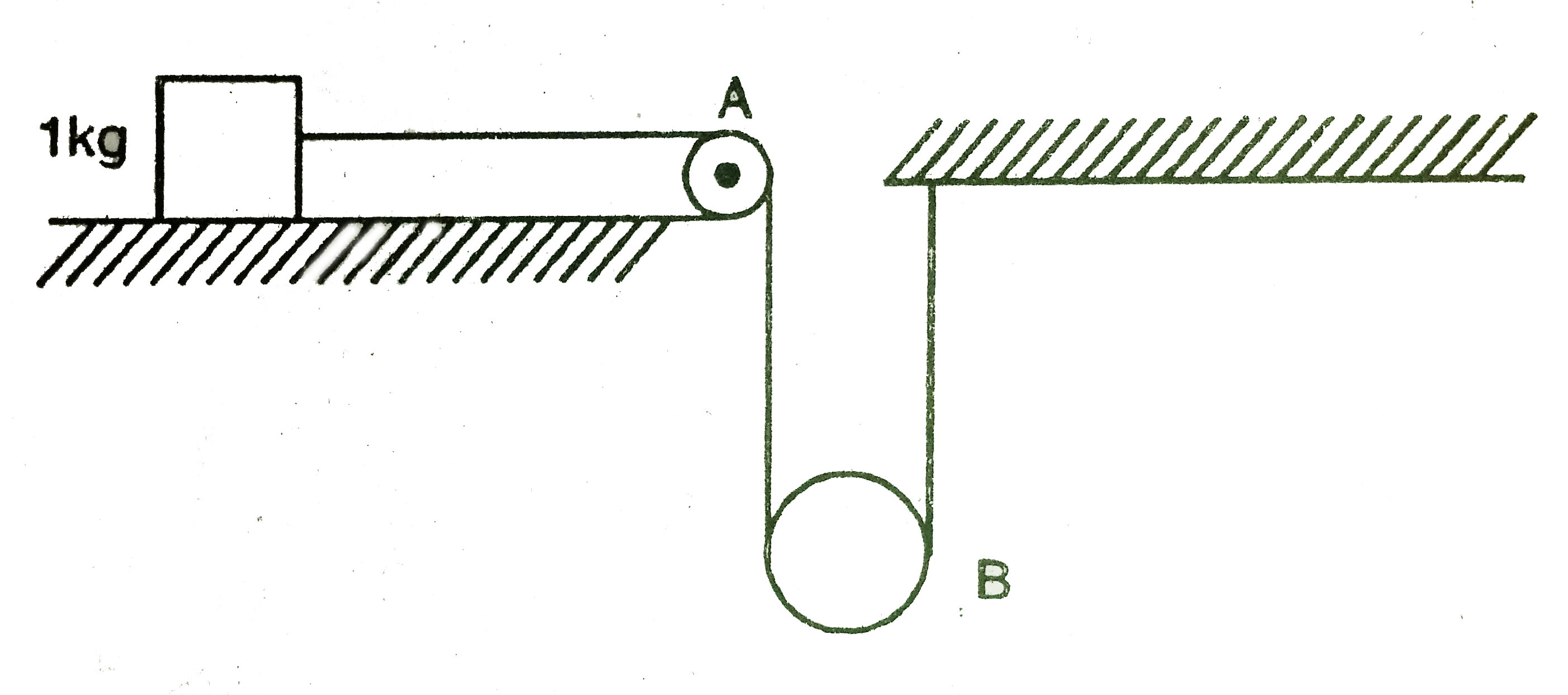
A is light pulley and B is the descending puley having I=0.20 kg-m^2 and r=0.2 m
Mass of the block =1kg
According to the question
`T_1=m_1a`……….1
`(T_2-T_1)r=Ialpha`……2
`m_2g=m_2alpha a/2=T_1+T_2`……. 3
`T_2-T_1=(Ia)/(2r^2)=(5a)/2`
and `T_1=a` (because `alpha=a/(2r))`
`rarr T_2=/2a`

`rarr m_2g=m_2a/2+7/5a+a`
[using 3]
`rarr (2I)/r^2g=(2I)/r^2a/2+9/2as (1/2mr^2=I)`
`rarr 98.5a+4.5a`
`rarr a=98/9.5=10.3 m/s^2`
Promotional Banner

Topper's Solved these Questions

  • ROTATIONAL MECHANICS

    HC VERMA|Exercise Objective -2|15 Videos
  • REST AND MOTION : KINEMATICS

    HC VERMA|Exercise Exercises|51 Videos
  • SIMPLE HARMONIC MOTION

    HC VERMA|Exercise Exercises|58 Videos

Similar Questions

Explore conceptually related problems

The pulley shown in figure has a radius 10 cm and moment of inertia 0.5 kg-m^2 about its axis. Assuming the inclined planes to be frictionless, calculate the acceleration of the 4.0 kg block.

The pulley shown in figure has a radius of 20 cm and moment of inertial 0.2 kg-m^2. The string going over it is attached at one end to a vertical sprign of spring constant 50 N/m fixed from below and supports a 1 kg mas at other end. The system is released from rest with the spring at its natural length. Find the speed of the block when it has desceds through 10 cm. Take g=10 m/s^2 .

Suppose the smaller pulley of the previous problem has its radius 5.0 cm and moment of inertia 0.10 kg-m^2. Find the tension in the part of the string joiningk the pulleys.

The pulleys in figure are identical, each having a radius R and moment of inertia I. Find the acceleration of the block M.

Consider the situation shown in figure. All the surfaces are frictions and the string and the pulley are light. Find the magnitude of the acceleration of the two blocks.

A string is wrapped on a wheel of moment of inertia 0.20 kg-m^2 and radius 10 cm and goes through a light pulley to support a block of mass 2.0 kg as shown in figure. Find the acceleration of the block.

The pulley shown in figure has a moment of inertia I about it's axis and its radius is R. Find the magnitude of the acceleration of the two blocks. Assume that the string is light and does not slip on the pulley.

Figure shows two blocks of masses m and M connected by a string passing over a pulley. The horizontal table over which the mass m slides is smooth. The pulley has a radius r and moment of inertia I about its axis and it can freely rotate about this axis. Find the acceleration of the mass M assuming that the string does not slip on the pulley.

Consider4 the situation shown in figure. Bothe the pulleys and the string are light and all the surfaces are friction less. a. Find the acceleration of the mass M. b. Find the tension in the string c. Calculate the force exerted by the clamp on the pulley A in the figure.

All the surfaces shown in figure are assumed to be frictionless. The block of mass m slides on the prism which in turn slides backward on the horizontal surface. Find the acceleration of the smaller block with respect to the prism.

HC VERMA-ROTATIONAL MECHANICS-Exercises
  1. Suppose the smaller pulley of the previous problem has its radius 5.0 ...

    Text Solution

    |

  2. The pulleys in figure are identical, each having a radius R and moment...

    Text Solution

    |

  3. The descending pulley shown in figure has a radius 20 cm and moment of...

    Text Solution

    |

  4. The pulley shown in figure has a radius 10 cm and moment of inertia 0....

    Text Solution

    |

  5. Solve the previous problem if the firction coefficient between the 2.0...

    Text Solution

    |

  6. A uniform metre stick of mass 200 g is suspended from the ceiling thro...

    Text Solution

    |

  7. A uniform ladder of length 10.0 m and mass 16.0 kg is resting against ...

    Text Solution

    |

  8. Suppose the friction coefficient between the ground and the ladder of ...

    Text Solution

    |

  9. A 6.5 m long ladder rests against as vertical wall reaching a height o...

    Text Solution

    |

  10. the door of an almirah is 6 ft high, 1.5 ft wide and weights 8 kg. The...

    Text Solution

    |

  11. A uniform rod of length L rests against a smooth roller as shown in fi...

    Text Solution

    |

  12. A uniform rod of mass 300 g and length 50 cm rotates at a uniform angu...

    Text Solution

    |

  13. A uniform square plate of mass 2.0 kg and edge 10 cm rotates about one...

    Text Solution

    |

  14. Calculate the ratio of the angular momentum of the earth about its axi...

    Text Solution

    |

  15. Two particles of masses m1 and m2 are joined by a light rigid rod of l...

    Text Solution

    |

  16. A dumb bell consists of two identicasl small balls offmss 1/2 kg each ...

    Text Solution

    |

  17. A wheel of moment of inertia 0.500 kg-m^2 and radius 20.0 cm is rotati...

    Text Solution

    |

  18. A diver having a moment of inertia of 6.0 kg-m^2 about an axis through...

    Text Solution

    |

  19. A boy is seated in a revolving chair revolving at an angular speed of ...

    Text Solution

    |

  20. A boy is standing on a platform which is free to rotate about its axis...

    Text Solution

    |

