Home
Class 11
PHYSICS
The left block in filgure collides inela...

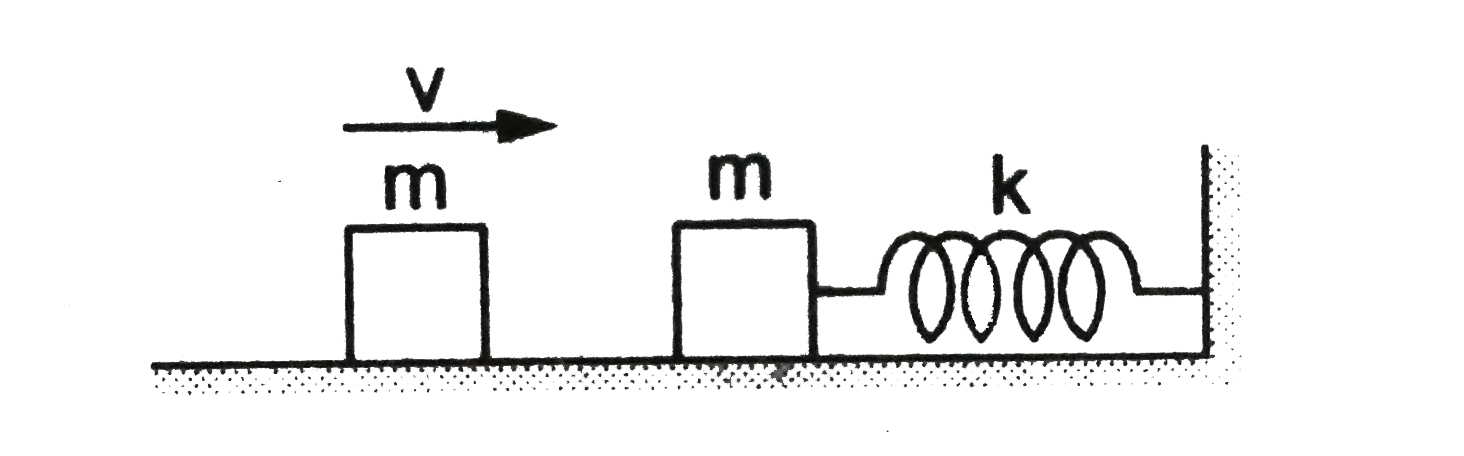
The left block in filgure collides inelastically with the right block and sticks to it. Find the amplitude of the resulting simple harmonic motion.

Text Solution

Verified by Experts

Assuming the collision to last for a small interval only, we can apply the principle of conservationn of momentum. The common velocity after the collisionn is `v/2`. The kinetic energy `=1/2(2m)(v/2)^2=1/4mv^2`. This is also the total energy of vibration as the spring is unstretched at this moment. If the amplitude is A, the total energy can also be written as `1/2kA^2`. Thus
`=1/2kA^2=1/4mv^2, giving A=sqrt(m/(2k))v`.
Promotional Banner

Topper's Solved these Questions

  • SIMPLE HARMONIC MOTION

    HC VERMA|Exercise Question for short Answer|17 Videos
  • SIMPLE HARMONIC MOTION

    HC VERMA|Exercise Objective -1|21 Videos
  • SIMPLE HARMONIC MOTION

    HC VERMA|Exercise Exercises|58 Videos
  • ROTATIONAL MECHANICS

    HC VERMA|Exercise Exercises|86 Videos
  • SOME MECHANICAL PROPERTIES OF MATTER

    HC VERMA|Exercise Exercises|32 Videos

Similar Questions

Explore conceptually related problems

In figure, k = 100 N//m, M = 1kg and F = 10 N (a) Find the compression of the spring in the equilibrium position (b) A sharp blow by some external agent imparts a speed of 2 m//s to the block towards left. Find the sum of the potential energy of the spring and the kinetic energy of the block at this instant. (c) Find the time period of the resulting simple harmonic motion. (d) Find the amplitude.

A cylindrical object of outer diameter 20 cm and mass 2 kg floats in water with its axis vertical. If it is slightly depressed and then released, find the time period of the resulting simple harmonic motion of the object.

A block of mass m having a charge q is placed on a smooth horizontal table and is connected to a wall through an unstressed spring of spring constant k as shown in figure . A horizontal electric field E parallel to the spring is switched on. Find the amplitude of the resulting SHM of the block.

All the surfaces shown in figure are frictionless. The mass of the car is M, that of the block is mk and the spring has spring constant. Initialy the car and the block are at rest and the spring is stretched through a length x_0 when the system is released. a. Find the amplitude of the simple harmonic motion of the blocks and of the car as seen from the road. b. Find the time periods of the two simple harmonic motions.

The piston in the cylinder head of a locomotive has a stroke (twice the amplitude) of 1.0 m. If the piston moves with simple harmonic motion with an angular frequency of 200 rad/min, what is its maximum speed ?

State the values of amplitude and frequency of a particle having the equation of simple harmonic motion as.

The left block in figure moves at a speed v towards the right block placed in equilibrium. All collisions to take place are elastic and the surfaces are frictionless. Show that motion of the two blocks are periodic. Find the time period of these periodic motions. Neglect the widths of the blocks.

Consider the situastion shown in figure. Show that if that blocks are displaced slightly in opposite directions and released, they will execute simple harmonic motion. Calculate the time period.

A block of mass m containing a net positive charge q is placed on a smooth horizontal table which terminates in a vertical wall as shown in figure(29-E2). The distance of the block from the wall is d. A horizontal electric field E to towards right is switched on. Assuming elastic collisions find the time period of the resulting oscillatory motion. Is it a simple harmonic motion?

HC VERMA-SIMPLE HARMONIC MOTION-worked out Examples
  1. A particle executing simple harmonic motion has angular frequency 6.28...

    Text Solution

    |

  2. A particle executes a simple harmonic motion of time period T. Find th...

    Text Solution

    |

  3. A block of mass m hangs from a vertical spring of spring constant k. I...

    Text Solution

    |

  4. A particle suspended from a vertical spring oscillates 10 times per s...

    Text Solution

    |

  5. The pulley shown in figure has a moment of inertias I about its axis a...

    Text Solution

    |

  6. Find the blanks:

    Text Solution

    |

  7. The left block in filgure collides inelastically with the right block ...

    Text Solution

    |

  8. Describe the motion of the mass m shown in figure. The walls and the b...

    Text Solution

    |

  9. A block of mass m is suspended from the ceiling of a stationary standi...

    Text Solution

    |

  10. The spring as shown in figure is kept in a stretched position with ext...

    Text Solution

    |

  11. Assume that as narrow tunnel is dug between two diametrically opposite...

    Text Solution

    |

  12. A simple pendulum of length 40 cm oscillates with an angular amplitude...

    Text Solution

    |

  13. A simple pendulum having a bob of mass m under goes small oscillations...

    Text Solution

    |

  14. A simple pendulum is taken at a place where its separation from the ea...

    Text Solution

    |

  15. A simple pendulum is suspended from the ceiling a car accelerating uni...

    Text Solution

    |

  16. A uniform meter stick is suspended through a small pin hole at the 10 ...

    Text Solution

    |

  17. The moment of inertia of the disc used in a torsional pendulum about t...

    Text Solution

    |

  18. A uniform rod of mass m and length l is suspended through a light wire...

    Text Solution

    |

  19. A particle is subjected to two simple harmonic motions x1=A1 sinomeg...

    Text Solution

    |

  20. A particle is subjected to two simple harmonic motions in the same dir...

    Text Solution

    |
