Home
Class 11
PHYSICS
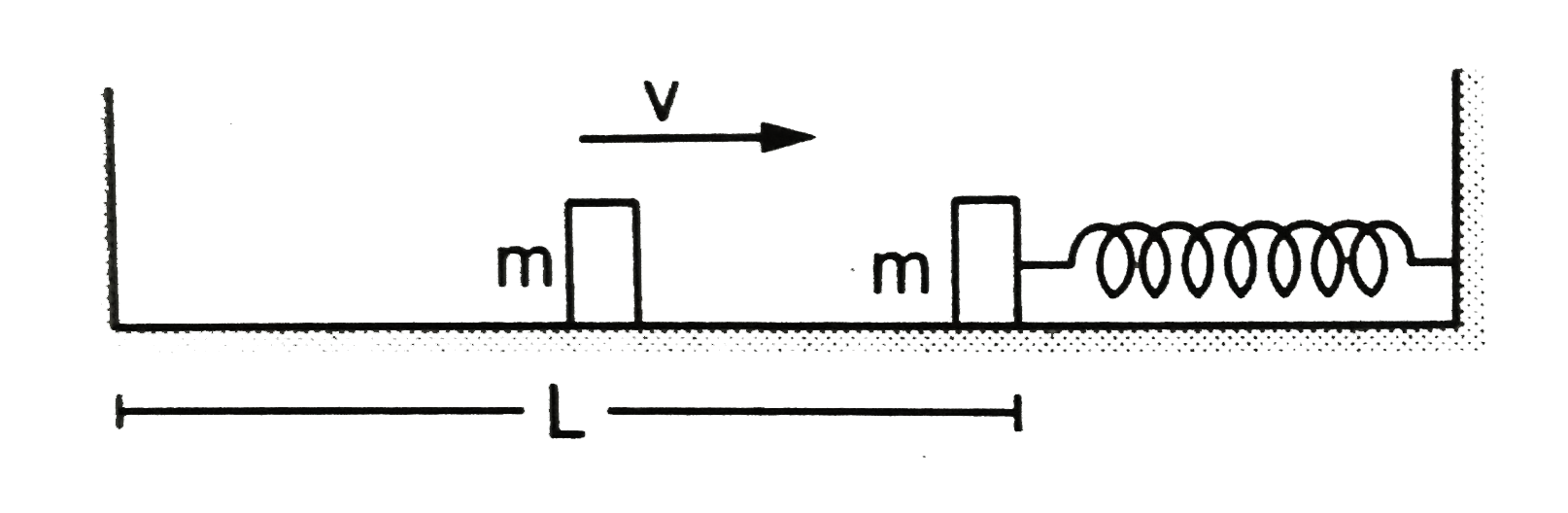
The left block in figure moves at a spee...

The left block in figure moves at a speed v towards the right block placed in equilibrium. All collisions to take place are elastic and the surfaces are frictionless. Show that motion of the two blocks are periodic. Find the time period of these periodic motions. Neglect the widths of the blocks.

Text Solution

Verified by Experts

The correct Answer is:

B

When the block A moves with velocity V and collides with the block B, it transfers all energy to the block B. (because it is an elastic collision). The block A will move a distance x against the spring, again the spring, again the block b will return to the origiN/Al point and completes half of the oscillation.
So, the time period of b is
`(2pisqrt(m/k))/2=m/k`
The block B collides with the block A and comes o rest at that point. The block AS again moves a further distance L to return to its origiN/Al position. The time taken is
`L/V+L/V=2(L/V)`
So the period of the periodic motion is
`2L/V+pi sqrt((m/k))`
Promotional Banner

Topper's Solved these Questions

  • SIMPLE HARMONIC MOTION

    HC VERMA|Exercise Objective-2|16 Videos
  • ROTATIONAL MECHANICS

    HC VERMA|Exercise Exercises|86 Videos
  • SOME MECHANICAL PROPERTIES OF MATTER

    HC VERMA|Exercise Exercises|32 Videos

Similar Questions

Explore conceptually related problems

Consider the situation shown in figure. All the surfaces are frictions and the string and the pulley are light. Find the magnitude of the acceleration of the two blocks.

Three blocks of masses m_1, m_2 and m_3 are connected as shown in the figure. All the surfaces are frictionless and the string and the pulleys are light. Find the acceleration of m_1

Find the elastic potential energy stored in each spring shown in figure, when the block is in equilibrium. Also find the time period of vertical oscillation of the block.

The left block in filgure collides inelastically with the right block and sticks to it. Find the amplitude of the resulting simple harmonic motion.

Find the time period of the motion of the particle shown in figure. Neglected small effect of the bend near the bottom.

Figure shows a small body of mass m placed over a larger mass M whose surface is horizontal near the smaller mass and gradually curves to become verticle. The smaller mass is pushed on the longer on at a speed v and the system is left to itself. Assume thast all the surfaces are frictionless. a. find teh speed of the larger block when the smaller block is sliding on the vertical part. b. find the speed of the smaller mass when it breaks off the larger mas at height h. c. find the maximum height (from the ground) that the smaller mass seconds. d show that the smaller mass will again land on the bigger one. Find the distane traversed by the bigger block during the time when the smaller block was in its flight under gravity.

Figure shows a small block of mass m which is started with a speed v on the horizontal part of the bigger block of mas m placed on a horizontal floor. The curved part of the surface shown is semicircular. All the surfaces are frictionless. Find the speed of the bigger block when the smaller block reaches the point A of the surface.

A small block oscillates back and forth on as smooth concave surface of radius R in figure. Find the time period of small oscillation.

find the acceleration of the block of mass M in the situation shown in figure. All the surfaces are frictionless and the pulleys and the string are light.

Each of the blocks shown in figure has mass 1 kg. The rear block moves with a speed of 2 m/s towards the front block kept at rest. The spring attached to the front block is light and has a spring constant 50 N/m. find the maximum compression of the spring.

HC VERMA-SIMPLE HARMONIC MOTION-Exercises
  1. A rectangular plate of sides a and b is suspended from a ceiling by tw...

    Text Solution

    |

  2. A 1kg block is executing simple harmonic motion of amplitude 0.1 m on ...

    Text Solution

    |

  3. The left block in figure moves at a speed v towards the right block pl...

    Text Solution

    |

  4. Find the time period of the motion of the particle shown in figure. Ne...

    Text Solution

    |

  5. All the surfaces shown in figure are frictionless. The mass of the car...

    Text Solution

    |

  6. A uniform table of mas M stays horizontally and symmetrically on two w...

    Text Solution

    |

  7. Find the length of seconds pendulum at a place where g =10 m/s^2.

    Text Solution

    |

  8. State the laws of simple pendulum.

    Text Solution

    |

  9. The pendulum of certain clock has time period 2.04 s. How fast or slow...

    Text Solution

    |

  10. A pendulum clock giving correct time at a place where g=9.800 ms^-2 is...

    Text Solution

    |

  11. A simple pendulum is constructed by hanging a heavy ball by a 5.0 m lo...

    Text Solution

    |

  12. The maximum tension in the string of an oscillating pendulum is double...

    Text Solution

    |

  13. A small block oscillates back and forth on as smooth concave surface o...

    Text Solution

    |

  14. A spherical ball of mass m and radius r rolls without slipping on a ro...

    Text Solution

    |

  15. The simple pendulum of length 40 cm is taken inside a deep mine. Assum...

    Text Solution

    |

  16. Assume that a tunnel is dug across the earth (radius=R) passing throug...

    Text Solution

    |

  17. Assume that a tunnel ils dug along a chord of the earth, at a perpendi...

    Text Solution

    |

  18. A simple pendulum of length l is suspended through the ceiling of an e...

    Text Solution

    |

  19. A simple pendulum of length 1 feet suspended from the ceiling of an el...

    Text Solution

    |

  20. A simple pendulum fixed in a car has a time period of 4 seconds when t...

    Text Solution

    |
