Home
Class 11
PHYSICS
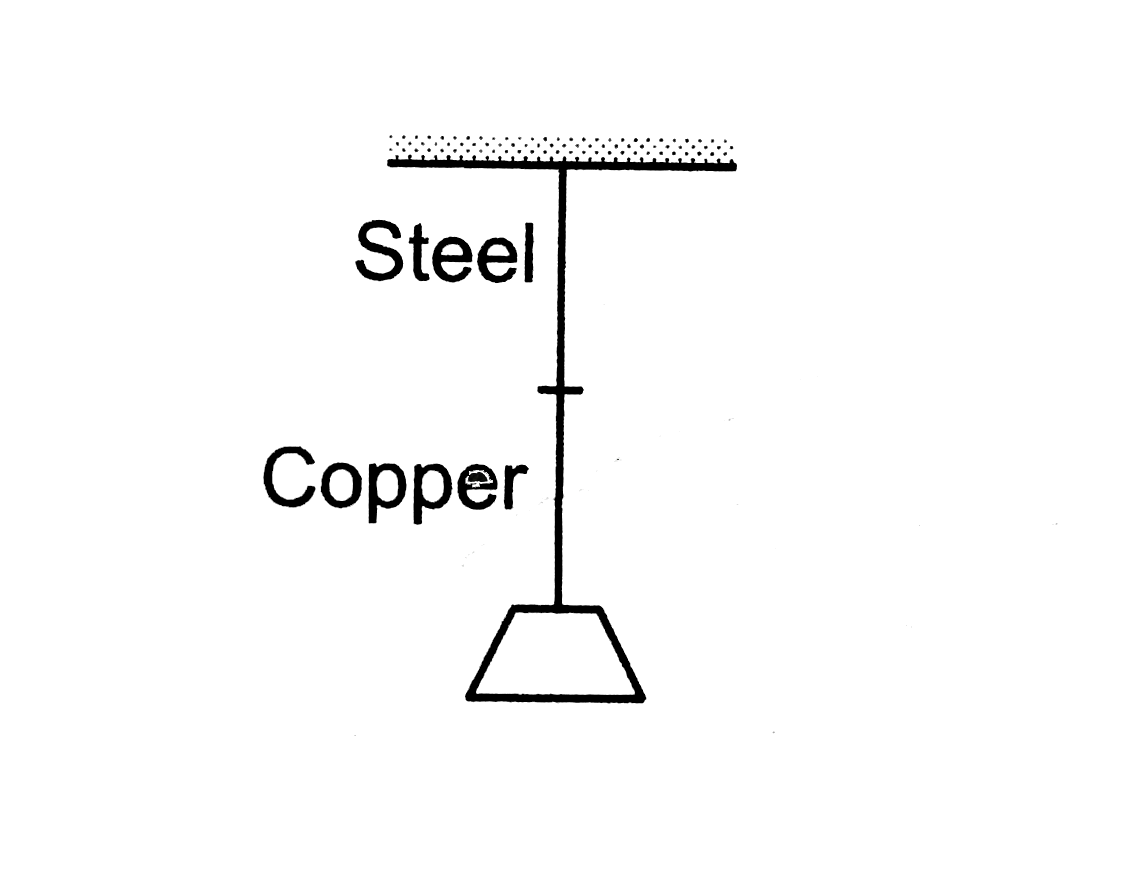
In figure the upper wire is made of stee...

In figure the upper wire is made of steel and the lower of copper. The wires have equal cross section. Find the ratio of the longitudinal strains developed in the two wires.

Text Solution

Verified by Experts

The correct Answer is:

A, C, D

`rarr ((DeltaL)/L_(steel))F/(AY_(Steel))`
`rarr ((DeltaL)`/`L_(cu))=F/(AY_(cu))`

Strain in steel wire /Strain in copper wire`=F/(AY_(Steel))+(AY_(cu))/F`
`(A_cu)=A_(Steel)`
`Y_(cu)/Y_(Steel)=13/20=0.65`
Promotional Banner

Topper's Solved these Questions

  • SOME MECHANICAL PROPERTIES OF MATTER

    HC VERMA|Exercise Objective-2|7 Videos
  • SIMPLE HARMONIC MOTION

    HC VERMA|Exercise Exercises|58 Videos
  • SOUND WAVES

    HC VERMA|Exercise All Questions|139 Videos

Similar Questions

Explore conceptually related problems

Two wires of equal cross section but one made of steel and the other of copper, are joined end to end. When the combination is kept under tension, the elongations in the two wires are found to be equal. Find the ratio of the lengths of the two wires. Young modulus of steel =2.0xx10^11Nm^-2 and that of copper =1.1xx10^11Nm^-2

One end of a metal wire is fixed to a ceiling and a load of 2 kg hangs from the other end. A similar wire is attached to the bottom of the load and another load of 1 kg hangs from this lower wire. Find the longitudinal strain in both wires. Area of cross section of each wire is 0.005 cm^2 and Young modulus of the metal is 2.0xx10^11 Nm^-2. Take g=10ms^-2

A steel wire and a copper wire of equal length and equal cross sectional area are joined end to end and the combination is subjected to a tension. Find the ratio of a. The stresses developed in the two wire and b. the strains developed. Y of steel =2xx10^11Nm^-2 . Y of copper =1.3xx10^11 Nm^-2 .

Two wire A & B are of the same metal and are of same length have area of cross section in the ratio of 2:1 If the same potential difference is applied across each wire. What will be the ratio of the current flowing through the wires A & B ?

Consider the situation shown in figure. The force F is equal to the (m_2g)/2 . If the area of cross section of the string is A and its Young modulus Y, find the strain developed in it. The string is light and there is no friction anywhere.

Each of the three blocks P, Q and R shown in figure has a mass of 3 kg. Each of the wires A and B has cross sectional area 0.005 cm^2 and Young modulus 2xx10^11Nm^-2 . Neglect friction. Find the longitudinal strain developed in each of the wires. Take g=10ms^-2

Two copper wires of length 1m and 9m have equal resistances. Then their diameters are in the ratio:

Two wires are made of the same material and have the same volume. The area of cross sections of the first and the second wires are A and 2A respectively. If the length of the first wire is increased by Delta l on applying a force F, how much force is needed to stretch the second wire by the same amount ?

HC VERMA-SOME MECHANICAL PROPERTIES OF MATTER-Exercises
  1. The elastic limit of steel is 8xx10^8Nm^-2 and its Young modulus 2xx10...

    Text Solution

    |

  2. A steel wire and a copper wire of equal length and equal cross section...

    Text Solution

    |

  3. In figure the upper wire is made of steel and the lower of copper. The...

    Text Solution

    |

  4. The two wires shown in figure are made of the same material which has ...

    Text Solution

    |

  5. Two person pull a rope towards themselves. Each person exerts a force ...

    Text Solution

    |

  6. A steel rod of cross sectional area 4cm^2 and length 2m shrinks by 0.1...

    Text Solution

    |

  7. Consider the situation shown in figure. The force F is equal to the (m...

    Text Solution

    |

  8. A sphere of mass 20 kg is suspended by a metal wire of unstretched le...

    Text Solution

    |

  9. A steel wire of original length 1 m and cross-sectional area 4.00 mm^2...

    Text Solution

    |

  10. A copper wire of cross sectional area 0.01 cm^2 is under a tension of ...

    Text Solution

    |

  11. Find the increase in pressure required to decrease the volume of a wat...

    Text Solution

    |

  12. Calculate the apprroximate change in density of water in a lake at a d...

    Text Solution

    |

  13. A steel plate of face area 4 cm^2 and thickness 0.5 cm is fixed rigidl...

    Text Solution

    |

  14. Water is kept in a beaker of radius 5.0 cm. Consider a diameter of the...

    Text Solution

    |

  15. Find the excess pressure inside (a) a drop of mercury of radius 2 mm (...

    Text Solution

    |

  16. Consider a small surface area of 1 mm^2 at the top of a mercury drop o...

    Text Solution

    |

  17. The capillaries shown in figure have inner radii 0.5 mm, 1.0 mm and 1...

    Text Solution

    |

  18. The lower end of a capillary tube is immersed in mercury. The level of...

    Text Solution

    |

  19. A barometer is constructed with its tube having radius 1.0 mm. Assume ...

    Text Solution

    |

  20. A capillary tube of radius 0.50 mm is dipped vertically in a pot of wa...

    Text Solution

    |
