Home
Class 11
PHYSICS
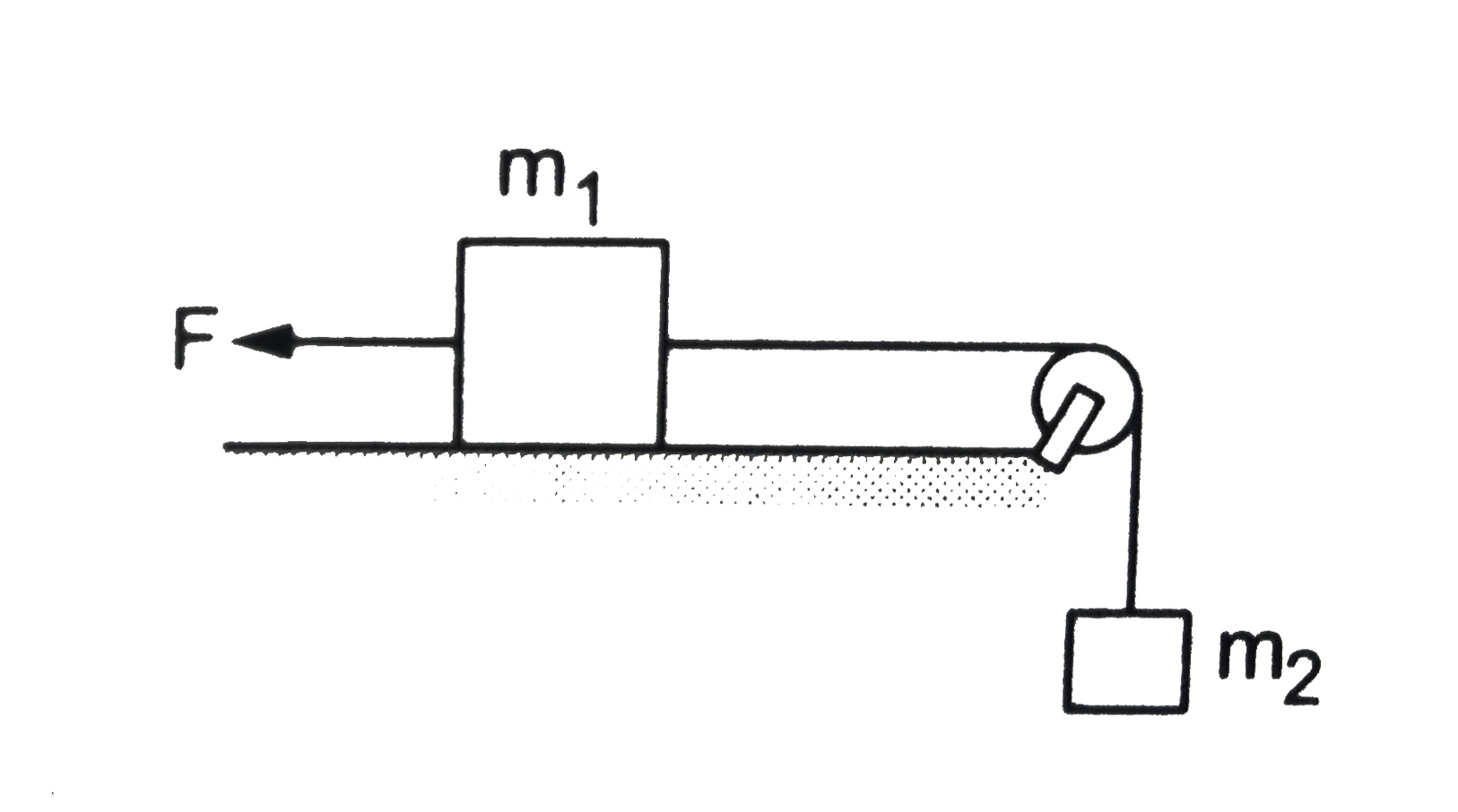
Consider the situation shown in figure. ...

Consider the situation shown in figure. The force F is equal to the `(m_2g)/2`. If the area of cross section of the string is A and its Young modulus Y, find the strain developed in it. The string is light and there is no friction anywhere.

Text Solution

Verified by Experts

The correct Answer is:
A, B

From the ure `m_2g-T=m_2a……….1`
and `T-f=m_1a`…………….2

From eqn 1 and 2 we get
`a=(m_2g-F)/(m_1+m_2)`
`=(m_2g)/(2(m_1+m_2))`
Again `T=F+m_1a`
`rarr T=(m_2g)/2+m_1(m_2g)/(2(m_1+m_2))`
Now, `Y=(FL)/(A/_\\L)`
`rarr (/_\\\\L)/L=F/(AY)`
`rarr (/_\\\\L)/L=((m_2^2+2m_1m_2)g)/(2(m-1+m_2)AY)`
`=(m_2g(m_2+m_1))/(2AY(m_1+m_2))`
Promotional Banner

Topper's Solved these Questions

  • SOME MECHANICAL PROPERTIES OF MATTER

    HC VERMA|Exercise Objective-2|7 Videos
  • SIMPLE HARMONIC MOTION

    HC VERMA|Exercise Exercises|58 Videos
  • SOUND WAVES

    HC VERMA|Exercise All Questions|139 Videos

Similar Questions

Explore conceptually related problems

Consider the situation shown in figure. All the surfaces are frictions and the string and the pulley are light. Find the magnitude of the acceleration of the two blocks.

In figure the upper wire is made of steel and the lower of copper. The wires have equal cross section. Find the ratio of the longitudinal strains developed in the two wires.

Consider4 the situation shown in figure. Bothe the pulleys and the string are light and all the surfaces are friction less. a. Find the acceleration of the mass M. b. Find the tension in the string c. Calculate the force exerted by the clamp on the pulley A in the figure.

Conside the situation shown in figure. The frame is made of the same material and has a unifrom cross-section area everywhere. Calculate the amount of heat flowing per second through a cross section of the bent part if the total heat taken out per second from the end at 100^(@)C is 130J .

Consider the situation shown in figure. The horizontal surface below the bigger block is smooth. The coefficient of friction between the blocks is mu . Find the minimum and the maximum force F that can be applied in order to keep the smaller block at rest with respect to the bigger block.

Calculate the tension in the string shown in figure. The pulley and the string are light and all surfaces are frictionless. Take g=10 m/ s^2 .

Consider the situation shown in figure .The plates of the capacitor have plate area A and are clapmed in the laborstory . The dielectric slab is released from rest with a length a inside the capacitor. Neglecting any effect of friction or gravity, show that slab will execute periodie motion and find its time period.

Consider the situation shown in figure. The wire which has a mass of 4.00 g oscillates in its second harmonic and sets the air column in the tube into vibrations in its fundamental mode. Assuming that the speed of sound in air is 40 m s^-1 , find the tension in the wire. .

Each of the three blocks P, Q and R shown in figure has a mass of 3 kg. Each of the wires A and B has cross sectional area 0.005 cm^2 and Young modulus 2xx10^11Nm^-2 . Neglect friction. Find the longitudinal strain developed in each of the wires. Take g=10ms^-2

The speed of a transverse wave going on a wire having a length 50 cm and maas 5.0 g is 80ms^(-1) The area of cross section of the wire is 1.0mm.^2 and its Young modulus is 16 xx 10^(11) N m^(-2). Find the extension of the wire over its natural lenth.

HC VERMA-SOME MECHANICAL PROPERTIES OF MATTER-Exercises
  1. Two person pull a rope towards themselves. Each person exerts a force ...

    Text Solution

    |

  2. A steel rod of cross sectional area 4cm^2 and length 2m shrinks by 0.1...

    Text Solution

    |

  3. Consider the situation shown in figure. The force F is equal to the (m...

    Text Solution

    |

  4. A sphere of mass 20 kg is suspended by a metal wire of unstretched le...

    Text Solution

    |

  5. A steel wire of original length 1 m and cross-sectional area 4.00 mm^2...

    Text Solution

    |

  6. A copper wire of cross sectional area 0.01 cm^2 is under a tension of ...

    Text Solution

    |

  7. Find the increase in pressure required to decrease the volume of a wat...

    Text Solution

    |

  8. Calculate the apprroximate change in density of water in a lake at a d...

    Text Solution

    |

  9. A steel plate of face area 4 cm^2 and thickness 0.5 cm is fixed rigidl...

    Text Solution

    |

  10. Water is kept in a beaker of radius 5.0 cm. Consider a diameter of the...

    Text Solution

    |

  11. Find the excess pressure inside (a) a drop of mercury of radius 2 mm (...

    Text Solution

    |

  12. Consider a small surface area of 1 mm^2 at the top of a mercury drop o...

    Text Solution

    |

  13. The capillaries shown in figure have inner radii 0.5 mm, 1.0 mm and 1...

    Text Solution

    |

  14. The lower end of a capillary tube is immersed in mercury. The level of...

    Text Solution

    |

  15. A barometer is constructed with its tube having radius 1.0 mm. Assume ...

    Text Solution

    |

  16. A capillary tube of radius 0.50 mm is dipped vertically in a pot of wa...

    Text Solution

    |

  17. Find the surface energy of water kept in a cylindrical vessel of radiu...

    Text Solution

    |

  18. A drop of mercury of radius 2 mm is split into 8 identical droplets. F...

    Text Solution

    |

  19. A capillary tube of radius 1 mm is kept vertical with the lower end in...

    Text Solution

    |

  20. The lower end of a capillary tube of radius 1 mm is dipped vertically ...

    Text Solution

    |

