Home
Class 12
PHYSICS
Consider the situation shown in figure. ...

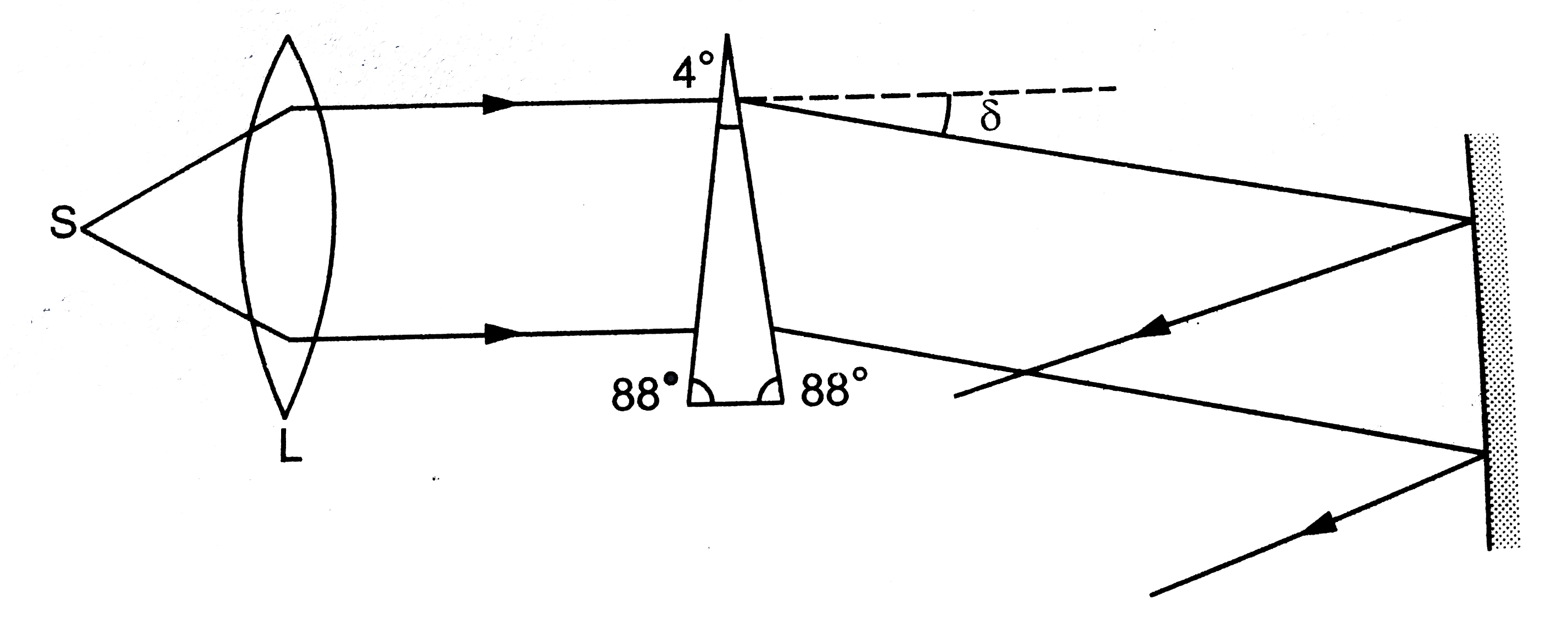
Consider the situation shown in figure. Light from a point source S is made parallel by a convex lens L. The beam travels horizontally and falls on an `88^@-88^@-4^@` prism as shown in figure. It passes through the prism symmetrically. The transmitted light falls on a vertical mirror. Through what angle should the mirror be rotated so that an image of S is formed on S itself?

Text Solution

Verified by Experts

The parallel beam after going through the prism will be deviated by an angle `delta`. If the mirror is also rotated by this angle `delta`. The rays will fal normally on it. The rays will be reflected back along the same path and form the image of S on itself.
as the prismis thin, the angle `delta` is given by
`delta=(mu-1)A`
`=(1.5-10xx4^@=2^@`
thus , the mirror should be rotated by `2^@`
Promotional Banner

Topper's Solved these Questions

  • GEOMETRICAL OPTICS

    HC VERMA|Exercise Question For short Answer|19 Videos
  • GEOMETRICAL OPTICS

    HC VERMA|Exercise Objective -1|18 Videos
  • GEOMETRICAL OPTICS

    HC VERMA|Exercise Exercises|79 Videos
  • GAUSS LAW

    HC VERMA|Exercise Exercises|24 Videos
  • LIGHT WAVES

    HC VERMA|Exercise Exercises|41 Videos

Similar Questions

Explore conceptually related problems

A point source S is placed midway between two converging mirrors having equal focal length f as shown in figure. Find the values of d for which only one image is formed.

Consider the situation shown in figure. The two slits S_1 and S_2 placed symmetrically around the central line are illuminated by a monochromatic light of wavelength lamda . The separation between the slits is d. The light transmitted by the slits falls on a screen Sigma_1 placed at a distance D from the slits. The slit S_3 is at the placed central line and the slit S_4 , is at a distance z from S_3 . Another screen Sigma_2 is placed a further distance D away from 1,1. Find the ratio of the maximum to minimum intensity observed on Sigma_2 if z is equal to a. z=(lamdaD)/(2d) b. (lamdaD)/d c. (lamdaD)/(4d)

Both the cacpacitors shown in figure are made ofsquare of edge a The separations between the plates of the capacitors are d_1and d_2as shown in the figure A potential difference V is applied between the point a and b .An electron is projected between the plate s of the upper capacitor along the central line . With what minimum speed should the electron be projected so that it is does not collide with any plate ? consider only the electric forces.

Consider the situation in figure. The bottom of the pot is a reflecting plane mirror, S is a small fish and T is a human eye. Refractive index of water is mu. (a) At what distance(s) from itself will the fish see the image(s) of the eye ? (b) At what distance(s) from itself will the eye see the image(s) of the fish.

A totally reflecting, small plane mirror placed horizontally faces a parallel beam of lighy as shown in figure. The mass of the mirror is 20g. Assume that there is no absorption in the lens and that 30% of the light emitted by the source goes through the lens. Find the power of the source needed to support the weight of the mirror. Take g= 10 m s^-2.

Consider the stituation shown in figure. The elevator is going up with an acceleration of 2.00 ms^-2 and the focal length of the mirror is 12.0 cm. All the surfaces are smooth and the pulley is light. The mass-pulley system is released from rest (with respect to the elevator) at t=0 when the distance of B from the mirror is 42.0 cm. Find the distance between the image of the block B and the mirror at t=0.200 s. Take g=10 ms^-2

A consider the situation in figure. The bottom of the pot is a reflecting plane mirror. F is a fish and B is a bird. (a) At what distance(s) from itself will the fish see the image (b) At what distance(s) from itself will the bird see the image(s) of the fish? Take m_(wa) = 4/3

The convex surface of a thin concave-convex lens of glass of refractive index 1.5 has a radius of curvature 20 cm. The concave surface has a radius of curvature 60 cm. The convex side is silvered and placed on a horizontal surface as shown in figure. (a) Where should a pin be placed on the axis so that its image is formed at the same place ? (b) If the concave part is filled with water (mu = 4/3), find the distance through which the pin should be moved so that the image of the pin again coincides with the pin.

A right prism is to be made by selecting a proper material and the angles A and B (BleA) as shown in figure. It is desired that a ray of light incident normally on AB emerges parallel to the incident direction after two internal reflection.a. What should be the minimum refractive index mu for this to be possible? b. For mu=5/3 is it possible to achieve this with the angle A equal to 60 degrees?

A converging mirror M_1 a point source S and a diverging mirror M_2 are arranged as shown in figure. The source is placed at a distance of 30 cm from M_1 . The focal length of each of the mirrors is 20 cm. Consider only the images formed by a maximum of two reflections. It is found that one image is formed on the source itself. (a) Find the distance between the two mirrors. (b) Find the location of the image formed by the single reflection from M_2

HC VERMA-GEOMETRICAL OPTICS-Worked out Examples
  1. A beaker contains water up to a height h1 and K oil above water up to...

    Text Solution

    |

  2. Monochramatic light is incident on the pane interface AB between two m...

    Text Solution

    |

  3. A concave mirror of radius 40 cm lies on a horizontal table and water ...

    Text Solution

    |

  4. An object is placed 21 cm in fron of a concave mirror of radius of cur...

    Text Solution

    |

  5. The refractive indices of silicate fint glass for wavelength 400 nm an...

    Text Solution

    |

  6. Consider the situation shown in figure. Light from a point source S is...

    Text Solution

    |

  7. Locate the image formed by refraction in the situation shown in figure...

    Text Solution

    |

  8. One end of a horizontal cylindrical glass rod (mu=1.5) of radius 5.0 c...

    Text Solution

    |

  9. There is a small air bubble inside a glass sphere (mu=1.5) of radius ...

    Text Solution

    |

  10. A parallel bean of light travelling in water (refractive index = 4/3) ...

    Text Solution

    |

  11. Calculate the focal length of the thin lens shown infigure. The pionts...

    Text Solution

    |

  12. A point source S is placed at a distance of 15 cm from a converging le...

    Text Solution

    |

  13. A converging lens of focal length 15 cm and a converging mirror of foc...

    Text Solution

    |

  14. A biconvex thin lens is prepared from glass (mu=1.5), the two bounding...

    Text Solution

    |

  15. A concave convex figure lens made of glas (mu=1.5) has surface of radi...

    Text Solution

    |

  16. A thin lens of focal length + 12 cm is immersed in water (mu = 1.33). ...

    Text Solution

    |

  17. A long cylindrical tube containing water in closed by an equinvex lens...

    Text Solution

    |

  18. A slide projector produces 500 times enlarged image of a slide on a sc...

    Text Solution

    |

  19. A convex lens focusses an object 10 cm from it on a screen placed 10 c...

    Text Solution

    |

  20. Two convex lenses f focal length 20 cm each are placed coaxially with ...

    Text Solution

    |
