Home
Class 12
PHYSICS
A converging lens of focal length 15 cm ...

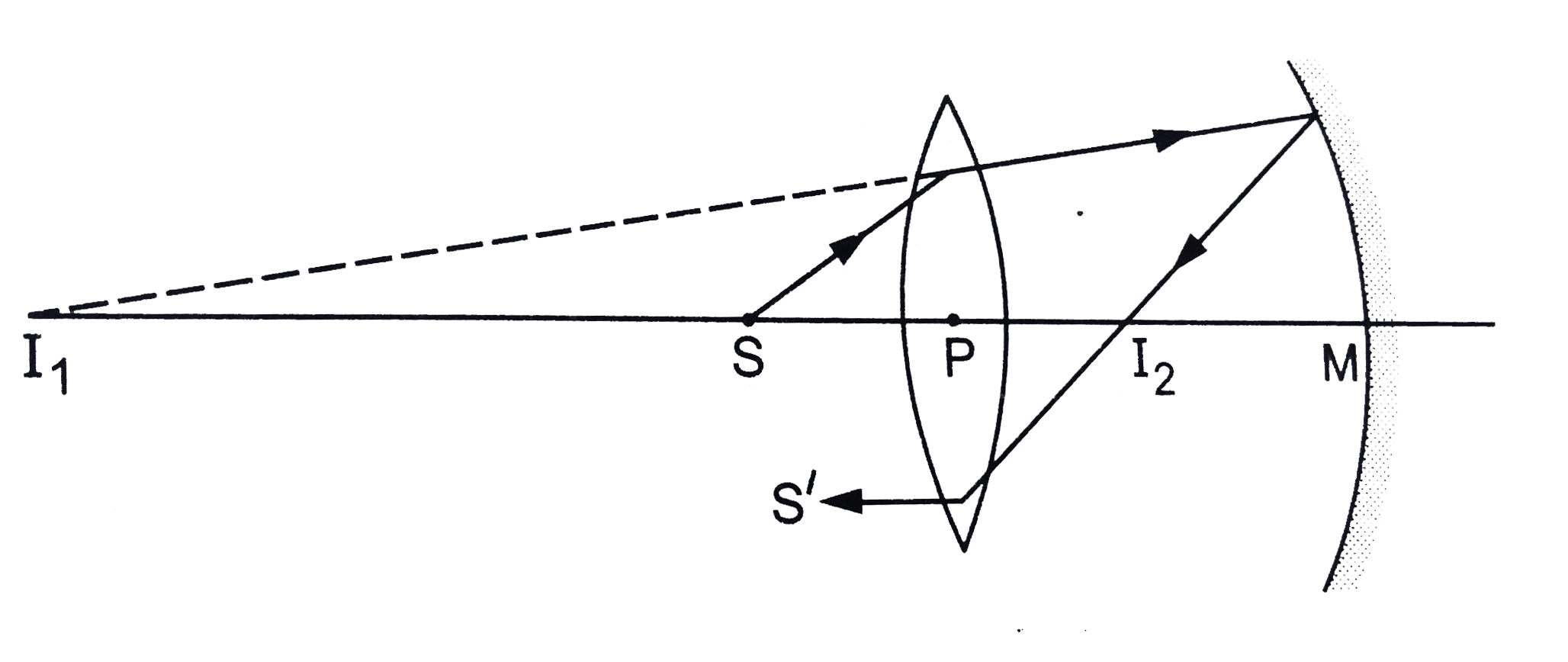
A converging lens of focal length 15 cm and a converging mirror of focal length 20 cm are placed with their principal axes coinciding. A point source S is placed on the principal axis at a distance of 12 cm from the lens as shown in figure. It is found that the final beam comes out parallel to the principal axis. Find the separation between the mirror and the lens.

Text Solution

Verified by Experts

Let us first locate the image of S formed byi the lens L. Here `u=-12cm and f=15 cm`. We have
`1/v-1/u=1/f`
`or 1/v=1/f+1/u`
`=1/(15cm)-1/(12cm)`
`or v=-60cm`
The negative sign shows that the image is formed to the left of the lens as suggeted in the ure. The image `I_1` acts as the source for the mirror. The mirror forms and image `I_2` of the source `I_1`. This image I_2 then acts as the source for the lens and the fiN/Al beam comes out parallel to the principal axis. Clearly `I_2` must be at the focus of the lens. We have
`I_1I_2=I_1L+L_2=60cm15cm=75cm`.
Suppose the distance of the mirror from `I_2` is x cm. For the reflection from the mirror.
`u=MI_1(=-(75+x)cm, v=-xcm =75cm`
Suppose the distance of the mirror from `I_2` is cm. For the reflection from the mirror.
`u=MI_1=-(75+x)cm,v=-xcm and f=-20cm`
Using `1/v+1/u=1/f`
`1/x+1/(75+x)=1/20`
`or (75+2x)/((75+x)x)=1/20`
`or x^2+35-1500=0`
or `x=(-35+-sqrt(35xx35+4x1500))/2`
This gives x=25 or -60.
As the negatives sign has no physical meaning only positive sigh should be taken. Taking `x=25` the separatioin between the lens and the mirror is `(15+25)cm=40cm.`
Promotional Banner

Topper's Solved these Questions

  • GEOMETRICAL OPTICS

    HC VERMA|Exercise Question For short Answer|19 Videos
  • GEOMETRICAL OPTICS

    HC VERMA|Exercise Objective -1|18 Videos
  • GEOMETRICAL OPTICS

    HC VERMA|Exercise Exercises|79 Videos
  • GAUSS LAW

    HC VERMA|Exercise Exercises|24 Videos
  • LIGHT WAVES

    HC VERMA|Exercise Exercises|41 Videos

Similar Questions

Explore conceptually related problems

A converging lens of focal length 15 cm and a converging mirror of focal length 10 cm are placed 50 cm apart with common principal axis. A point source is placed in between the lens and the mirror at a distance of 40 cm from the lens. Find the locations of the two images formed.

A diverging lens of focal length 20 cm and a converging lens of focal length 30 cm are placed 15 cm apart with their principal axes coinciding. Where should an object be placed on the principal axis so that its image formed at infinity ?

A converging lens of focal length 12 cm and a diverging mirror of focal length 7.5 cm are placed 5.0 cm apart with their principal axes coinciding. Where should an object be placed so that its image falls on itself ?

A convex lens of focal length 20 cm and a concave lens of focal length 10 cm are placed 10 cm apart with their principal axes coinciding. A beam of light travelling parallel to the principal axis and having a beam diameter 5.0 mm, is incident on the combination. Show that the emergent beam is parallel to the incident one. Find the beam diameter of the emergent beam.

A diverging lens of focal length 20 cm and a converging mirror of focal length 10 cm are placed coaxially at a separation of 5 cm. Where should an object be placed so that a real image is formed at the object itself ?

A converging lens of focal length 15 cm and a converging mirror of focal length 10 cm are placed 50 cm apart. If a pin of length 2.0 cm is placed 30 cm from the lens farther away from the mirror, where will the final image form and what will be the size of the final image ?

A convex lens has a focal length of 10 cm. Find the location and nature of the image if a point object is placed on the principal axis at a distance of (a) 9.8 cm, (b) 10.2 cm from the lens.

An object is placed 40 cm from a concave mirror of focal length 20 cm, the image formed is

If an object is placed 10 cm in front of a concave mirror of focal length 20 cm, the image will be.

An object is placed at 20 cm from a convex mirror of focal length 10 cm. The image formed by the mirror is

HC VERMA-GEOMETRICAL OPTICS-Worked out Examples
  1. A beaker contains water up to a height h1 and K oil above water up to...

    Text Solution

    |

  2. Monochramatic light is incident on the pane interface AB between two m...

    Text Solution

    |

  3. A concave mirror of radius 40 cm lies on a horizontal table and water ...

    Text Solution

    |

  4. An object is placed 21 cm in fron of a concave mirror of radius of cur...

    Text Solution

    |

  5. The refractive indices of silicate fint glass for wavelength 400 nm an...

    Text Solution

    |

  6. Consider the situation shown in figure. Light from a point source S is...

    Text Solution

    |

  7. Locate the image formed by refraction in the situation shown in figure...

    Text Solution

    |

  8. One end of a horizontal cylindrical glass rod (mu=1.5) of radius 5.0 c...

    Text Solution

    |

  9. There is a small air bubble inside a glass sphere (mu=1.5) of radius ...

    Text Solution

    |

  10. A parallel bean of light travelling in water (refractive index = 4/3) ...

    Text Solution

    |

  11. Calculate the focal length of the thin lens shown infigure. The pionts...

    Text Solution

    |

  12. A point source S is placed at a distance of 15 cm from a converging le...

    Text Solution

    |

  13. A converging lens of focal length 15 cm and a converging mirror of foc...

    Text Solution

    |

  14. A biconvex thin lens is prepared from glass (mu=1.5), the two bounding...

    Text Solution

    |

  15. A concave convex figure lens made of glas (mu=1.5) has surface of radi...

    Text Solution

    |

  16. A thin lens of focal length + 12 cm is immersed in water (mu = 1.33). ...

    Text Solution

    |

  17. A long cylindrical tube containing water in closed by an equinvex lens...

    Text Solution

    |

  18. A slide projector produces 500 times enlarged image of a slide on a sc...

    Text Solution

    |

  19. A convex lens focusses an object 10 cm from it on a screen placed 10 c...

    Text Solution

    |

  20. Two convex lenses f focal length 20 cm each are placed coaxially with ...

    Text Solution

    |
