

Home
Class 12
PHYSICS
A narrow beam of light passes through a ...

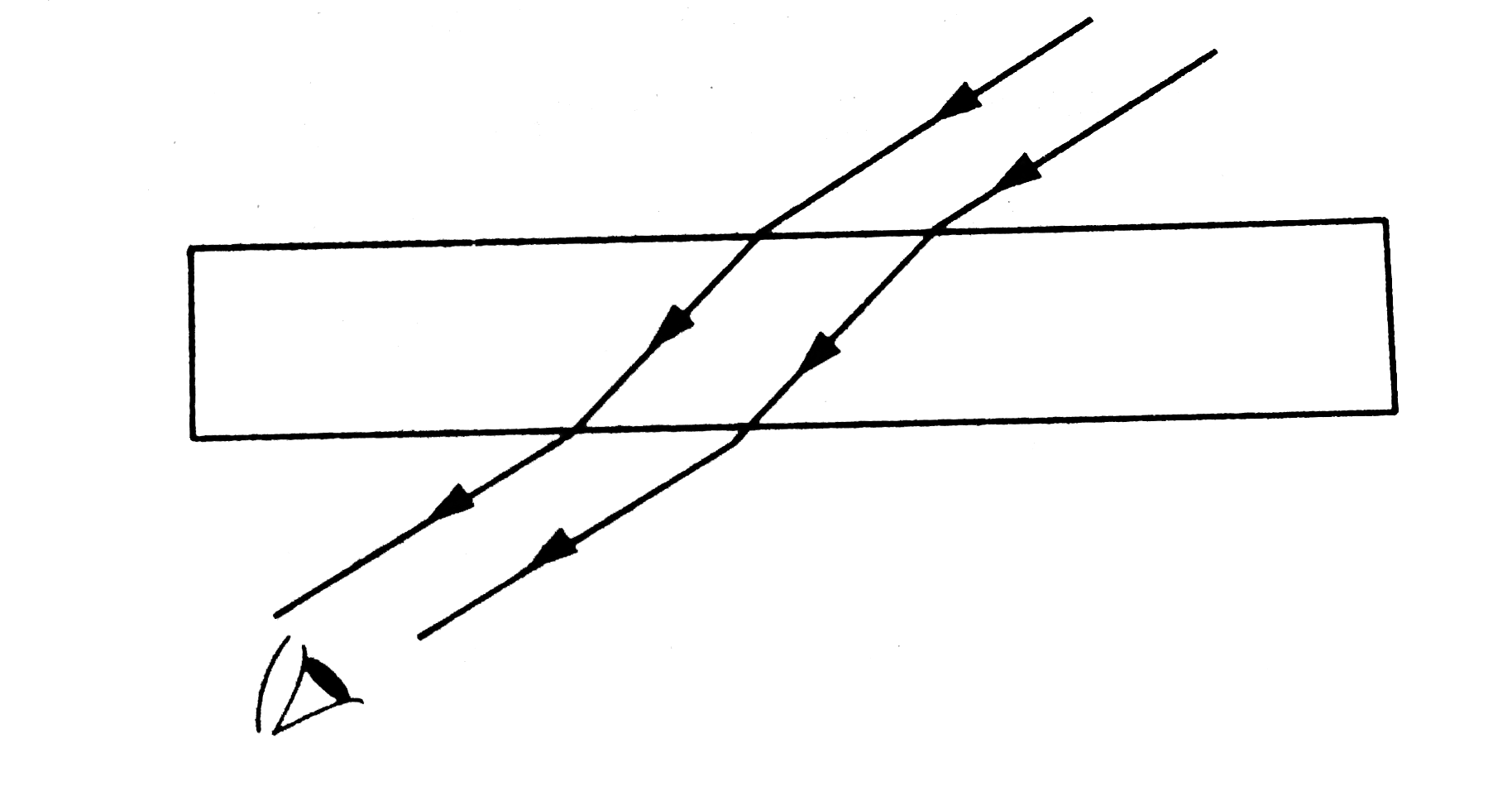
A narrow beam of light passes through a slab obliquely and is then received by an eye. The index of refraction of the material in the slab fluctuates slowly with time. How will it appear to the eye? The twinkling of stars has a similar explanation.

Promotional Banner

Topper's Solved these Questions

  • GEOMETRICAL OPTICS

    HC VERMA|Exercise Objective -1|18 Videos
  • GEOMETRICAL OPTICS

    HC VERMA|Exercise Objective -2|7 Videos
  • GEOMETRICAL OPTICS

    HC VERMA|Exercise Worked out Examples|28 Videos
  • GAUSS LAW

    HC VERMA|Exercise Exercises|24 Videos
  • LIGHT WAVES

    HC VERMA|Exercise Exercises|41 Videos

Similar Questions

Explore conceptually related problems

A ray of light passes through a glass slab of thickness t and refractive index mu . If the speed of light in air be 'c', the time taken by the ray to cross through the plate is _______

A beam of light passing from one transparent medium to another obliquely, undergoes an abrupt change in direction. This phenomenon is known as refraction of light. a. Name the law which satisfies during this refraction. b. Draw the figure which shows refraction through a parallel sided glass slab. (Ray passing from air ) c. Using the figure obtaind in (b). Show that the incident ray and the emergent ray are parallel to each other.

Read the passage and Answer the following question: In, vacuum the velocity of light radiation with different wavelength is the same. But in a material medium, the velocity of different colour radiations is not the same and they travel with different paths. Due to this, the refractive index of the medium is different for different colours. If white beam of light is incident on a glass prism, the angle of refraction for different colours is different. When Sunlight is incident on a refracting surface, then it gets split into seven coloured spectrum and emerges out. The splitting of light into its component colours is called dispersion. Sir Isaac Newton was the first to use a glass prism to obtain the spectrum of Sunlight. A glass prism is transparent medium bounded by two plane surfaces inclined at an angle. When white light is dispersed into seven colours by a prism, different colours of light bend through different angles with respect to incident ray. Out of these seven colours, red light bends the least, while violet light bends the most. So, the rays of each colour emerge along different paths and becomes distinct. Hence, we get spectrum of seven - different colours. Q. How do emergent rays appear ?

The refractive index of a material changes by 0.014 as the colour of the light changes from red to violet. A rectangular slab of height 2.00 cm made of this material is placed on a newspaper. When viewed normally in yellow light, the letters appear 1.32 cm below the top surface of the slab. Calculate the dispersive power of the material.

Light travels from air into glass slab of thickness 50 cm and refractive index 1.5. (i) What is the speed of light in glass? (ii) What is the time taken by the light to travel through the glass slab? (iii) What is the optical path of the glass slab?

HC VERMA-GEOMETRICAL OPTICS-Question For short Answer
  1. Is the formula "Real depth/Apparent depth = mu." valid if viewed from ...

    Text Solution

    |

  2. Can you ever have a situation in which a light ray goes undeviated thr...

    Text Solution

    |

  3. Why does a diamond shine more than a glass piece cut to the same shape...

    Text Solution

    |

  4. A narrow beam of light passes through a slab obliquely and is then rec...

    Text Solution

    |

  5. Can a plane mirror ever form a real image ?

    Text Solution

    |

  6. If a piece of paper is placed at the position of a virtual image of a ...

    Text Solution

    |

  7. Can a virtual image be photographed by a camera ?

    Text Solution

    |

  8. In motor vehicles, a convex mirror is attached near the driver's seat ...

    Text Solution

    |

  9. If an object far away from a convex mirror moves towards the mirror, t...

    Text Solution

    |

  10. Suppose you are inside the water in a swimming pool near an edge. A fr...

    Text Solution

    |

  11. The equation of refraction at a spherical surface is mu2/v-mu1/u=(mu2-...

    Text Solution

    |

  12. A thin converging lens is formed with one surface convex and the other...

    Text Solution

    |

  13. A single lens is mounted in a tube. A parallel beam enters the tube an...

    Text Solution

    |

  14. An air bubble is formed inside water. Does it act as a converging lens...

    Text Solution

    |

  15. Two converging lenses of unequal focal lengths can be used to reduce t...

    Text Solution

    |

  16. If a spherical mirror is dipped in water, does its focal length change...

    Text Solution

    |

  17. If a thin lens is dipped in water, does its focal length change ?

    Text Solution

    |

  18. Can mirrors give rise to chromatic aberration ?

    Text Solution

    |

  19. A laser light is focussed by a converging lens. Will there be a signif...

    Text Solution

    |