Home
Class 12
PHYSICS
Figure shows a transparent hemisphere o...

Figure shows a transparent hemisphere of radius 3.0 cm made of a material of refractive index 2.0. (a) A narrow beam of parallel rays is incident on the hemisphere as shown in the figure. Are the rays totally reflected at the plane surface ? (b) Find the image formed by the refraction at the first surface. (c) Find the image formed by the reflection or by the refraction at the plane surface. (d) Trace qualitatively the final rays as they come out of the hemisphere.

Text Solution

Verified by Experts

The correct Answer is:
A, B, C, D

a. For plane surface
`musinthetac=1sin90^@`
thetac=30^@=sin^-1(1/2)`

But there `i=45^@thetac`
so they are torally reflected
b. `mu_2/v-mu_1/u=(mu_2-mu_1)/R here u=oo`
`2/v=9/3`
`=v=6cm`
Promotional Banner

Topper's Solved these Questions

Similar Questions

Explore conceptually related problems

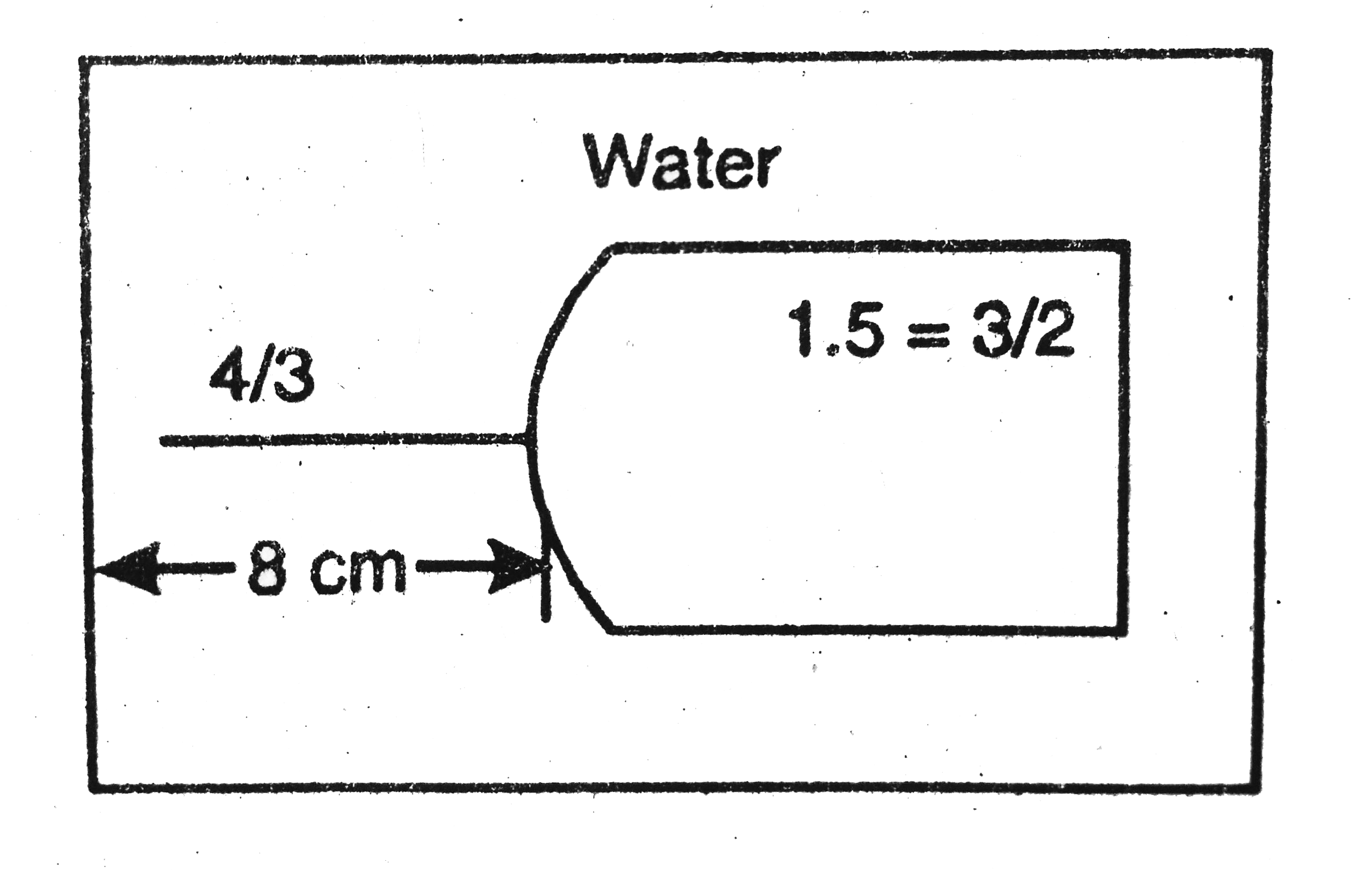
Locate the image formed by refraction in the situation shown in figure

Find the value of critical angle for a material of refractive index sqrt(3) .

Imagine that parallel rays are incident on an irregular surface.Are the rays reflected from this surface parallel to each other?

The angle of incidence for an equilateral prism of refractive index sqrt(3) so that the ray is parallel to the base inside the prism is

Images formed by totally reflected light are brighter than the images formed by ordinary reflected light. Why?

Locate the image formed by refraction in the situation shown in figure. The point C is the centre of curvature

Find the size of the image formed in the situation shown in figure.

Find the angle of minimum deviation for an equilateral prism made of a material of refractive index 1.732. What is the angle of incidence for this deviation ?

Find the total surface area of a hemisphere of radius 10 cm . (use pi =3.14

Consider the situation shown in figure. Find the maximum angle theta for which the light suffers total internal reflection at the vertical surface.

HC VERMA-GEOMETRICAL OPTICS-Exercises
  1. Locate the image formed by refraction in the situation shown in figure

    Text Solution

    |

  2. A spherical surface of radius 30 cm separates two transparent media A ...

    Text Solution

    |

  3. Figure shows a transparent hemisphere of radius 3.0 cm made of a mate...

    Text Solution

    |

  4. A small object is embedded in a glass sphere (mu =1.5) of radius 5.0 c...

    Text Solution

    |

  5. A biconvex thick lens is constructed with glass (mu = 1.50). Each of t...

    Text Solution

    |

  6. A narrow pencil of parallel light is incident normally on a solid tran...

    Text Solution

    |

  7. One end of a cylindrical glass rod (mu = 1.5) of radius 1.0 cm is roun...

    Text Solution

    |

  8. A paperweight in the form of a hemisphere of radius 3.0 cm is used to ...

    Text Solution

    |

  9. Find the image shift if the paperweight is inverted at its place so th...

    Text Solution

    |

  10. A hemispherical portion of the surface of a solid glass sphere (mu = 1...

    Text Solution

    |

  11. The convex surface of a thin concave-convex lens of glass of refractiv...

    Text Solution

    |

  12. A double convex lens has focal length 25 cm. The radius of curvature o...

    Text Solution

    |

  13. The radii of curvature of a lens are + 20 cm and + 30 cm. The material...

    Text Solution

    |

  14. Lenses are constructed by a material of refractive indeic 1'50. The ma...

    Text Solution

    |

  15. A thin lens made of a material of refractive indexmu2 has a medium of ...

    Text Solution

    |

  16. A convex lens has a focal length of 10 cm. Find the location and natur...

    Text Solution

    |

  17. A slide projector has to project a 35 mm slide (35 mm xx 23 mm) on a 2...

    Text Solution

    |

  18. A particle executes a simple harmonic motion of amplitude 1.0 cm along...

    Text Solution

    |

  19. An extended object is placed at a distance of 5.0 cm from a convex len...

    Text Solution

    |

  20. A pin of length 2.00 cm is placed perpendicular to the principal axis ...

    Text Solution

    |

