Home
Class 11
PHYSICS
A thermodynamic system is taken through ...

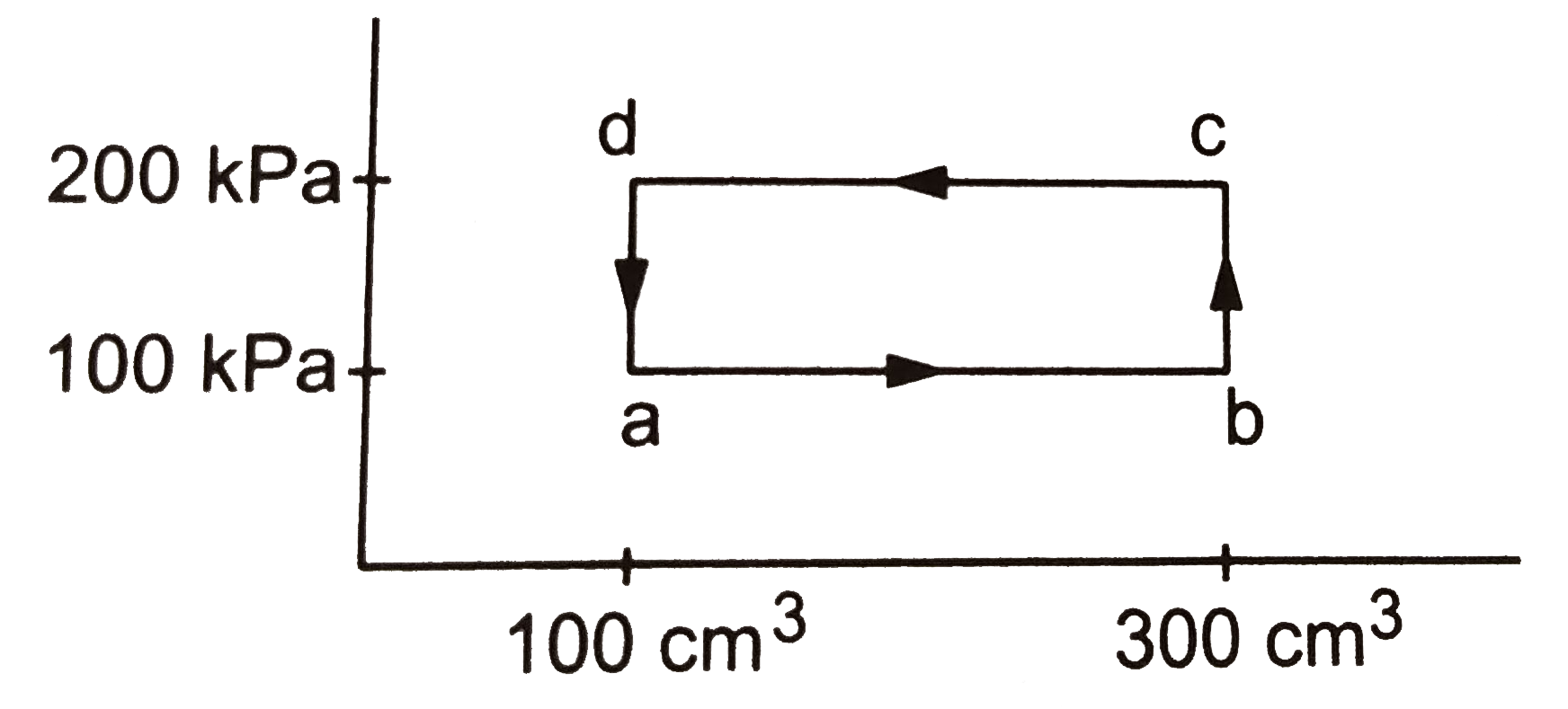
A thermodynamic system is taken through the cycle abcda. (a) calculate the work done by the gas during the parts ab, bc, cd and da. (b) find the total heat rejected by the gas during the process.

Text Solution

Verified by Experts

(a) The work done during the part ab,
`=int_(a)^(b)pdV=(100 kPa)int_(a)^(b) dV`
`=(100 kPa)(300 cm^(3)-100 cm^(3))
`=20 J`
The work done during bc is zero as the volume does not change. The work done during cd
`=int_(c)^(d) pdV=(200 kPa)(100 cm^(3)-300 cm^(3)) ==-40 J)`.
The work done during da is zero as the volume does not change.
(b) The total work done by the system during the cycle abcda
`DeltaW=20 J-40 J=-20 J`.
The change in internal energy `DeltaU=0` as the initial state is the same as the final state. thus `DeltaQ=DeltaU+DeltaW=20 J`. so the system reject 20 J of heat during the cycle.
Promotional Banner

Topper's Solved these Questions

  • LAWS OF THERMODYNAMICS

    HC VERMA|Exercise Objective I|9 Videos
  • LAWS OF THERMODYNAMICS

    HC VERMA|Exercise Objective II|5 Videos
  • LAWS OF THERMODYNAMICS

    HC VERMA|Exercise Short Answer|14 Videos
  • KINETIC THEORY OF GASES

    HC VERMA|Exercise All Questions|120 Videos
  • NEWTON'S LAWS OF MOTION

    HC VERMA|Exercise Exercises|42 Videos

Similar Questions

Explore conceptually related problems

A thermodynamic system is taken through the cycle ABCD as shown in figure. Heat rejected by the gas during the cycle is:

A gas is taken through the cycle A rarr B rarr C rarr A , as shown. What is the network done by the gas? .

calculate the work done by a gas as it is taken from the state a to b, b to c and c to a as shown in

An ideal gas goes from the state i to the state int as shown in .the work done by the gas during the process

A sample of an ideal gas is taken through the cyclic process abca . It absorbs 50 J of heat during the part ab, no heat during bc and rejects 70 J of heat during ca. 40 J of work is done on the gas during the part bc.(a) find the internal energy of the gas at b and c if it is 1500 J at a. (b) calculate the work done by the gas during the part ca.

An LR circuit with emf epsilon is connected at t = 0. (a) find the charge Q which flows through the battery during O to t. (b) Calculate the work done by the battery during this period. (c) Find the heat developed during this period (d) find the magnetic field energy stored in the circuit at time t. (e) Verify that the results in the three parts above are consistent with enegy conservation.

Figure Shows a process ABCA performed on an ideal gas. Find the net heat given to the system during the process.

A parallel - plate capacitor having plate area 20cm^2 and seperation between the plates 1.00 mm is connected to a battery of 12.0V . The plates are pulled apart to increase the separation to 2.0mm . (a ) calculate the charge flown through the circuit during the process . (b ) How much energy is absorbed by the battery during the process ? (c ) calculate the stored energy in the electric field before and after the process . (d ) Using the expression for the force between the plates , find the work done by the person polling the plates apart . (e ) Show and justify that no heat is produced during this transfer of charge as the separation is increased.

when a system is taken through the process abc shown in the fig. 80 J of heat is absorbed by the system and 30 J of work is done by it. If the system does 10 J work during the process adc, how much heat flows into it during the process ?

shows three paths through which a gas can be taken from the state A to the state B. calculate the work done by the gas in each of the three paths.
