Home
Class 11
PHYSICS
Figure Shows a process ABCA performed on...

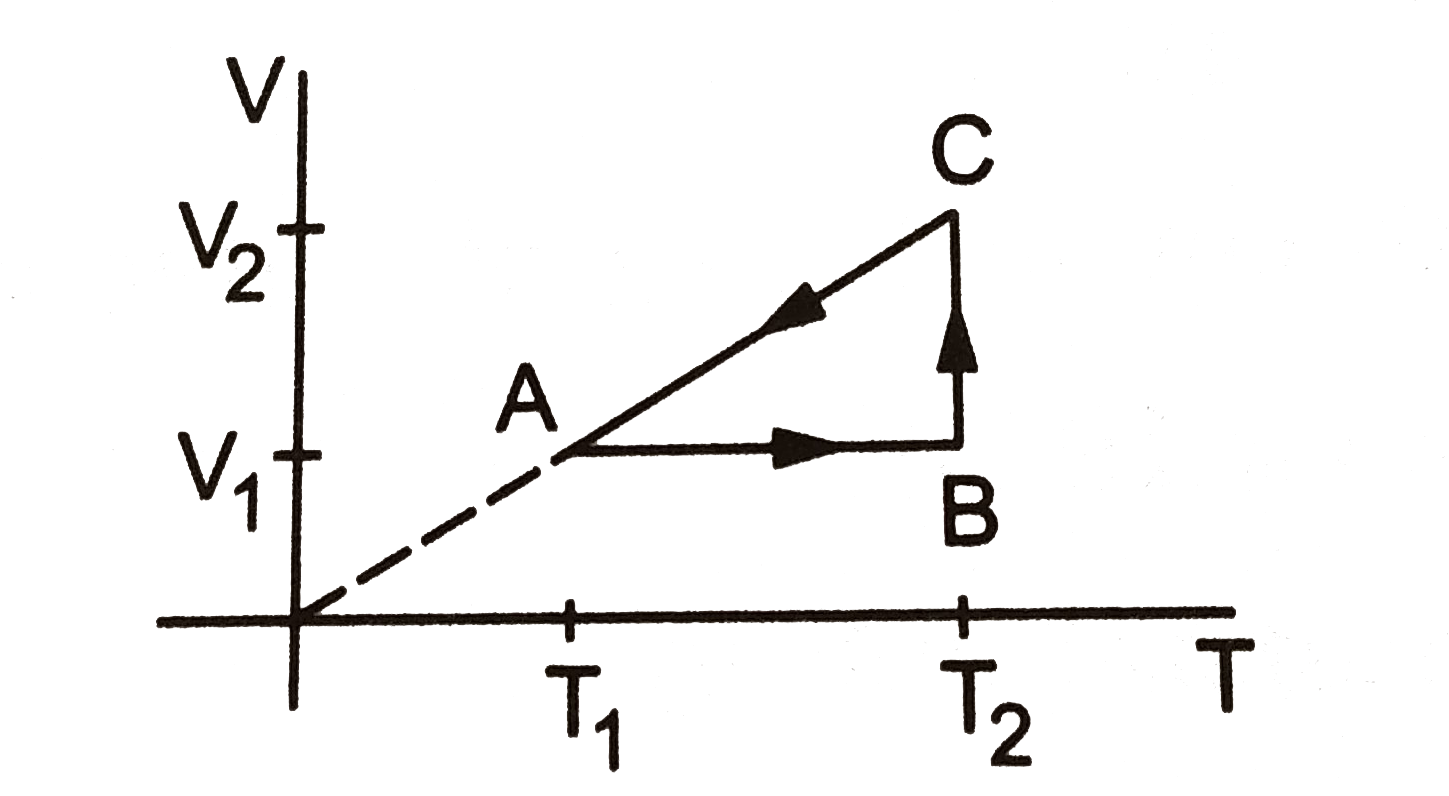
Figure Shows a process ABCA performed on an ideal gas. Find the net heat given to the system during the process.

Text Solution

Verified by Experts

As the process is cycle, the change in internal energy is zero. The heat given to the system is then equal to the work done byh it.
The work done in part `AB is W_(1)=0` as the volume remains constant. The part BC represent an isothermal procces so that the work done by the gas during this part is
`W_(2)=nRT_(2)In(V_(2)//V_(1))`
during the part CA,
`VpropT`.
so, `V//T` is constant and hence,
`p=(nRT)/V` is constant.
The work done by the gas during the part CA is ` the work done by the gas the part CA is
`W_(3)=p(V_(1)-V_(2))`
`=nRT_(1)-nRT_(2)`
`=-nR(T_(2)-T-(1).
The net work done by the gas in the process ABCA is
W=W_(1)+W_(2)+W_(3)=nR[T_(2)InV_(2)/V_(1)-(T_(2)-T_(1))]`.
The same amount of heat is given to the gas.
Promotional Banner

Topper's Solved these Questions

  • LAWS OF THERMODYNAMICS

    HC VERMA|Exercise Objective I|9 Videos
  • LAWS OF THERMODYNAMICS

    HC VERMA|Exercise Objective II|5 Videos
  • LAWS OF THERMODYNAMICS

    HC VERMA|Exercise Short Answer|14 Videos
  • KINETIC THEORY OF GASES

    HC VERMA|Exercise All Questions|120 Videos
  • NEWTON'S LAWS OF MOTION

    HC VERMA|Exercise Exercises|42 Videos

Similar Questions

Explore conceptually related problems

Figure shows two processes A and B on a system.Let DeltaQ_(1) and DeltaQ_(2) be the heat given to the system in processes A and B respectively. Then

In which process there is no exchange of heat between the system and surrounding during the process ?

Refer to figure. Let DeltaU_(1) and DeltaU_(2) be the changes in internal energy in the system in process A+B and DeltaW be the net work done by the system in the process A+B ,

Figures below shows two paths that may be taken by a gas to go from a state A to a state C. In process AB , 400J of heat is added to the system an in process ? BC ,100J of heat is added to the system . The heat absorbed by the system in the process AC will be :

Can a process on an ideal gas be both adiabatic and isothermal. ?

Consider the cyclic process ABCA, shown in fig, performed on a sample of 2.0 mol if an ideal gas. A total of 1200 J if heat is withdrawn from the sample in the process. Find the work done by the gas during the part BC.

One mole of an ideal monoatomic gas undergoes a process described by the equation PV^3 = constant. The heat capacity of the gas during this process is

A thermodynamic system is taken through the cycle abcda. (a) calculate the work done by the gas during the parts ab, bc, cd and da. (b) find the total heat rejected by the gas during the process.

An ideal gas has pressure p_(0) , volume V_(0) and temperature T_(0) . It is taken an isochoric process till its pressure is doubled. It is now isothermally expanded to get the original pressure. Finally , the gas is isobarically compressed to its original volume V_(0) . (a) Show the process on a p-V diagram. (b) What is the tempertaure in the isothermal part of the process? (c) What is the volume at the end of the isothermal part of the process?

consider the cyclic process ABCA on a sample of 2.0 mol of an ideal gas as shown in the fig. temperature of the gas at A and B are 300 K and 500 k respectively. A total of 1200 J heat is withdrawn from the sample in the process. Find the work done by the gas in part BC. take R=8.3 JK^(-1) mol^(-1)
