Home
Class 11
PHYSICS
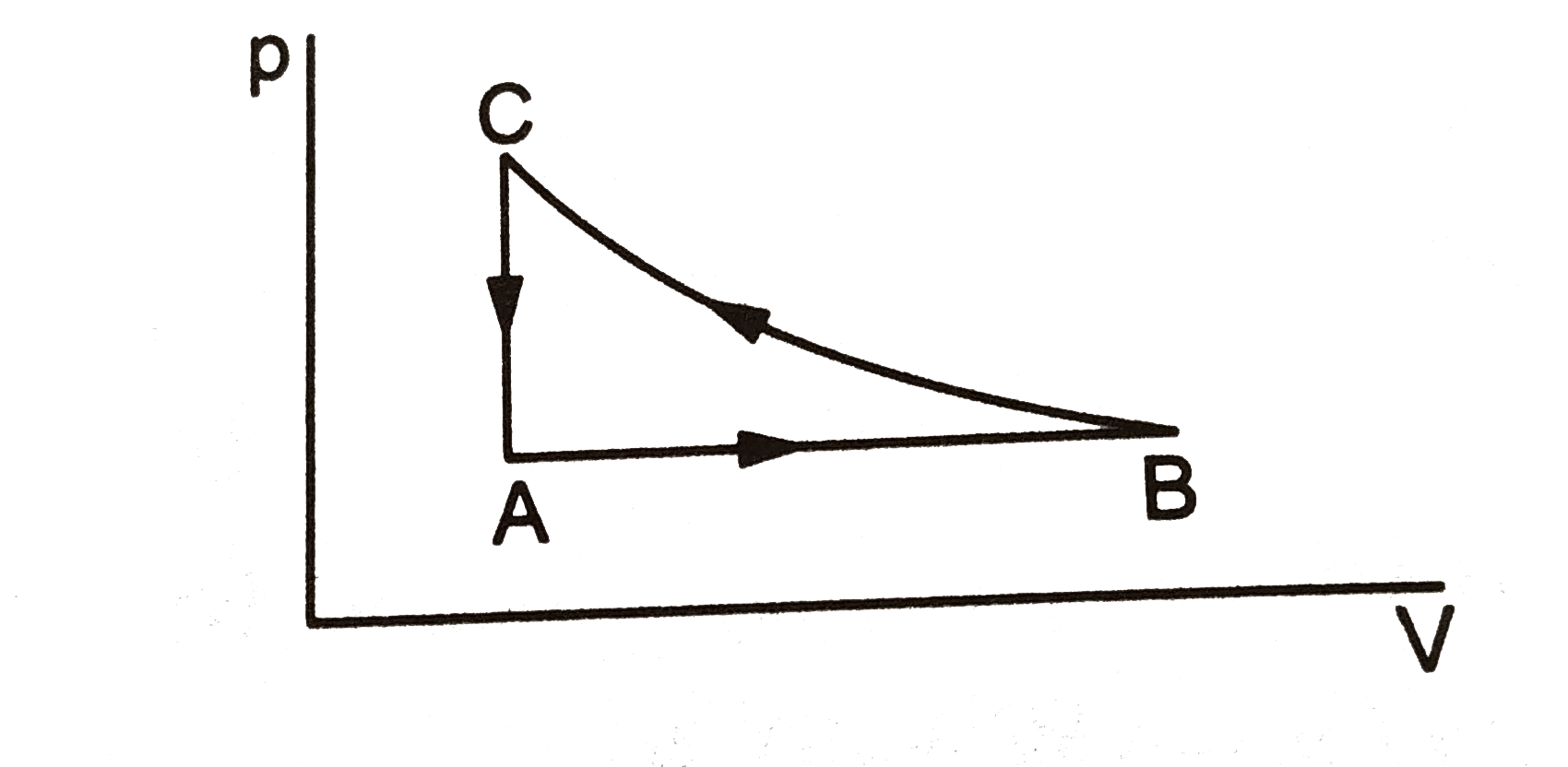
consider the cyclic process ABCA on a sa...

consider the cyclic process ABCA on a sample of 2.0 mol of an ideal gas as shown in the fig. temperature of the gas at A and B are 300 K and 500 k respectively. A total of 1200 J heat is withdrawn from the sample in the process. Find the work done by the gas in part BC. take `R=8.3 JK^(-1) mol^(-1)`

Text Solution

Verified by Experts

The change in internal energy during the cuclic process is zero. Hence, the heat supplied to the gas is equel to the work done by it, Hence, `W_(AB)+W_(BC)+W_(CA)=1200 J`.
The work done during the process AB is
W_(AB)=p_(A)(V_(B)-V_(A)`
=nR(T(B)-T_(A))`
`(2.0 mol)(8.3 JK^(-1) mol^(-1))(200 K)`
`=3320 J`.
The work done by the gas during the process CA is zero as the volume remains constant. from (i),
`3320 J+W_(BC)=1200 J`
or, `W_(BC)=-4520 J`.
`~~-4500 J`.
Promotional Banner

Topper's Solved these Questions

  • LAWS OF THERMODYNAMICS

    HC VERMA|Exercise Objective I|9 Videos
  • LAWS OF THERMODYNAMICS

    HC VERMA|Exercise Objective II|5 Videos
  • LAWS OF THERMODYNAMICS

    HC VERMA|Exercise Short Answer|14 Videos
  • KINETIC THEORY OF GASES

    HC VERMA|Exercise All Questions|120 Videos
  • NEWTON'S LAWS OF MOTION

    HC VERMA|Exercise Exercises|42 Videos

Similar Questions

Explore conceptually related problems

Consider the cyclic process ABCA, shown in fig, performed on a sample of 2.0 mol if an ideal gas. A total of 1200 J if heat is withdrawn from the sample in the process. Find the work done by the gas during the part BC.

Fig shows the variation in the internal energy U with the volume V of 2.0 mol of an ideal gas in a cyclic process abcda. The temperatures of the gas at b and c are 500 K and 300 K respectively. Calculate the heat absorbed by the gas during the process.

An ideal gas (gamma = 1.67 ) is taken through the process abc shown in figure . The temperature at the point a is 300 k . Calculate (a) the temperature at b and c, (b) the work done in the process.

1 mole of an ideal gas, maintained at 4.1 atm and at a certain temperature , absorbs heat 3710 J and expands to 2 litres . Calculate the entropy changes in expansion process.

One mole of an ideal gas requires 207 J heat to rise the temperature by 10 K when heated at constant pressure. If the same gas is heated at constant volume to raise the temperature by the same 10 K , the heat required is (Given the gas constant, R = 8.3 J/mol-K).

Find the loss in the mass of 1 mole of an ideal monatomic gas kept in a rigid container as it cools down by 10^@C . The gas constant R = 8.3 J K ^(-1) mol ^(-1) .

Ten moles of an ideal gas at constant temperature 600 K is compressed from 100l to 10L. The work done in the process is ……………. .

consider two processes on a system as shown in fig the volumes in the initial stage are the same in the two processes and the volume in the final stage are also the same.Let DeltaW_(1) and DeltaW_(2) be the work done by the system in the processes A and B respectively.

An adiabatic vessel of total volume V is divided into two equal parts by a conducting separator. The separator is fixed in this position. The part on the left contains one mole of an ideal gas (U=1.5 nRT) and the part on the right contains two moles of the same gas. initially, the pressure on each side is p. the system is left for sufficient time so that a steady state is reached. find (a) the work done by the gas in the left part during the process, (b) the temperature on the two sides in the beginning, (c ) the final common temperature reached by the gases, (d) the heat given to the gas in the right part and (e) the increase in the internal energy of the gas in the left part.
