Home
Class 11
PHYSICS
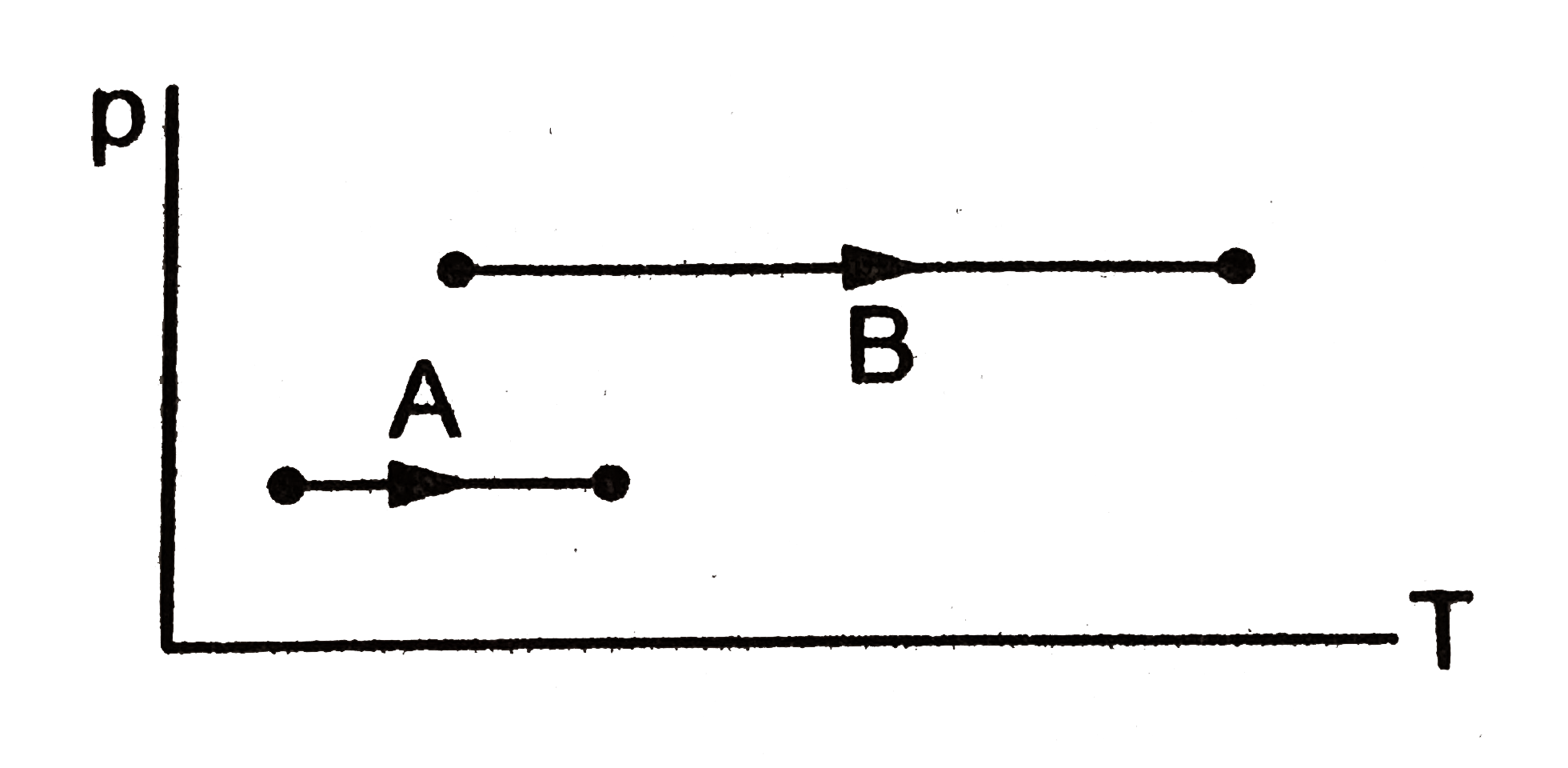
consider two processes on a system as sh...

consider two processes on a system as shown in fig
the volumes in the initial stage are the same in the two processes and the volume in the final stage are also the same.Let `DeltaW_(1) and DeltaW_(2)` be the work done by the system in the processes A and B respectively.

A

a) `DeltaW_(1)gtDeltaW_(2)`

B

b) `DeltaW_(1)=DeltaW_(2)`

C

c) `DeltaW_(1)ltDeltaW_(2)`

D

d) nothing can be said about the relation between `DeltaW_(1) and DeltaW_(2)`.

Text Solution

Verified by Experts

The correct Answer is:

C

`DeltaW_(1)ltDeltaW_(2)`
Promotional Banner

Topper's Solved these Questions

  • LAWS OF THERMODYNAMICS

    HC VERMA|Exercise Objective II|5 Videos
  • LAWS OF THERMODYNAMICS

    HC VERMA|Exercise Exercises|22 Videos
  • LAWS OF THERMODYNAMICS

    HC VERMA|Exercise Worked out Example|11 Videos
  • KINETIC THEORY OF GASES

    HC VERMA|Exercise All Questions|120 Videos
  • NEWTON'S LAWS OF MOTION

    HC VERMA|Exercise Exercises|42 Videos

Similar Questions

Explore conceptually related problems

Refer to figure. Let DeltaU_(1) and DeltaU_(2) be the changes in internal energy of the system in the processes A and B. then

Figure shows two processes A and B on a system.Let DeltaQ_(1) and DeltaQ_(2) be the heat given to the system in processes A and B respectively. Then

Consider the process on a system as shown in the figure. During the process, the work done by the system

Refer to figure. Let DeltaU_(1) and DeltaU_(2) be the changes in internal energy in the system in process A+B and DeltaW be the net work done by the system in the process A+B ,

a) In a process on a system, the initial pressure and volume are equal to final pressure and volume, then

two samples 1 and 2 are initially kept in the same state. the sample 1 is expanded through an isothermal process where as sample 2 through an adiabatic process up to the same final volume.Let p_(1) and p_(2) be the final pressure of the samples and 2 respectively in the previous question then.

The final volume of a system is equal to the initial volume in a certain process. Is the work done by the system necessarily zero? Is it necessarily nonzero?

An ideal gas compressed to half its initial volume by means of several processes. Which of the process results in the maximum work done on the gas?

A system can be taken from the initial state p_(1),V_(1) to the final state p_(2,V_(2) by two different methods, let DeltaQ and DeltaW represent the heat given to the system and the work done by the system. Which of the following must be the same in both the method?

An adiabatic vessel of total volume V is divided into two equal parts by a conducting separator. The separator is fixed in this position. The part on the left contains one mole of an ideal gas (U=1.5 nRT) and the part on the right contains two moles of the same gas. initially, the pressure on each side is p. the system is left for sufficient time so that a steady state is reached. find (a) the work done by the gas in the left part during the process, (b) the temperature on the two sides in the beginning, (c ) the final common temperature reached by the gases, (d) the heat given to the gas in the right part and (e) the increase in the internal energy of the gas in the left part.
