Home
Class 12
PHYSICS
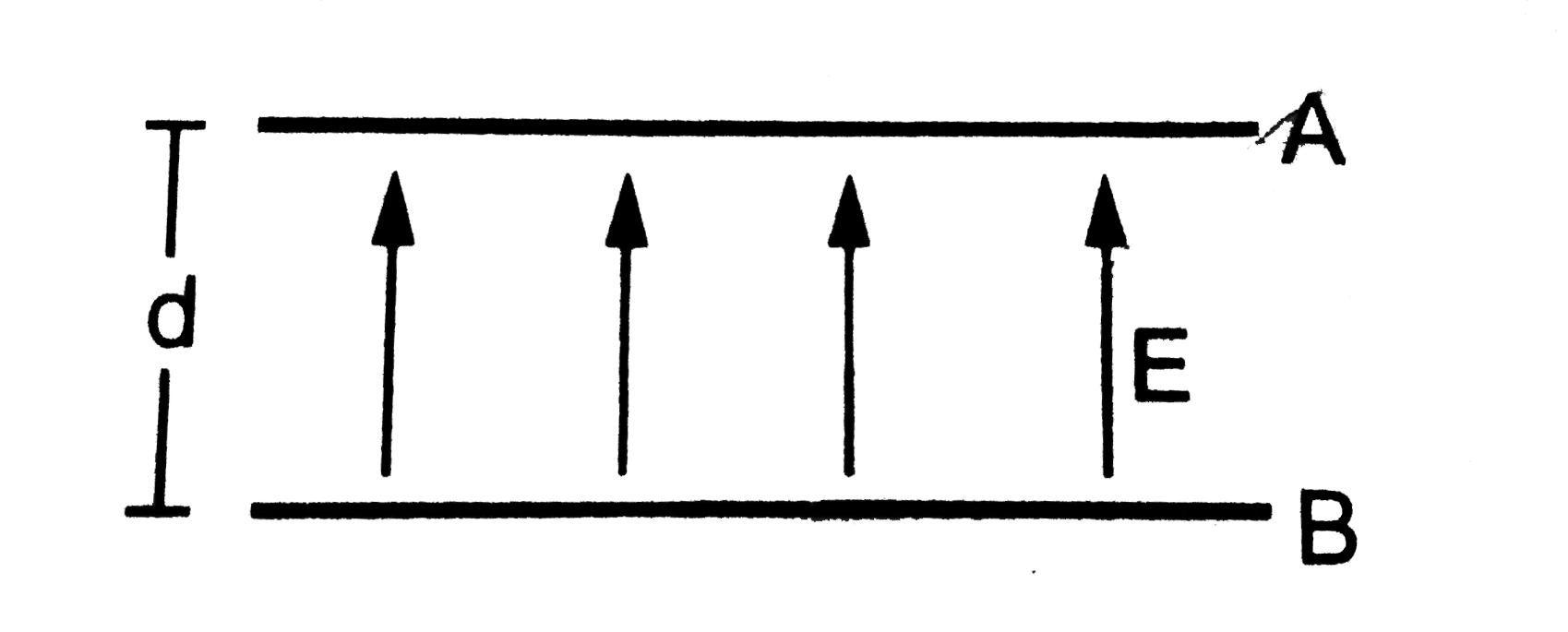
Figure shows two metallic plates A and B...

Figure shows two metallic plates A and B placed parallel to each other at a seperation d. A uniform electric field E exists between the plates in the direction from plate B to plate A. Find the potential difference between the plates.

Text Solution

Verified by Experts

Let us take the origin at plate a and x-axis
along the direction from plate A to plate B. We have
`V_B - V_A =-int_(r_A)^(r_B) vecE dvecr = -int_0^d - E dx = Ed.
if we work in Cartesian coordinate system
`E = E_x veci +E_y vec j +E_z veck`
and `dvecr = dx veci +dy vecj +dz veck.`
Thus from
`dV = E_x dx- E_y dy-Ez dz. (i)`
If we change x to x + dx keeping y and z constant,
dy = dz = 0 and from (i),
`|(E_x=-(delV)/(delx)),(E_y=-(delV)/(dely)),(E_z = -(delV)/(delz))|`
The symbols `(del)/(delx), (del)/(dely)` ect. are used to indicate that
while differentiating with respect to one coordinate, the other are kept constant.
if we know the electric field in a region, we can
find the electric using equation and
if we know the electrinc potential in a retgion, we can find the electric field using
Equation may also be written as
`dV = -E dr cos theta`
Where `theta` is the angle between the field `vecE` and the small
displacement `dvecr.` Thus.
`-(dV)/(dr) = E cos theta`
We see that, `-(dV)/(dr)` gives the compnent of the electric

field in the direction of displacement `dvecr.` In we show a small displacement PP' = dr. The electric field
is E making an angle `theta` with PP.' we have
`dV = V(P,) - V(P)`
so that `(V(P) - V(P))/(dr) = E cos theta.`
This gives us a method to get the component fo
the electric field in any given direction if we know the
potential. MOve a small distance dr in the given
direction and see the change dV in the potential. The
component of electric field along that direction is
`(dV)/(dr).`
If we move a distance dr in the direction of the
field, `theta` is zero and ` -(dV)/(dr) = E` is maximum. Thus the
electric field is along the direction in which the potential decrease at the maximum rate.
If a mall displacement `dvecr` perpendicular to the
electric field is considered, `theta = 90^@` and
`dV = -vecE.dvecr = -0.` The potential does not vary in a
direction perpendicular to the electric field.
Promotional Banner

Topper's Solved these Questions

  • ELECTRIC FIELD AND POTENTIAL

    HC VERMA|Exercise worked out Examples|19 Videos
  • ELECTRIC FIELD AND POTENTIAL

    HC VERMA|Exercise question for short answer|14 Videos
  • ELECTRIC CURRENT THROUGH GASES

    HC VERMA|Exercise Exercise|23 Videos
  • ELECTROMAGNETIC INDUCTION

    HC VERMA|Exercise EXERCISE|98 Videos

Similar Questions

Explore conceptually related problems

What is the electric field in between the plates of the capacitor, if sigma is the surface charge density?

A charge of 1 muC is given to one plate of a parallel - plate capacitor of capacitance 0.1muF and a charge of 2 muC is given to the other plate . Find the potential difference developed between the plate .

Two large glass plates are placed vertically and parallel to each other inside a tank of water with separation between the plates equal to 1 mm. Find the rise of water in the space between the plates. Surface tension of water =0.075Nm^-1 .

What is the electric field in between the plates of a capacitor in the presence of adielectric medium?

Two plates are 1 cm aprt and the potential difference between them is 10 V. the electric field between the plates is

A parallel plate capacitor is charged by a battery after some time, the battery is disconnected and a dielectric slab with its thicnkess equal to the plate so reparation is insected between the plates. How will (i) the capacitance of the capacitor (ii) potential difference between the plates & (iii) the energy sotred in the capacitor the affected ? Q_(0) -charge V_(0) - potential difference, C_(0) - capacitance, E_(0) electric field. U_(0) - energy spred, before the dielectric slab is inserted. Q_(0)=C_(0) V_(0), (V_(0))/(d), U_(0)=(1)/(2)C_(0)V_(0)^(2)?

A capacitor is connected to an alternating- current source. Is there a magnetic field between the plates ?

Two plates are 2 cm apart. If a potential difference of 10 V is applied between them. The electric field between the plates will be

A parallel -plate capacitor with the plate area 100cm^2 and the separation between the plate 1.0cm is connected across a battery of emf 24 volts .Find the force of attraction between the plates.

HC VERMA-ELECTRIC FIELD AND POTENTIAL-Exercises
  1. Figure shows two metallic plates A and B placed parallel to each othe...

    Text Solution

    |

  2. Find the dimensional formula of epsilon0 .

    Text Solution

    |

  3. A charge of 1.0 C is placed at the top of your college building and an...

    Text Solution

    |

  4. At what separation should two equal charges 1.0 C each, be placed so t...

    Text Solution

    |

  5. Two equal charges are placed at a separtion of 1.0 m. What should be t...

    Text Solution

    |

  6. Find the electric force between two protons separted by a distance of ...

    Text Solution

    |

  7. Two chargea 2.0xx10^(-6) C and 1.0xx10^(-6) C are placed at a separati...

    Text Solution

    |

  8. Suppose the second charge in the previous problem is -1.0 xx 10^(-6) C...

    Text Solution

    |

  9. Two charged particles are placed at a distance 1.0 cm apart. What is t...

    Text Solution

    |

  10. Estimate the number of electrons in 100 g water. How much is the total...

    Text Solution

    |

  11. Suppose all the electrons of 100 g are lumped together to form a nega...

    Text Solution

    |

  12. Consider a gold nucleus to be a sphere of redius 6.9 fermi in whichpr...

    Text Solution

    |

  13. Two insulating small spheres are rubbed against each other and placed ...

    Text Solution

    |

  14. Na Cl molecule is bound due to the electric force between the sodium a...

    Text Solution

    |

  15. Find the ratio of the electric and gravitational forces between two pr...

    Text Solution

    |

  16. Suppose ana attractive nuclear force acts between two protons which ma...

    Text Solution

    |

  17. Three equal charges, 2.0xx 10^(-6) C each, are held fixed at the thr...

    Text Solution

    |

  18. Four equal charges 2.0xx10^(-6) C each are fixed at the four corners o...

    Text Solution

    |

  19. A hydrogen atom contains one proton and one electron. It may be assume...

    Text Solution

    |

  20. A hydrogen atom contains one proton and one electron. It may be assume...

    Text Solution

    |

  21. Ten positively charged particles are kept fixed on the x-axis at point...

    Text Solution

    |
