Home
Class 12
PHYSICS
Two identical pith balls, each carrying ...

Two identical pith balls, each carrying charge q, are suspended from a common point by two strings of equal length l. Find the mass of each ball if the angle between the strings is `2theta` in equilibrium.

Text Solution

Verified by Experts
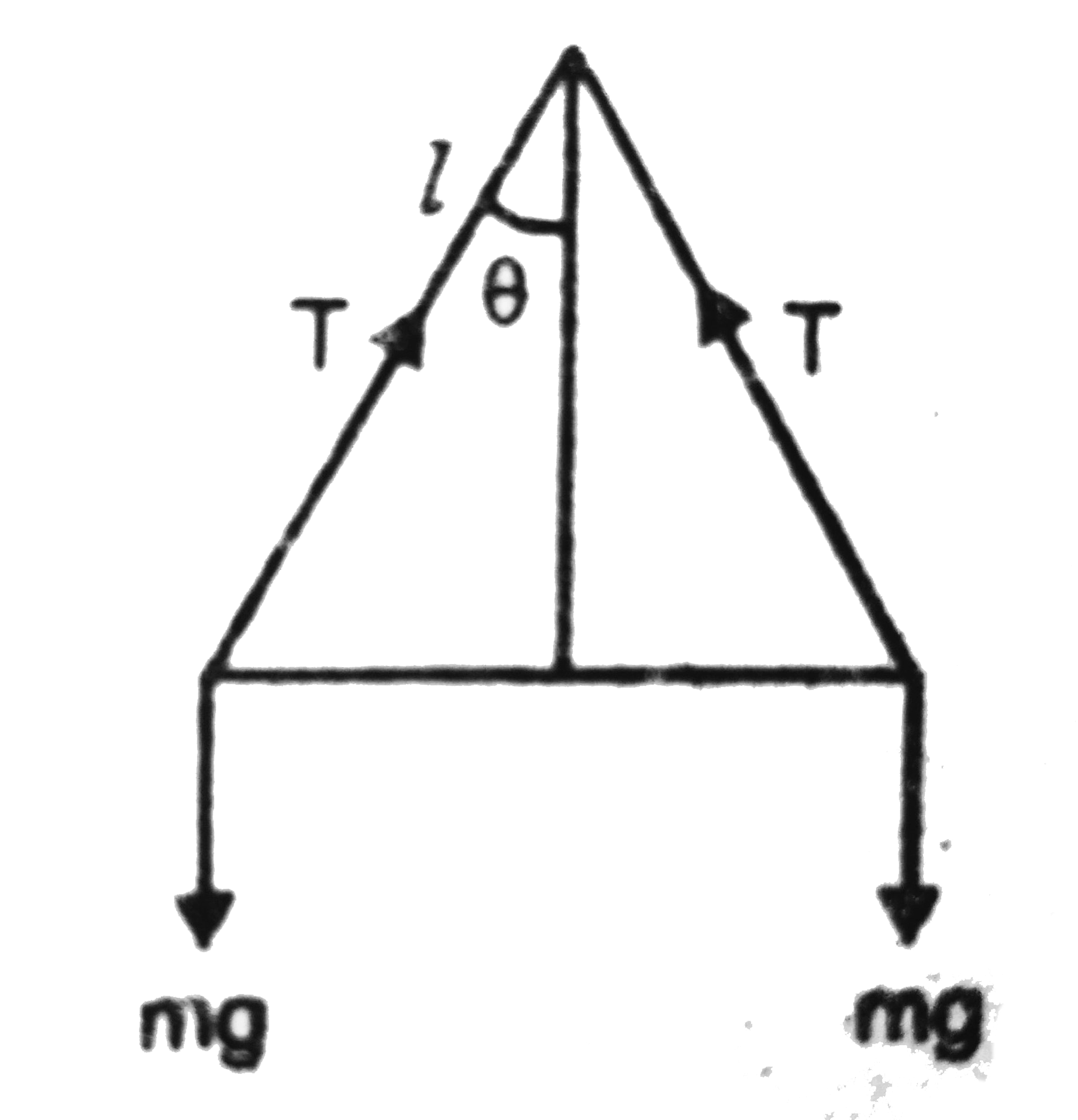
`Tcostheta=(mg), Tsintheta=F_e `
` Then, tantheta =F_e/(mg) `
` F_e=(1) /(4piepsilon_0)q^2/(2lsintheta)^2 `
` :. m=(q^2cottheta)/(16piepsilon_0gl^2sin^2theta)`.
Promotional Banner

Topper's Solved these Questions

  • ELECTRIC FIELD AND POTENTIAL

    HC VERMA|Exercise Objective 2|8 Videos
  • ELECTRIC CURRENT THROUGH GASES

    HC VERMA|Exercise Exercise|23 Videos
  • ELECTROMAGNETIC INDUCTION

    HC VERMA|Exercise EXERCISE|98 Videos

Similar Questions

Explore conceptually related problems

Two pith balls carrying equal charges are suspended from a common point by strings of equal length, the equilibrium separation between them is r.Now the strings are rigidly clamped at half the height.The equilibrium separation between the balls now become:

Two small spheres, each having a mass of 20 g, are suspended form a common point by two insulating strings of length 40 cm each. The spheres are identically charged and the speration between the balls at equilibrium is found to be 4 cm . Find the charge on each sphere.

Two indentical balls, each having a charge of 2.00xx10^(-7) C and a mass of 100g , are suspended from a common point by two insulating strings each 50 cm long. The balls are held at a separation 5.0cm apart and then released. Find (a) the electric force on one of the charged balls (b) the components of the resultant force on it along and perpendicular to the string (c) the tension is the string (d) the acceleration of one of the balls. Answers are to be obtained just after the release.

Two idential charged spheres suspended from a common point by two massless strings of lengths l, are intially at a distance d(d<<1) a part because of their mutual repulsion. The charges begin to leak from both the spheresapproach each other with a velocity v.Then v varies as a function of the distance x between the spheres as:

Two idential pith balls. Each of mass 'm' and charges 'q' hang from noncoducting threads of length I as shown in figure , theta is very small and hence tan theta ~~sin theta . Show that , for equilibrium x=[( q^(2) l)/( 2pi in _0mg) ]^((1)/(3))

A rectangular plate of sides a and b is suspended from a ceiling by two parallel strings of length L each in the figure. The separation between the strings is d. The plate is displaced slightly in its plane keeping the strings tight. Show that it will execute harmonic motion. Find the time period.

Two positive ions , each carrying a charge q, are separated by a distance d. If F is the force of repulsion between the ions,the number of electrons missing from each ion will be (e being the charge on an electron).

Figure shows as rod of length 20 cm pivoted near an end and which is made to rotate in a horizontal plane with a constant angular speed. A ball ofmass m is spuspended by a string angular also of length 20 cm from the other end of the rod. If the angle theta made by the stirng with the vertical is 30^0 . find the anglular speed of the rotation. Take g=10 m/s^2

A body of mass m is suspended by two strings making angles alpha and beta with the horizontal. Find the tensions in the strings.

Two charged particles having charge 2.0xx 10^(-8)C each are joined by an insulating string of length 1 m and the system is kept on a smooth horizontal table. Find the tension in the string.

HC VERMA-ELECTRIC FIELD AND POTENTIAL-Exercises
  1. Two pith balls carrying equal charges are suspended from a common poin...

    Text Solution

    |

  2. Two small spheres, each having a mass of 20 g, are suspended form a co...

    Text Solution

    |

  3. Two identical pith balls, each carrying charge q, are suspended from ...

    Text Solution

    |

  4. A particle having a charge of 2.0xx10^(-4) C is placed directly below ...

    Text Solution

    |

  5. Two particles A and B having charges 8.0 xx 10 ^(-6) C and -2.0 xx 1...

    Text Solution

    |

  6. Two identically charged particles are fastened to the two ends of a sp...

    Text Solution

    |

  7. Two particles, each having a mass of 5 g and charge. 1.0 xx 10^(-7) C...

    Text Solution

    |

  8. A particle A having a charge of 2.0xx 10^(-6) C and a mass of 100 g i...

    Text Solution

    |

  9. Two particles A and B having equal charges are placed at distance d ap...

    Text Solution

    |

  10. Two particles A and B , each carrying charge Q are held fixed with a s...

    Text Solution

    |

  11. Two particles A and B , each carrying charge Q are held fixed with a s...

    Text Solution

    |

  12. The electric force experienced by a charge of 1.0xx10^(-6) C is 1.5 xx...

    Text Solution

    |

  13. Two particles A and B having charges of +2.00 xx 10^(-6) C and of - 4....

    Text Solution

    |

  14. A Point charge produces an electric field in room. What is its direct...

    Text Solution

    |

  15. A water particle of mass 10.0 mg and having a charge of 1.50 xx 10^(-6...

    Text Solution

    |

  16. Three identical charges, each having a value 1.0 xx10^(-8)C, are place...

    Text Solution

    |

  17. Positive charge Q is distributed uniformly over a circular ring of rad...

    Text Solution

    |

  18. A rod of length L has a total charge Q distributed uniformly along its...

    Text Solution

    |

  19. A 10 cm long rod carries a charge of +50 muC distributed uniformly al...

    Text Solution

    |

  20. Find the point on the X-axis which is equidistant from (2, -5) and (-2...

    Text Solution

    |

