Home
Class 12
PHYSICS
A block of mass m containing a net posit...

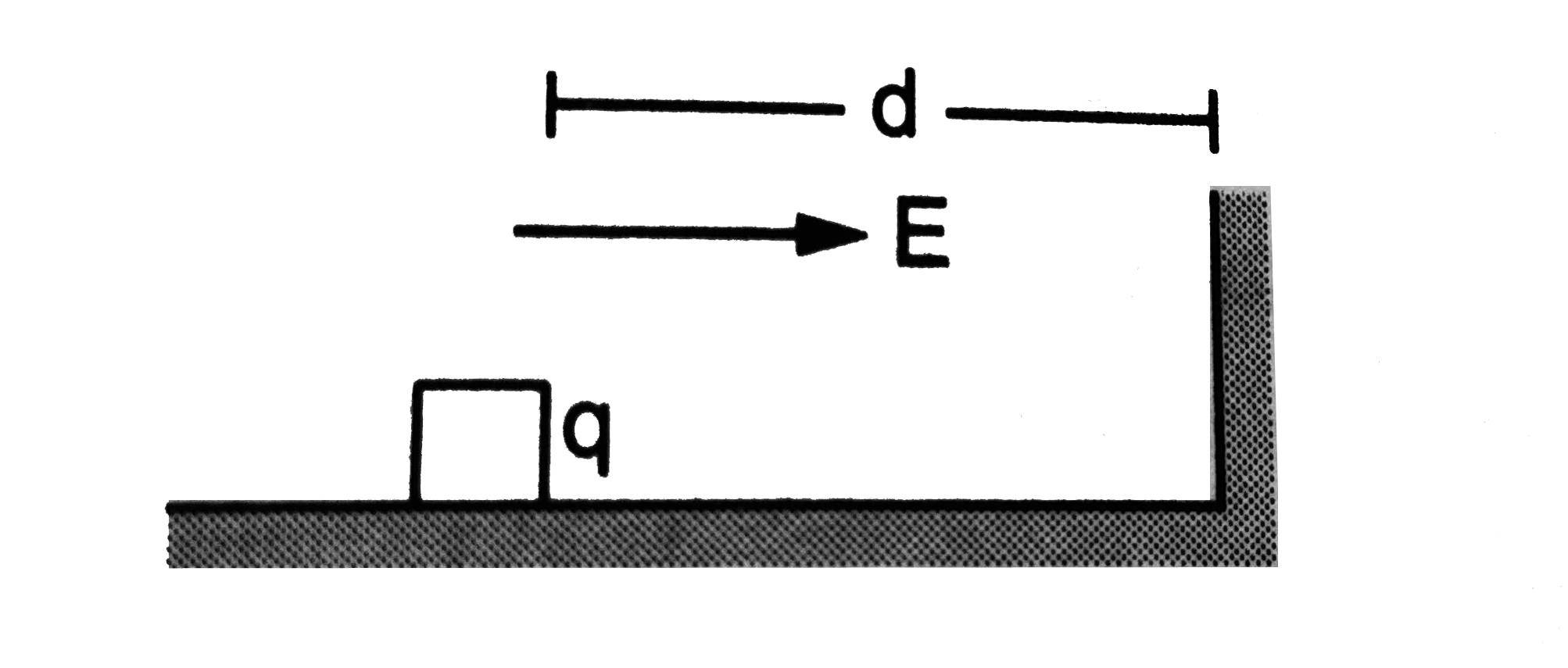
A block of mass m containing a net positive charge q is placed on a smooth horizontal table which terminates in a vertical wall as shown in figure(29-E2). The distance of the block from the wall is d. A horizontal electric field E to towards right is switched on. Assuming elastic collisions find the time period of the resulting oscillatory motion. Is it a simple harmonic motion?

Text Solution

Verified by Experts
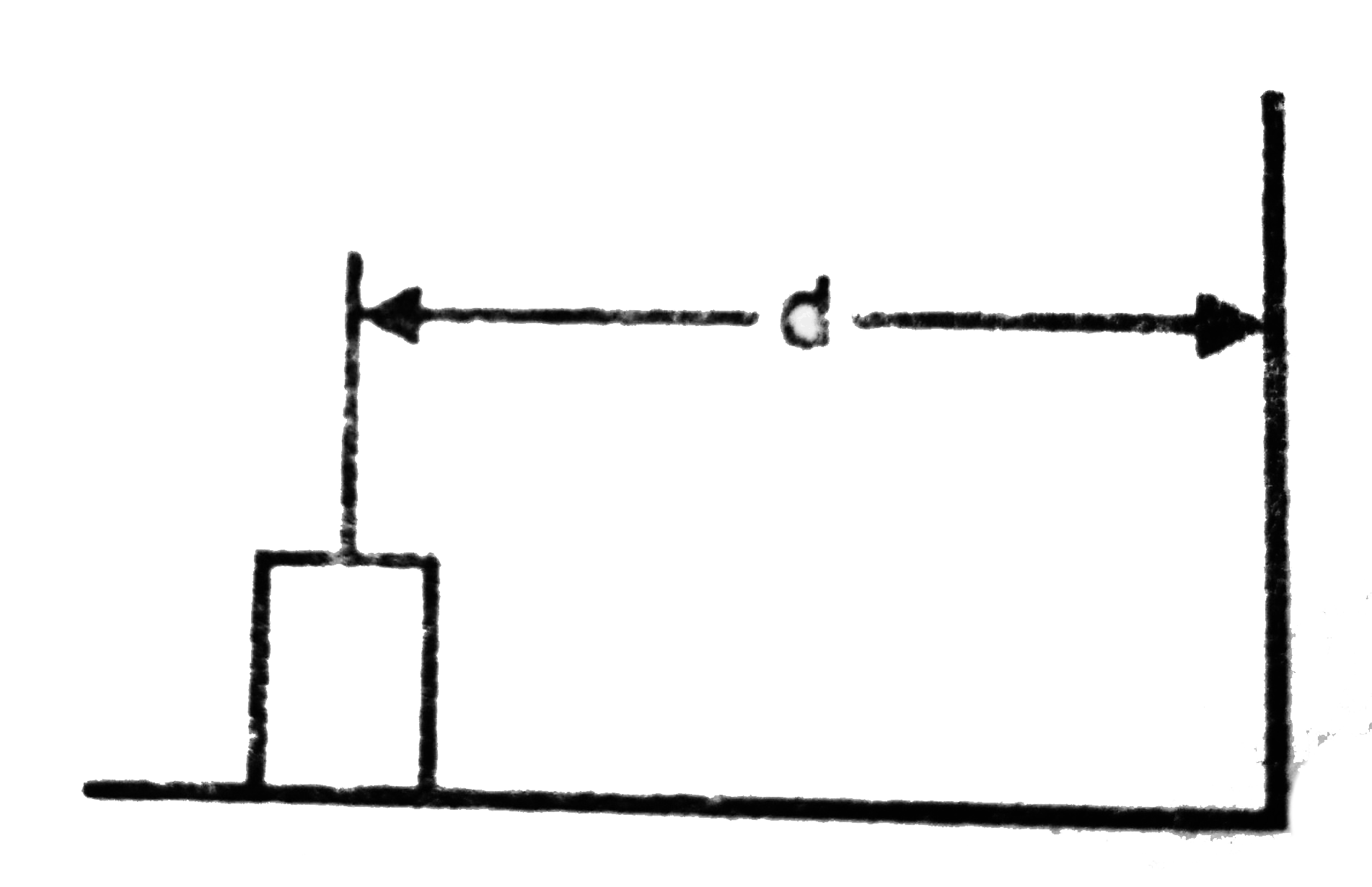
The block does not undergo SHM.
` D=ut+1/2at^2 `
` Here, u=0, a=(qE)/m `
` t_1=sqrt((2d)/a)=sqrt((2dm)/(qE)) `
` v=u+at=(qE)/m sqrt((2dm)/(qE) )`
` Again, u=v+at_2=0 `
` or t_2=v/a=(qE)/m sqrt((2dm)/(qE))/a=sqrt((2dm)/(qE)) `
` Total time `
` t=t_1+t_2=2=sqrt((2dm)/(qE) )`
` =sqrt((8dm)/(qE))`.
Promotional Banner

Topper's Solved these Questions

  • ELECTRIC FIELD AND POTENTIAL

    HC VERMA|Exercise Objective 2|8 Videos
  • ELECTRIC CURRENT THROUGH GASES

    HC VERMA|Exercise Exercise|23 Videos
  • ELECTROMAGNETIC INDUCTION

    HC VERMA|Exercise EXERCISE|98 Videos

Similar Questions

Explore conceptually related problems

A block of mass m having a charge q is placed on a smooth horizontal table and is connected to a wall through an unstressed spring of spring constant k as shown in figure . A horizontal electric field E parallel to the spring is switched on. Find the amplitude of the resulting SHM of the block.

A block of mass m and positive charge q is placed on an insulated frictionless inclined plane as shown in the figure. A uniform electric field E is applied parallel to the inclined surface such that the block is at rest. Calculate the magnitude of the electric field E.

A small block of mass m and a concave mirror of radius R fitted with a stand lie on a smooth horizontal table with a separation d between them. The mirror together with its stand has a mass m. The block is pushed at t = 0 towards the mirror so that it starts moving towards the mirror at a constant speed V and collides with it. The collision is perfectly elastic. Find the velocity of the image (a) at a time t lt d/V, (b) at a time t gt d/V .

A small ball of conducting material having a charge +q and mass m is thrown upward at and angle theta to horizontal surface with an initial speed nu_(0) as shown in the figure. There exists an uniform electric field E downward along with the gravitational field g . Calculate the range maximum height and time of flight in the motion of this charged ball. Neglect the effect of air and treat the ball as a point mass .

A 1kg block is executing simple harmonic motion of amplitude 0.1 m on a smooth horizontal surface under the restoring force of a spring constant 100Nm^-1 . A block of mass 3 kg is gently placed on it at the instant it passes through the mean position. Assuming that the two blocks move together, find the frequency.

Two charged particles of masses m and 2m are placed distance d apart on a smooth horizontal table. Because of their mutual attraction, they move towards each other and collide. Where will the collision occur with respect to the initial positions?

In figure, k = 100 N//m, M = 1kg and F = 10 N (a) Find the compression of the spring in the equilibrium position (b) A sharp blow by some external agent imparts a speed of 2 m//s to the block towards left. Find the sum of the potential energy of the spring and the kinetic energy of the block at this instant. (c) Find the time period of the resulting simple harmonic motion. (d) Find the amplitude.

A block of mass 0.5 kg hanging from a vertical spring executes simple harmonic motion of amplitude 0.1 m and time period 0.314s. Find the maximum fore exerted by the spring on the blockl.

An electric dipole formed by two particles fixed at the ends of a light rod of length l. The mass of each particle is m and the charges are -q and +q . The system is placed in such a way that the dipole axis is parallel to a uniform electric field E that exist in the region. The dipole is slightly rotated abut its centre and released. Show that for small angular displacement, the motion is angular simple harmonic and find its time period.

HC VERMA-ELECTRIC FIELD AND POTENTIAL-Exercises
  1. The bob of a simple pendulum has a mass of 40 g and a positive char...

    Text Solution

    |

  2. A block of mass m having a charge q is placed on a smooth horizontal t...

    Text Solution

    |

  3. A block of mass m containing a net positive charge q is placed on a sm...

    Text Solution

    |

  4. A Uniform electric field of 10NC ^(-1) exists in the vertically downwa...

    Text Solution

    |

  5. 12 j of work has to be done against an existion electric field to take...

    Text Solution

    |

  6. Two equal charges, 2.0xx10^(-7) C each, are held fixed at a separation...

    Text Solution

    |

  7. An electric field of 20 N//C exists along the x-axis in space. Calcula...

    Text Solution

    |

  8. Consider the situation of the previous problem. A charge of 2.0xx 10 ^...

    Text Solution

    |

  9. An electric field vecE = (20i + 30j) NC^(-1) exists in the space. If t...

    Text Solution

    |

  10. An electric field vecE = vec I Ax exists in the space, where A= 10 V ...

    Text Solution

    |

  11. The electric potential existing in space is V(x,y,z)= A (xy+ yz+zx).(a...

    Text Solution

    |

  12. Two charged particles, having equal charges of 2.0xx 10^(-5) C each, a...

    Text Solution

    |

  13. Some equipotential surfaces are shown in figure(29.E3) What can you sa...

    Text Solution

    |

  14. Consider a circular ring of radius r, uniformly charged with linear ch...

    Text Solution

    |

  15. An electric field of magnitude 1000 NC ^(-1) is produced between two p...

    Text Solution

    |

  16. A uniform field of 2.0 NC^(-1) exists in space in x direction (a) Taki...

    Text Solution

    |

  17. How much work has to be done in assembling three charged particles at ...

    Text Solution

    |

  18. The kinetc energy of a chargd particle decreased by 10 J as it moves f...

    Text Solution

    |

  19. Two charged particles, having equal charges of 2.0xx 10^(-5) C each, a...

    Text Solution

    |

  20. Two particles have equal masses of 5.0 g each and opposite charges of ...

    Text Solution

    |

