Home
Class 12
PHYSICS
Consider N=n(1)n(2)indentical cells, eac...

Consider `N=n_(1)n_(2)`indentical cells, each of emf`(epsilon)` and internal resistance r. Suppose `n_(1)` cells are joined in series to forn a line and n_(2) such are connected in parallel. The combination drives a current in an external resistance R.(a) find the current in the external resistance, (b) Assuming that `n_(1)`and n_(2) can be continuously varied, find the relation between `n_(1) ,n_(2) R and r for which the current in R in maximum.

Text Solution

Verified by Experts
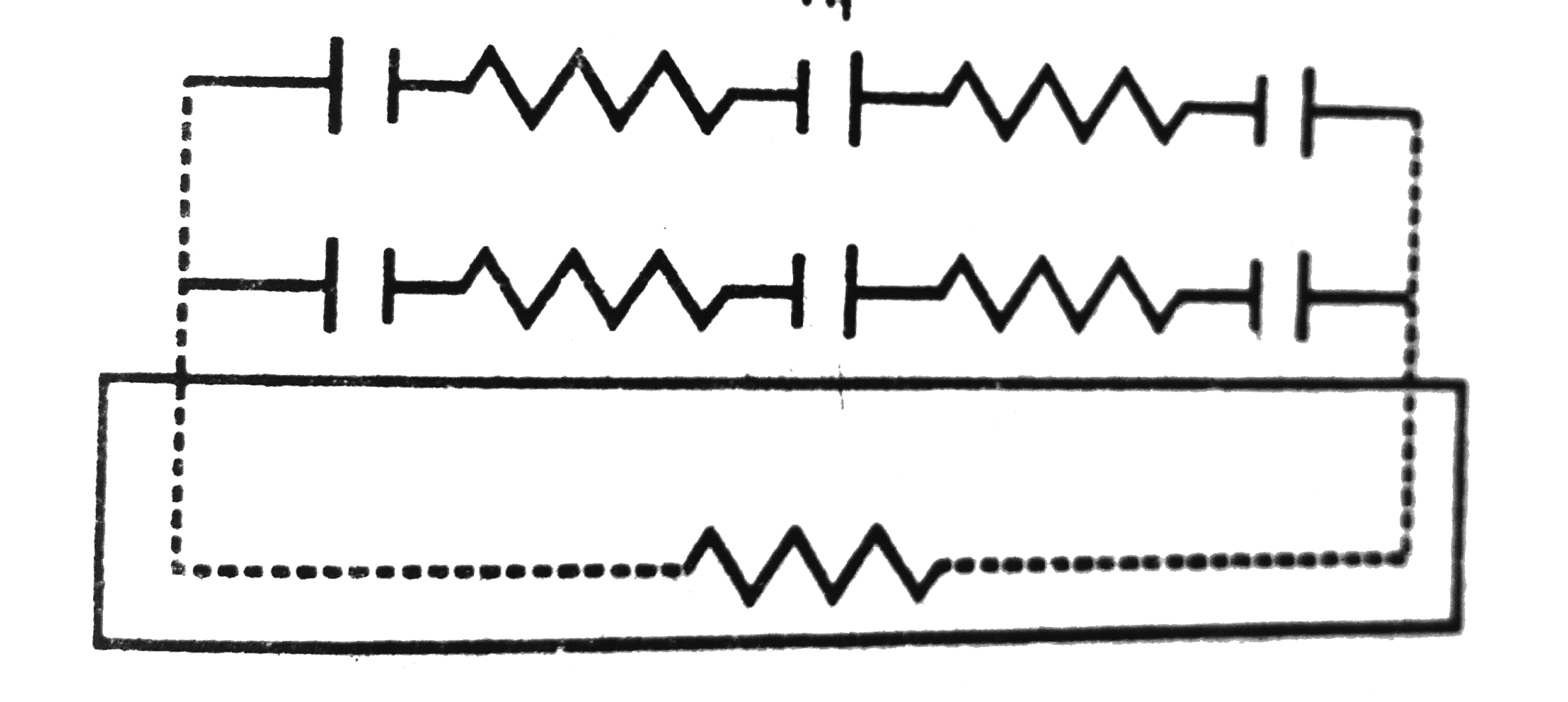
Total e.m.f. = ` n_1` E in one row
Total e.m.f. in all rows = `n_1 E`
Total resistance in one row = `n_1`r/`n_2`
Net resistance = `R+ (n_1)r/(n_2)`
` So, Current = R + ((n_1)r/n_2)`
` (b) L = ((n_1)(n_2)E/ n_2 R + n_2 r)`
For, L = max
` (n_1)r + (n_2)R = minimum `
` rArr ((sqrt (n_1)r)- (sqrt(n_2)R))^2 + 2((sqrt(n_1)R(n_2)R)) = min. `
It is minimum when,
` (sqrt(n_1)r) = (sqrt(n_2)R) `
` n_1r = n_2R`
L is maximum when,
` n_1r = n_2R` .
Promotional Banner

Topper's Solved these Questions

  • ELECTRIC CURRENT IN CONDUCTORS

    HC VERMA|Exercise objective 2|9 Videos
  • DISPERSION AND SPECTRA

    HC VERMA|Exercise Exercises|11 Videos
  • ELECTRIC CURRENT THROUGH GASES

    HC VERMA|Exercise Exercise|23 Videos

Similar Questions

Explore conceptually related problems

When n resistors of equal resistance (R ) are connected in series, the effective resistance is …………… .

Two cells of emf E_1 and E_2 are joined in opposition (such that E_1>E_2 ). If r_1 and r_2 be the internal resistances and R be the external resistance, then the terminal potential difference is:

When 'n' resistors of requal resistance (R) are connected in series and in parallel resectively, then the ratio of their effective resistance is

When 'n' number of resistors of equal resistance R connected in series, the equivalent resistance is R_(p)=(R )/(n)

n resistances, each of r Omega , when connected in parallel give an equivalent resistance of R Omega . If these resistances were connected in series, the combination would have a resistance in homs equal to

Prove that combinatorial argument that ""^(n+1)C_r=^n C_r+^n C_(r-1)""

HC VERMA-ELECTRIC CURRENT IN CONDUCTORS-Exercises
  1. The internal resistance of an accumulator battery of emf 6V is 10(Omeg...

    Text Solution

    |

  2. Find the value of i(1)/I(2)in figure if where R=10Omega

    Text Solution

    |

  3. Consider N=n(1)n(2)indentical cells, each of emf(epsilon) and internal...

    Text Solution

    |

  4. A battery of emf 100V and a resistor of resistance 10k(Omega)are joine...

    Text Solution

    |

  5. If the reading of ammeter A(1)in figure is 2.4 A, what will the ammete...

    Text Solution

    |

  6. The resistance of the rheostat shown in figure is 30(Omega). Neglectin...

    Text Solution

    |

  7. Three bulbs,each having a resistance of 180(Omega)are connected in par...

    Text Solution

    |

  8. Suppose you have three resistor of (20 Omega),(50 Omega)and (100 Omega...

    Text Solution

    |

  9. A bulb is made using two filaments.A switch selects whether the filame...

    Text Solution

    |

  10. 100A exists in the 5k(Omega) resistor, find the currents in the other ...

    Text Solution

    |

  11. An ideal battery sends a current of 5A in a resistor. When another res...

    Text Solution

    |

  12. Find the equivalent resistances of the network shown in figurebetween ...

    Text Solution

    |

  13. A wire of resistance 15.0(Omega)is bent to form a regular hexagon ABCD...

    Text Solution

    |

  14. Consider the circuit shown in figure.Find the current through the10(Om...

    Text Solution

    |

  15. Find the currents through the three resistors shown in Figure

    Text Solution

    |

  16. Shown a part of an electric circuit, The potentials at the points a,b,...

    Text Solution

    |

  17. Each of the resistors shown in figure has a resistances of 10(Omega)an...

    Text Solution

    |

  18. Find the potential difference V(a)-V(b)in the circutis shown in figure

    Text Solution

    |

  19. In the circuit shown in figure ,(epsilon)(1)=3V,(epsilon)(2)=2V,(epsil...

    Text Solution

    |

  20. Find the current through the 10(Omega)resistor shown in figure.

    Text Solution

    |

