Home
Class 12
PHYSICS
The collector plate in an experiment on ...

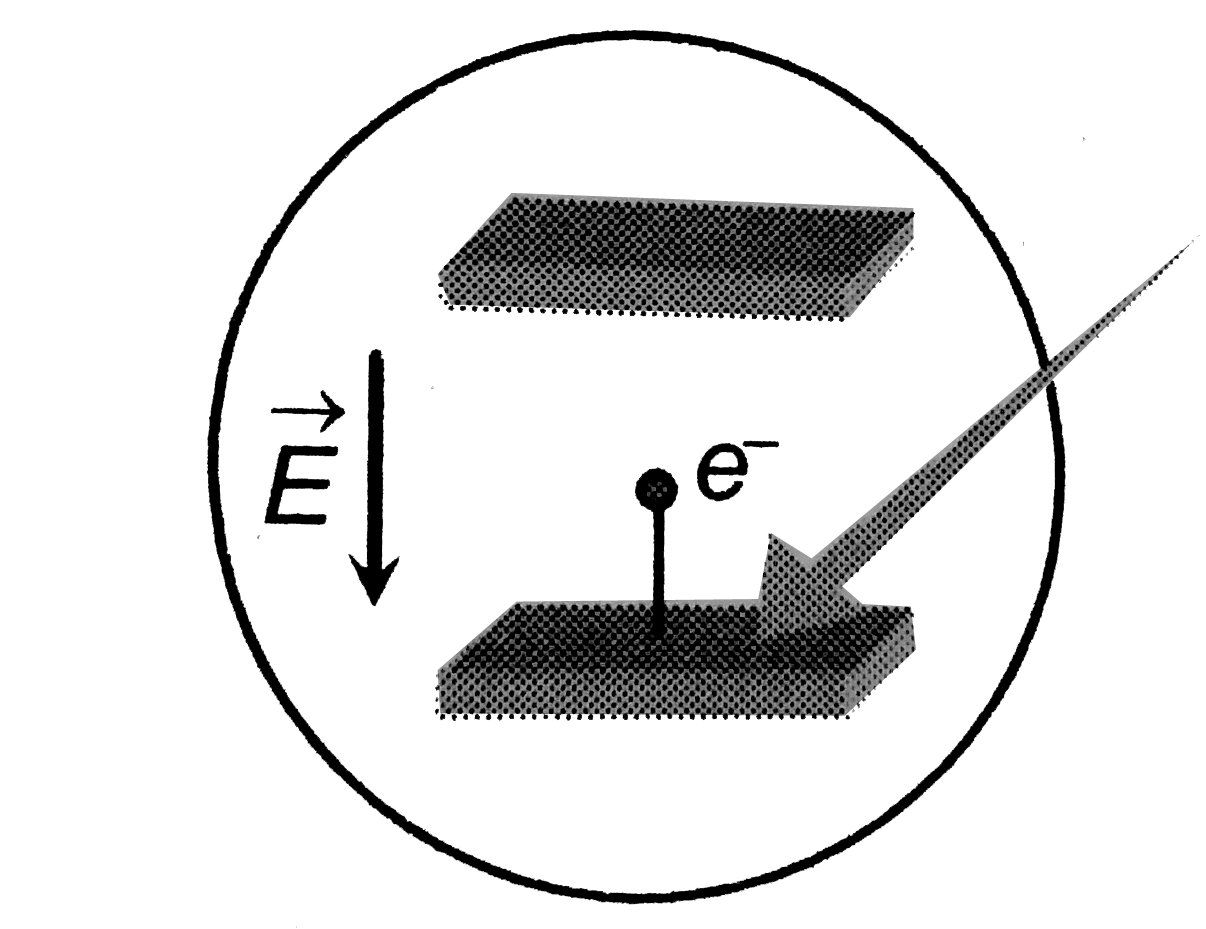
The collector plate in an experiment on photoelectric effect is kept vertically above the emitter plate . Light source is put on and a saturation photo current is recorded . An electric field is switched on which has a vertically downward direction . Then

A

The photocurrent will increased

B

The kinetic energy of the electrons will increase.

C

The stopping potential will decrease.

D

The threshold wavelength will increase.

Text Solution

Verified by Experts

The correct Answer is:

A
Promotional Banner

Topper's Solved these Questions

  • PHOTO ELECTRIC EFFECT AND WAVE PARTICLE DUALITY

    HC VERMA|Exercise Exercise|35 Videos
  • PHOTO ELECTRIC EFFECT AND WAVE PARTICLE DUALITY

    HC VERMA|Exercise objective I|14 Videos
  • PERMANENT MAGNETS

    HC VERMA|Exercise Exercise|25 Videos
  • PHOTOMETRY

    HC VERMA|Exercise All Questions|44 Videos

Similar Questions

Explore conceptually related problems

A point source causes photoelectric effect from a small metal plate. Which of the curves in Fig. may represent the saturation photo-current as a function of the distance between the source and the metal?

In an experiment on photoelectric effect, the emitter and the collector plates are placed at a separation of 10cm and are connected through an ammeter without any cell. A magnetic field B exists parallel to the plates. The work function of the emitter is 2.39 e V and the light incident on it has wavelengths between 400nm and 600nm. Find the minimum value of B for which the current registered by the ammeter is zero. Neglect any effect of space charge.

In an experiment on photoelectric effect light of wavelength 400 nm is incident on a metal plate at rate of 5W. The potential of the collector plate is made sufficiently positive with respect to emitter so that the current reaches the saturation value. Assuming that on the average one out of every 10^6 photons is able to eject a photoelectron, find the photocurrent in the circuit.

A 100 turn closely wound circular coil of radius 10 cm carries a current of 3.2 A. a. What is the field at the centre of the coil ? b. What is the magnetic moment of this coil ? The coil is placed in a vertical plane and is free to rotate about a horizontal axis which coincides with its diameter. A unifrom magnetic field of 2 T in the horizontal direction exists such that initially the axis of the coil is in the direction of the field. The coil rotates through an angle of 90^@ under the influence of the magnetic field . c. What are the magnitudes of the torques on the coil in the initial and final position ? d. What is the angular speed acqired by the coil when it has rotated by 90^(@) ? The moment of inertia of the coil is 0.1 kg m^2

a. The top of the atmosphere is at about 400 kV with respectto the surface of the earth, corresponding to an electric field that decreases with altitude. Near the surface of the earth, the field is about 100 Vm^(-1). Why then do we not get a electric shock as we step out of our house into the openy (Assume the house to be a steel cage so there is no field inside!) b. A man fixes outside his house one evening a two metre high insulating slab carrying on its top a large aluminium sheet of area 1m^(2) . Will he get an electric shock if he touches the metal sheet next morning? c. The discharging current in the atmosphere due to the small conductivity of air is known to be 1800A on an average over the globe. Why then does the atmosphere not discharge itself completely in due course and become electrically neutral? In other words, what keeps the atmosphere charged? d. What are the forms of energy into which the electrical energy of the atmosphere is dissipated during a lightning? (Hint: The earth has an electric field of about 100 Vm^(-1) at its surface in the downward direction, corresponding to a surface charge density =-10^(-9) Cm^(-2) ?.

In a photoelectric experiment, the collector plate is at 2.0 V with respect to the emitter plate made of copper phi = 4.5 . The emitter is illuminated by a source of monochromatic light of wavelength 200nm. Find the minimum and maximum kinetic energy of the photoelectrons reaching the collector.

A conducting wire ab of length l, resistance r and mass m starts sliding at t = 0 down a smooth, vertical, thick pair of connected rails as shown in . A uniform magnetic field B exists in the space in a diraction perpendicular to the plane of the rails. (a) Write the induced emf in the loop at an instant t when the speed of the wire is v. (b) what would be the magnitude and direction of the induced current in the wire? (c) Find the downward acceleration of the wire at this instant. (d) After sufficient time, the wire starts moving with a constant velocity. Find this velocity v_m. (e) Find the velocity of the wire as a function of time. (f) Find the displacement of the wire as a functong of time. (g) Show that the rate of heat developed inte wire is equal to the rate at which the gravitational potential energy is decreased after steady state is reached.

A metallic rod of linear density is 0.25 kg m^(-1) is lylong horizontally on a smooth inclined plane which makes an angle of 45^(@) with the horizontal. The rod is not allowed to slide down by flowing a current through it when a magnetic field of strength 0.25 T is acting on it in the vertical direction. Calculates the electric current flowing in the rod to keep it stationary .
