Home
Class 12
PHYSICS
A totally reflecting, small plane mirror...

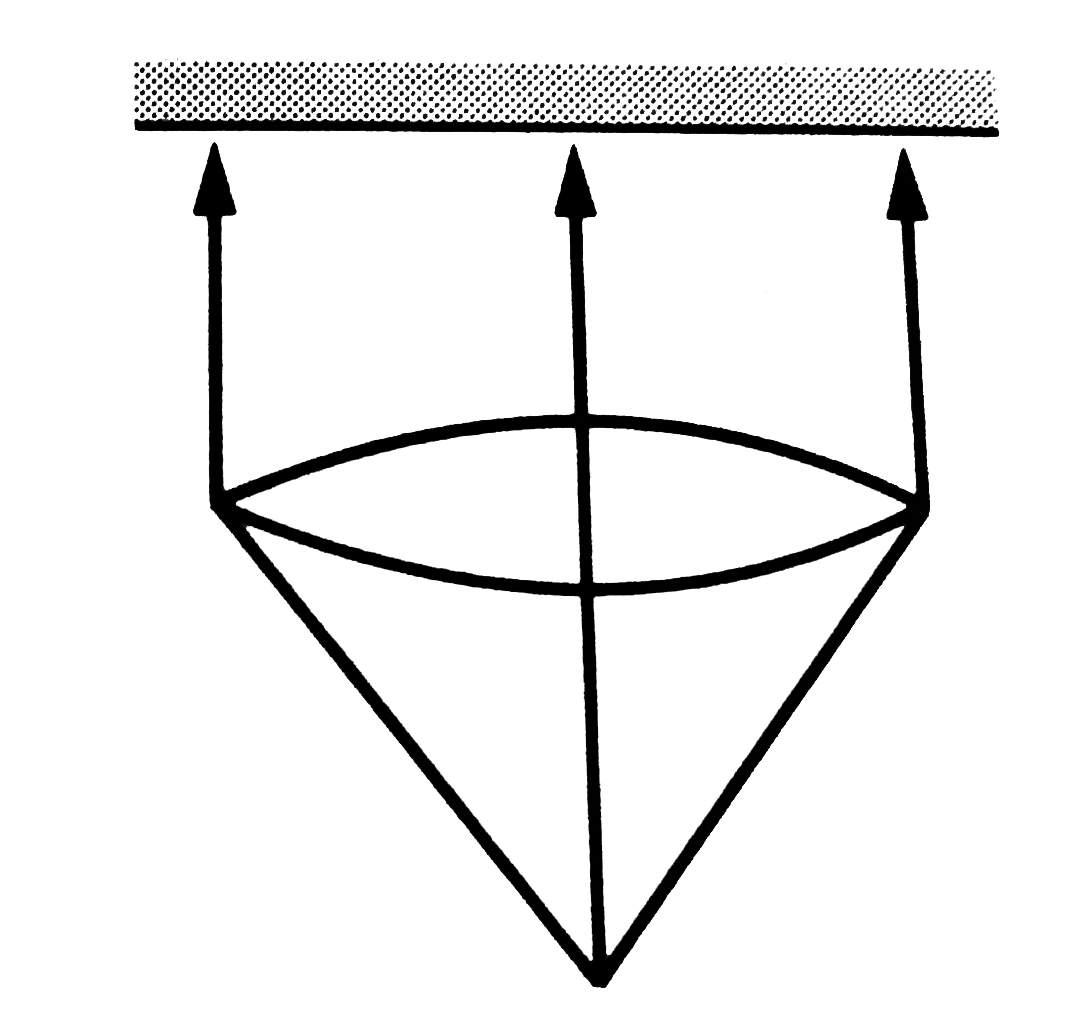
A totally reflecting, small plane mirror placed horizontally faces a parallel beam of lighy as shown in figure. The mass of the mirror is 20g. Assume that there is no absorption in the lens and that 30% of the light emitted by the source goes through the lens. Find the power of the source needed to support the weight of the mirror. Take ` g= 10 m s^-2. `

Text Solution

Verified by Experts

Here `m = 20 g = 20 xx 10^(-3) kg `
The weight of the mirror is balanced. So, force exerted by the photons is equal to weight .
` P = h / lambda and E=(hc)/(lambda) = Pc`
`implies E/t = (P)/(t)c`
`implies `Rate of change of momentum
= power//c`
`30%` of light passes through the lens.
Thus it exerts force, `70%` is reflected
`:. Force exerted - 2
(rate of change of momentum)
`= 2xxPower//c`
`30%((2xxPower)/(theta)) =mg`
`implies Power = (20 xx 10^(-3)xx10xx3xx10^(3)xx10)/(2 xx 3)`
`=10 W power = 100 MW`.
Promotional Banner

Topper's Solved these Questions

  • PHOTO ELECTRIC EFFECT AND WAVE PARTICLE DUALITY

    HC VERMA|Exercise objective II|7 Videos
  • PERMANENT MAGNETS

    HC VERMA|Exercise Exercise|25 Videos
  • PHOTOMETRY

    HC VERMA|Exercise All Questions|44 Videos

Similar Questions

Explore conceptually related problems

The friction coefficient between the horizontal surfce and ech of the blocks shown in figure is 0.20. The collision between the blocks is perfectly elastic. Find the separation between the two blocks when they come to rest. Take g=10 m/s^2 .

A converging mirror M_1 a point source S and a diverging mirror M_2 are arranged as shown in figure. The source is placed at a distance of 30 cm from M_1 . The focal length of each of the mirrors is 20 cm. Consider only the images formed by a maximum of two reflections. It is found that one image is formed on the source itself. (a) Find the distance between the two mirrors. (b) Find the location of the image formed by the single reflection from M_2

Figure shows a small diffused plane source S placed over a horizontal table-top at a distance of 2.4 m with its plane parallel to the table-top. The illuminance at the point A directly below the source is 25 lux. Find the illuminance at a point B of the table at a distance of 1.8 m from A.

Consider the stituation shown in figure. The elevator is going up with an acceleration of 2.00 ms^-2 and the focal length of the mirror is 12.0 cm. All the surfaces are smooth and the pulley is light. The mass-pulley system is released from rest (with respect to the elevator) at t=0 when the distance of B from the mirror is 42.0 cm. Find the distance between the image of the block B and the mirror at t=0.200 s. Take g=10 ms^-2

A small source of sound S of frequency 500 Hz is attached to the end of a light string and is whirled in a vertical circle of radius 1.6 in. The string just remains tight when the source is at the highest point. (a) An observer is located in the same vertical plane at a large distance and at the same height as the centre of the circle. The speed of sound in air = 330 m s^-1 and g = 10ms^-2 . Find the maximum frequency heard by the observer. (b) An observer is situated at a large distance vertically above the centre of the circle. Find the frequencies heard by the observer corresponding to the sound emitted by the source When it is at the same height as the centre. ltbr.

Figure shows a spring fixed at the bottom end of an incline of inclination 37^0 . A small block of mass 2 kg starts slipping down the incline from a point 4.8 m away from the spring. The block compresses the spring by 20 cm, stops momentarily and then rebounds through a distance of 1 m up the incline. Find a. the frictioin coefficient between the plane and the block and b. the spring constant of the spring. Take g=10 m/s^2 .

Figure shows as rod of length 20 cm pivoted near an end and which is made to rotate in a horizontal plane with a constant angular speed. A ball ofmass m is spuspended by a string angular also of length 20 cm from the other end of the rod. If the angle theta made by the stirng with the vertical is 30^0 . find the anglular speed of the rotation. Take g=10 m/s^2

Figure shows two block A and B , each having a mass of 320 g connected by a light string passing over a smooth light pulley. The horizontal surface on which the block A can slide is smooth. The block A is attached to spring constant 40 N//m whose other end is fixed to a support 40 cm above the horizontal surface. Initially, the spring is vertical and unstretched when the system is released to move. Find the velocity of the block A at the instant it breaks off the surface below it. Take g = 10 m//s^(2) .

Figure shows water in a container having 2.0-mm thick walls made of a material of thermal conductivity 0.50Wm^(-1)C^(-1) . The container is kept in a melting-ice bath at 0^(@)C . The total surface area in contact with water is 0.05m^(2) . A wheel is clamped inside the water and is coupled to a block of mass M as shown in the figure. As the goes down, the wheel rotates. It is found that after some time a steady state is reached in which the block goes down with a constant speed of 10cms^(-1) and the temperature of the water remains constant at 1.0^(@)C .Find the mass M of the block. Assume that the heat flow out of the water only through the walls in contact. Take g=10ms^(-2) .

Consider the situation shown in figure. Light from a point source S is made parallel by a convex lens L. The beam travels horizontally and falls on an 88^@-88^@-4^@ prism as shown in figure. It passes through the prism symmetrically. The transmitted light falls on a vertical mirror. Through what angle should the mirror be rotated so that an image of S is formed on S itself?

HC VERMA-PHOTO ELECTRIC EFFECT AND WAVE PARTICLE DUALITY-Exercise
  1. A parallel beam of monochromatic light of wavelength 663 nm is incide...

    Text Solution

    |

  2. A beam of white light is incident normally on a plane surface absorbin...

    Text Solution

    |

  3. A totally reflecting, small plane mirror placed horizontally faces a p...

    Text Solution

    |

  4. A 100 W light bulb is placed at the centre of a spherical chamber of r...

    Text Solution

    |

  5. A sphere of radius 1.00 cm is placed in the path of a parallel beam of...

    Text Solution

    |

  6. Consider the situation described in the previous problem. Show that th...

    Text Solution

    |

  7. It is not possible for a photon to be completely absorbed by a free el...

    Text Solution

    |

  8. Two neutral particles are kept 1m apart. Suppose by some mechanism som...

    Text Solution

    |

  9. Find the maximum kinetic energy of the photoelectrons ejected when lig...

    Text Solution

    |

  10. The work function of a metal is 2.5 xx 10^-19 J. (a) Find the thresho...

    Text Solution

    |

  11. The work function of a photoelectric material is 4.0 e V. (a) What i...

    Text Solution

    |

  12. Find the maximum magnitude of the linear momentum of a photoelectron e...

    Text Solution

    |

  13. When a metal plate is exposed to a monochromatic beam of light of wave...

    Text Solution

    |

  14. In an experiment on photoelectric effect, the stopping potential is me...

    Text Solution

    |

  15. The electric field associated with a monochromatic beam of light becom...

    Text Solution

    |

  16. The electric field associated with a light wave is given by E= E0 sin...

    Text Solution

    |

  17. The electric field at a point associated with a light wave is E=100Vm^...

    Text Solution

    |

  18. A monochromatic light source of power 5mW emits 8 xx 10^(15) photons p...

    Text Solution

    |

  19. Figure is the plot of the stopping potential versus the frequency of t...

    Text Solution

    |

  20. A photographic film is coated with a silver bromide layer. When light ...

    Text Solution

    |
