Home
Class 12
MATHS
Roots of equation x^(2)-2x+1=0 are:...

Roots of equation `x^(2)-2x+1=0` are:

A

not real

B

distinct

C

equal

D

zero

Text Solution

Verified by Experts

Let `f(X)=x^(2)-mx+1` as both roots of `f(x)=0` are less than 1 we can take `Dge0, af(1)ge0` and `-b/(2a)lt1`
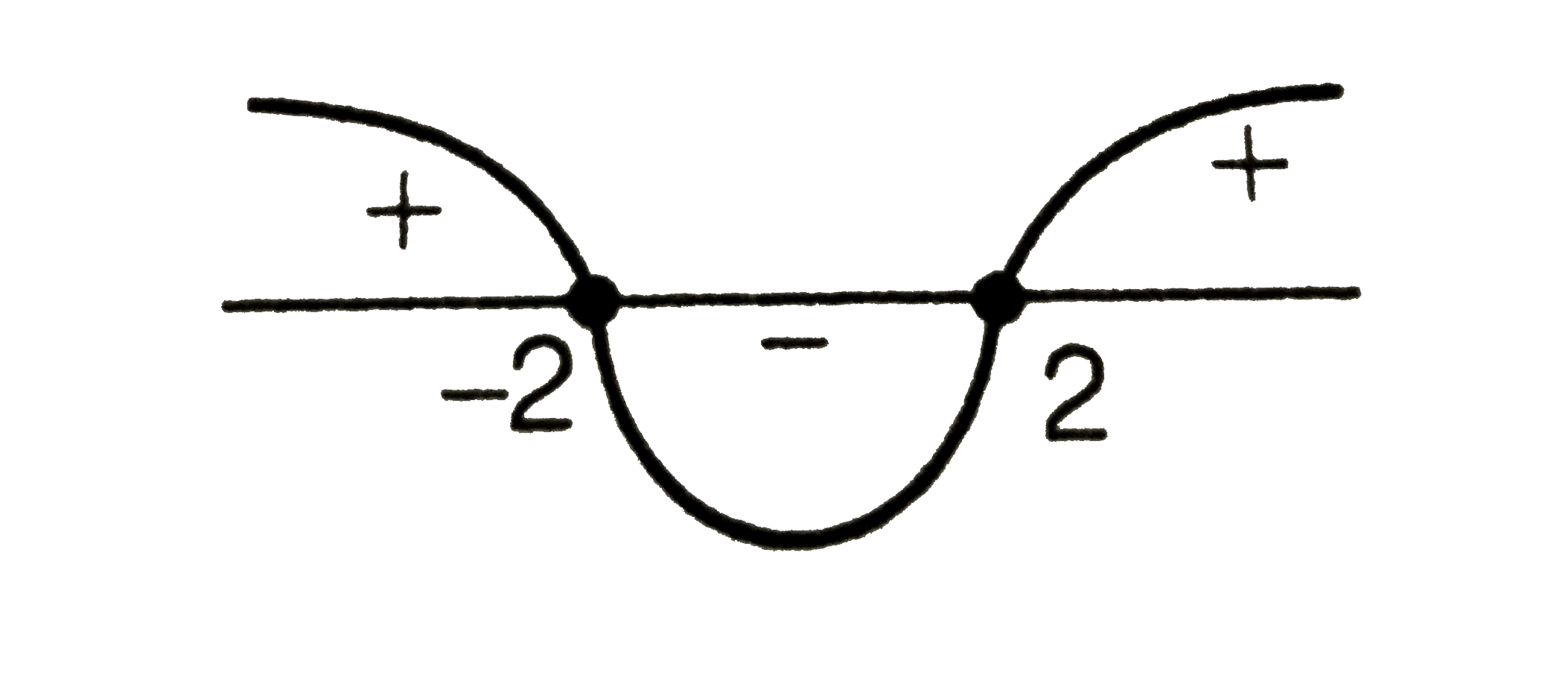
ltBrgt (i) Consider `Dge0(-m)^(2)-4.1.4ge0`

`implies(m+2)(m-2)ge0`
`impliesm epsilon (-oo,-2[uu[2,oo)`…......i
(ii) Consider af `(1) gt01(1-m+1)gt0`
`impliesm-2lt0impliesmlt2`
`impliesm epsilon (-oo,2)` .......ii
(iii) Consider `(-b/(2a)lt1)`
`m/2lt1impliesmlt2`
`impliesm epsilon (-oo,2)`........iii
Hence the values of `m` satisfying Eqs. (i), (ii) and (iii) at the same time are `m epsilon (-oo,-2]`
Promotional Banner

Similar Questions

Explore conceptually related problems

Roots of the equation x^(2) -2x+ 1 =0 are :

If m and n are roots of equations 2x^(2) - 6x +1=0 , then the value of m^(2) n+ mn ^(2) is:

Form the quadratic equations whose roots are the squares of the roots of the equation x^(2) -2x+ 4 =0

Let x_(1), x_(2) be the roots of the equation x^(2)-3 x+p=0 and let x_(3), x_(4) be the roots of the equation x^(2)-12 x+q=0 . If the numbers x_(1), x_(2) x_(3), x_(4) (in order) form an increasing G.P. then,

If alpha and beta are the root of the equation x^(2)-x+1=0 then alpha^(2009)+beta^(2009)=

Let alpha,beta be the roots of the equation x^(2)-px+r=0 and (alpha)/(2),2beta be the roots of the equation x^(2)-qx+r=0 then the value of r is

If cos^(4)theta+p, sin^(4)theta+p are the roots of the equation x^(2)+a(2x+1)=0 and cos^(2)theta+q,sin^(2)theta+q are the roots of the equation x^(2)+4x+2=0 then a is equal to

If the ratio of the roots of the equation a x^(2)+b x+c=0 is equal to the ratio of the roots of the equation x^(2)+x+1=0 , then a, b , c are in

If alpha, beta are the roots of the equation x^(2)+x+1=0 , then the equation whose roots are (alpha)/(beta) and (beta)/(alpha) is

If both roots of the equation x^(2)-2 a x+a^(2)-1= 0 lie between -2 and 2, then [a] can be