Home
Class 12
MATHS
ax^2 + bx + c = 0(a > 0), has two roots ...

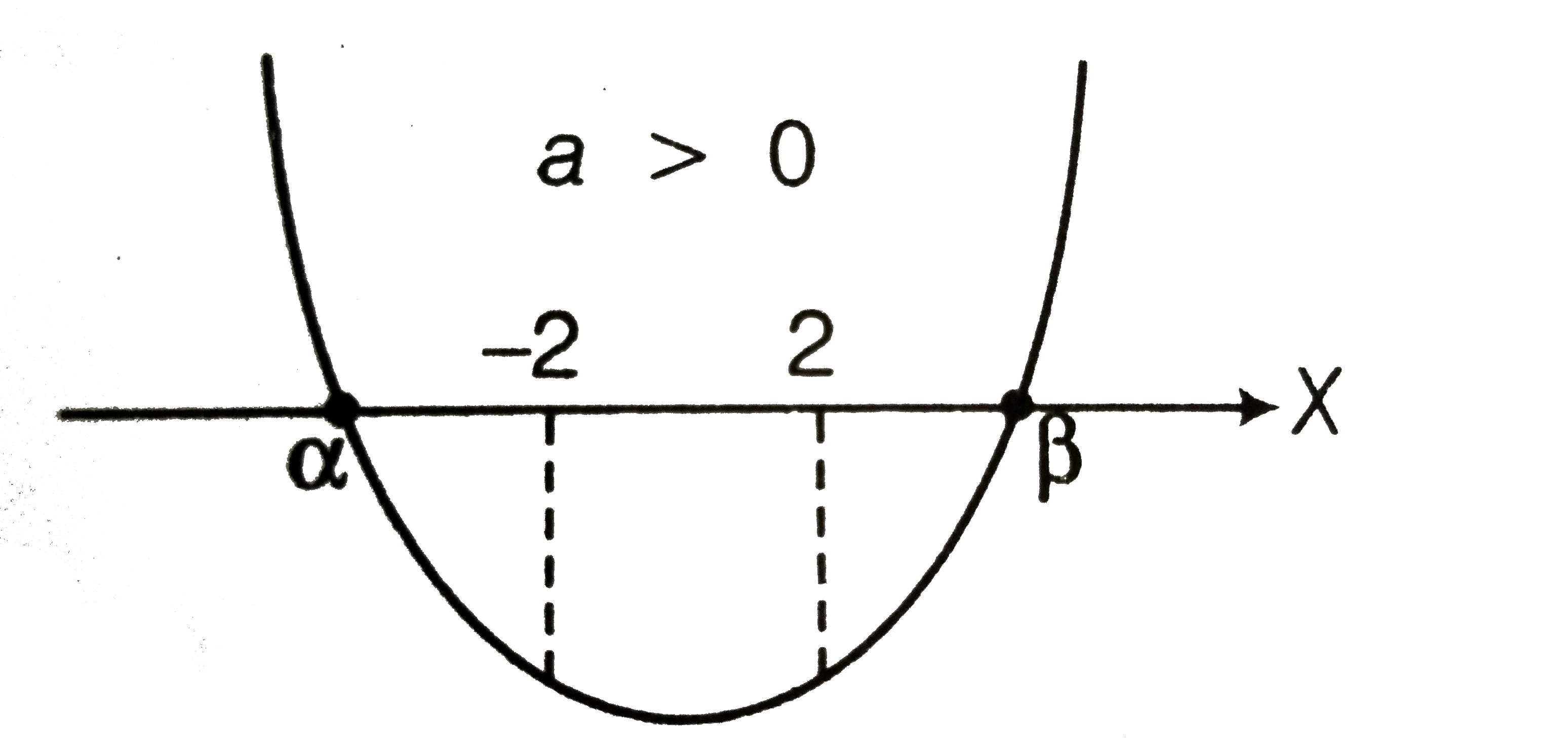
`ax^2 + bx + c = 0(a > 0),` has two roots `alpha and beta` such `alpha < -2 and beta > 2,` then

A

`4a-2|b|+clt0`

B

`9a-3|b|+clt0`

C

`a-|b|+clt0`

D

`clt0,b^(2)-4acgt0`

Text Solution

Verified by Experts

The correct Answer is:
A, C, D

Here `D gt 0`

`b^(2)-4acgt0`
or `b^(2)gt4ac`…… i and `f(0)lt0`
`impliesclt0`..ii
`f(1)lt0`
`impliesa+b+clt0`………iii
`f(-1)lt0`
`impliesa-b+clt0`………..iv
`f(2)lt0`
`implies4a+2b+clt0`………v
`f(-2)lt0`
`implies4a-2b+clt0`...............vi
From Eqs i and ii we get
`clt0,b^(2)-4acgt0`
From Eqs. (iii) and (iv) we get
`a-|b|+clt0`
and from Eqs (v) and (vi) we get
`4a-2|b|+clt0`
Promotional Banner

Similar Questions

Explore conceptually related problems

Let a, b, c be real. If a x^(2)+b x+c=0 has two real roots alpha and beta such that alpha lt -1 and beta gt 1 , then 1+(c)/(a)+|(b)/(a)| is

If alpha, beta be the roots of 4x^(2) - 16x + c = 0, c in R such that 1 lt alpha lt 2 and 2 lt beta lt 3 , then the number of integral values of c is

Given that alpha , gamma are roots of the equation Ax^(2) - 4x + 1 = 0 , and beta, delta 1 the equation of Bx^(2) - 6x + 1 = 0 , such that alpha , beta, gamma and delta are in H.P., then

If alpha and beta be the roots of the equation x^(2) + 7x + 12 = 0 . Then equation whose roots are (alpha + beta)^(2) and (alpha - beta)^(2) is :

Suppose alpha, beta are roots of ax^(2)+bx+c=0 and gamma, delta are roots of Ax^(2)+Bx+C=0 . If a,b,c are in GP as well as alpha,beta, gamma, delta , then A,B,C are in:

If the roots of the equation (x^(2) -bx)/(ax - c) = (lambda - 1)/(lambda + 1) are such that alpha + beta =0 , then the value of lambda is :

If alpha, beta are the roots of ax^(2) - 26x + c = 0 , then alpha^(3) beta^(3) + alpha^(2) beta^(3) + alpha^(3) beta^(2) equals :

If alpha, beta are the roots of a x^(2)+b x+c=0 the equation whose roots are alpha+(1)/(beta) and beta+(1)/(alpha) is

Let a, b,c in R and a ne 0. If alpha is a root of a^(2) x^(2) + bx + c = 0 , beta is a root of a^(2) x^(2) - bx - x = 0 and 0 lt alpha lt beta . Then the equation a^(2) x^(2) + 2 bx + 2c = 0 has a root gamma that always satisfies :

