Home
Class 12
MATHS
Suppose the cubic x^(3)-px+q has three d...

Suppose the cubic `x^(3)-px+q` has three distinct real roots, where `p gt 0` and `q gt 0`. Then which one of the following holds ?

A

a) The cubic has minima at `(-sqrt(p/3))` and maxima at `sqrt(p/3)`

B

The cubic has minima at both `sqrt(p/3)` and `(-sqrt(p/3))`

C

The cubic has maxima at both `sqrt(p/3)` and `(-sqrt(p/3))`

D

The cubic has minima at `sqrt(p/3)` and maxima at `(-sqrt(p/3))`

Text Solution

Verified by Experts

The correct Answer is:
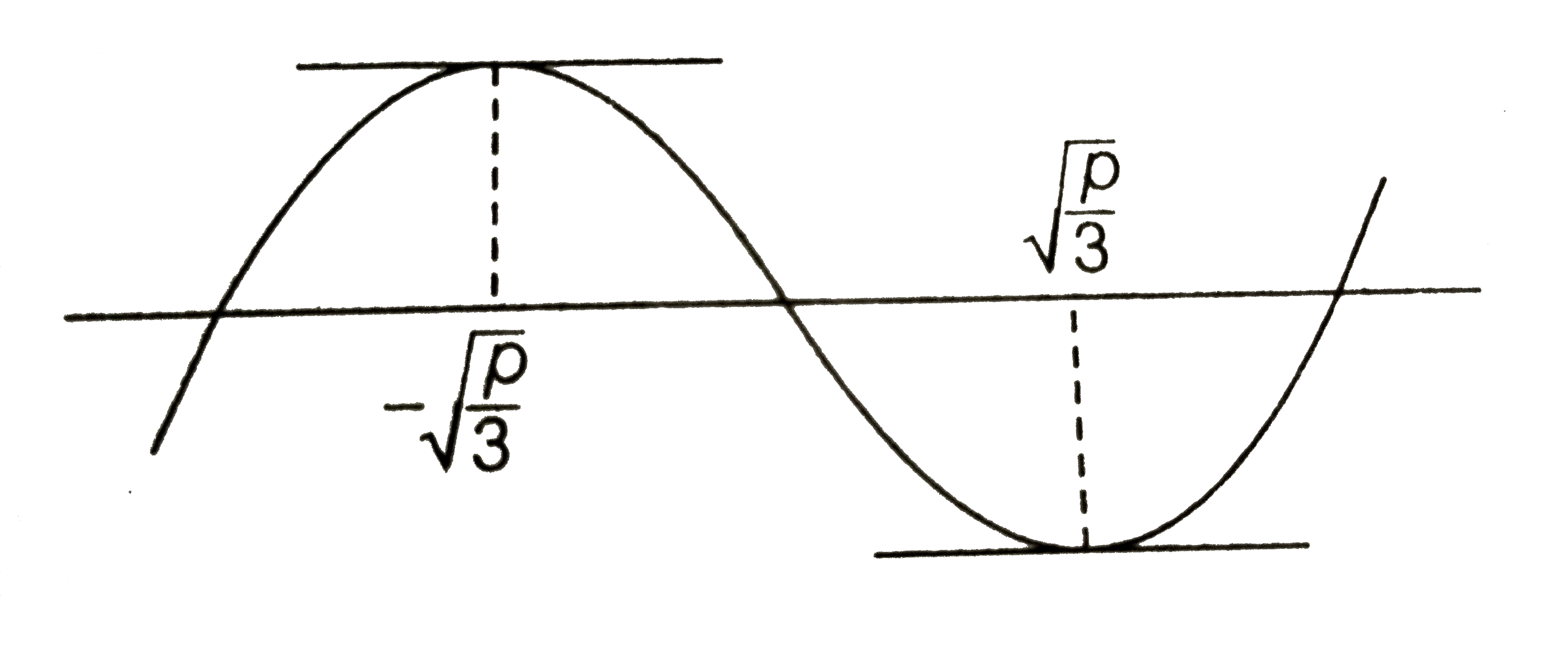
C

Let `f(x)=x^(3)-px+q`
`:.f'(x)=3x^(2)-p`
`impliesf''(x)=6x`

For maxima or minima `f'(x)=0`
`:.x=+-sqrt(p/3)`
`impliesf''(sqrt(p/3))=6sqrt((p/3))gt0`
and `f''(-sqrt(p/3)=-6sqrt(p/3)lt0`
Hence given cubic minima at `x=sqrt(p/3)` and maxima at `x=-sqrt(p/3)`
Promotional Banner

Similar Questions

Explore conceptually related problems

If x^(2)-p x+q=0 has equal integral roots, then

x and b are real numbers. If b gt 0 and |x| gt b , then

Consider the equation of the parabola y^(2)+4ax=0 where a gt0 which of the following is false

The equation (cosp - 1)x^(2) + (cosp)x + sinp = 0 , where x is a variable, has real roots. Then the interval of p may be any one of the following :

If the equation x^(4)+px^(3)+qx^(2)+rx+5=0 has four positive real roots, find the maximum value of pr .

The real number k for which the equation : 2x^(3)+3x+k=0 has two distinct real roots in [0, 1] :

If f(x) is a cubic polynomial x^3 + ax^2+ bx + c such that f(x)=0 has three distinct integral roots and f(g(x)) = 0 does not have real roots, where g(x) = x^2 + 2x - 5, the minimum value of a + b + c is

Let a in R and f : R rarr R be given by f(x)=x^(5)-5x+a , then (a) f(x)=0 has three real roots if a gt 4 (b) f(x)=0 has only one real root if a gt 4 (c) f(x)=0 has three real roots if a lt -4 (d) f(x)=0 has three real roots if -4 lt a lt 4

If the equation x^(2)-2px+q=0 has two equal roots, then the equation (1+y)x^(2)-2(p+y)x+(q+y)=0 will have its roots real and distinct only, when y is negative and p is not unity.

