Home
Class 12
MATHS
There are 2n guests at a dinner party...

There are `2n` guests at a dinner party. Supposing that eh master and mistress of the house have fixed seats opposite one another and that there are two specified guests who must not be placed next to one another, show that the number of ways in which the company can be placed is `(2n-2!)xx(4n^2-6n+4)dot`

Text Solution

Verified by Experts
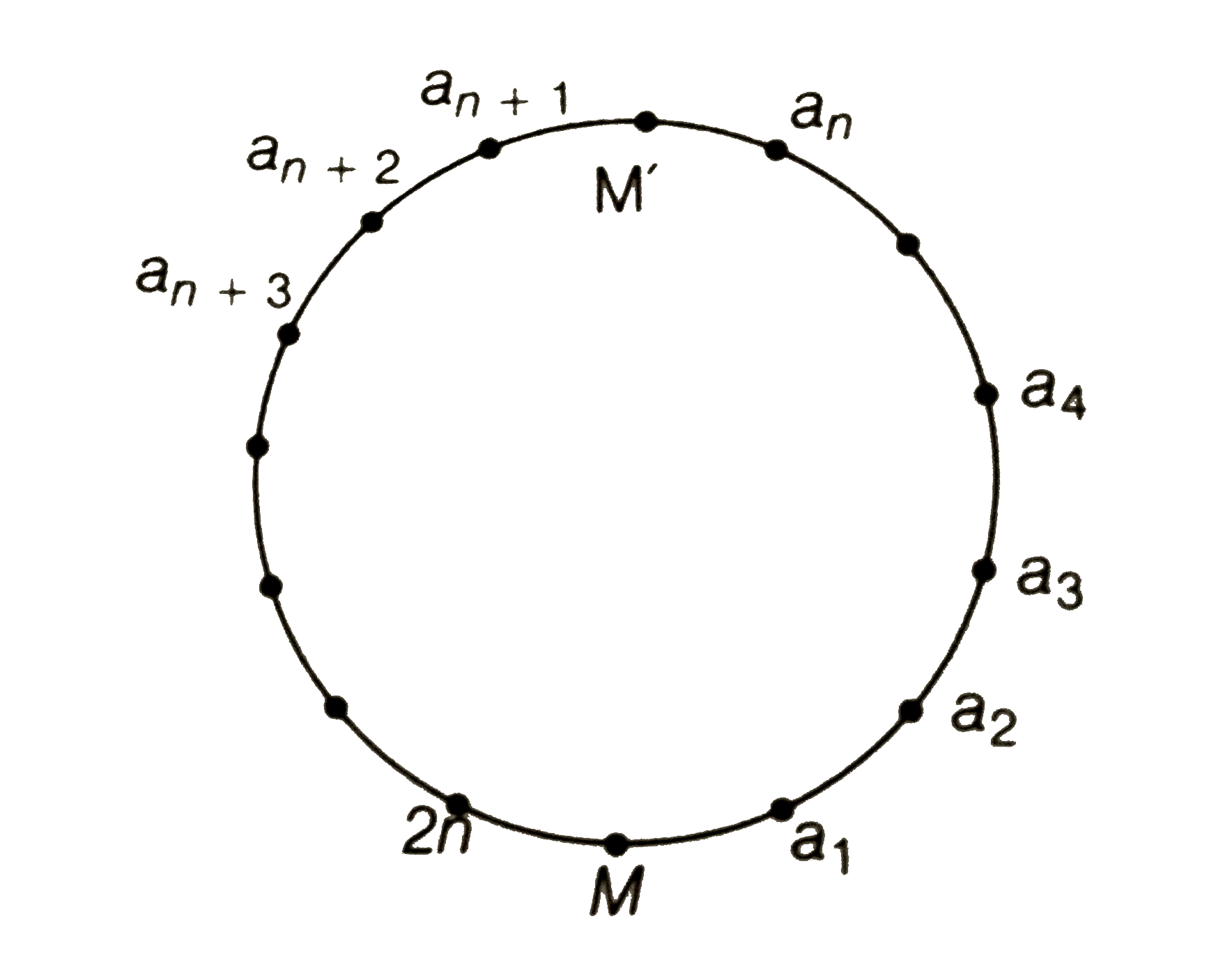
Let the M and `M^(')` represent seats of the master and mistress respectively annd let `a_(1),a_(2),a_(3), . .,a_(2n)` represent the 2n seats.

Let the guests who must not be placed next to one another be called P and Q.
Now, put P at `a_(1)` and Q at any position, other than `a_(2)`, say at remaining (2n-2) positions in (2n-2)! ways. hence, there will be altogether (2n-2)(2n-2)! arrangments of the guests, when P is at `a_(1)`.
the same number of arrangements when P is at `a_(n)` or `a_(n+1)` or `a_(2n)`. thus, for these positions `(a_(1),a_(n),a_(n+1),a_(2n))` or P, there are altogether `4(2n-2)(2n-2)!` ways.
If P is at `a_(2)`, then there are altogether `(2n-3)` positions for Q. hence, there will be altogether `(2n-3)(2n-2)!`
arrangements of the guests, when P is at `a_(2)`.
the same number of arrangements can be made when P is at any other position exception the four positions.
`a_(1),a_(n),a_(n+1),a_(2n)`.
Hence, for these (2n-4) positions of P, there will be altogether
`(2n-4)(2n-3)(2n-2)!` arrangements of the guests . . . (ii)
Hence, from Eqs. (i) and (ii), the total number of ways of arranging the guests
`=4(2n-2)(2n-2)!+(2n-4)(2n-3)(2n-2)!`
`=(4n^(2)-6n+4)(2n-2)!`.
Promotional Banner

Similar Questions

Explore conceptually related problems

The total number of ways in which 2n persons can be divided into n couples is

Number of ways in which three numbers in A.P. can be selected from 1,2,3,..., n is

There are 'n' seats round a table numbered 1,2, 3,….,n . The number of ways in which m(le n) persons can take seat is

A student is allowed to select at most n books from a collection of (2n+1) books. If the total number of ways in which he can select the books is 63, then n is :

A coin is tossed 2 n times. The chance that the number of times one gets head is not equal to the number of times one gets tail is

A person is permitted to select at least one and at most n coins from a collection of (2n+1) distinct coins. If the total number of ways in which he can select coins is 255, then find the value of n.

If the geometric mean is (1)/(n) times the harmonic mean between two numbers, then show that the ratio of the two numbers is 1+sqrt(1-n^(2)):1-sqrt(1-n^(2)) .

if 6n tickets numbered 0,1,2,....... 6n-1 are placed in a bag and three are drawn out , show that the chance that the sum of the numbers on then is equal to 6n is (3n)/((6n-1)(6n-2))

Two numbers are chosen from [1,2,3,4,5,6] one after another without replacement . Find the probability that one of the smaller value of two is less than 4 :

Two consecutive numbers from 1,2,3 …., n are removed .The arithmetic mean of the remaining numbers is 105/4 The sum of all numbers

