Home
Class 12
MATHS
Prove the following by the principle of ...

Prove the following by the principle of mathematical induction:`\ 11^(n+2)+12^(2n+1)` is divisible 133 for all `n in Ndot`

Text Solution

Verified by Experts
Let `P(n)=11^(n+2)+12^(2n+1)`
Step I For `n=1`,
`P(1) =11^(1+2)+12^(2xx1+1)=11^(3)+12^3`
`=(11+12)(11^2-11xx12+12^2)`
`=23 xx13` , which is divisible by 133.
Therefore , the result is true for `n=1`.
Step II Assume that the result is true for `n=k`, then
`P(k)=11^(k+2)+12^(2k+1)` is divisible by 133.
`rArr P(k)=133r`, where r is an integer .
Step III For `n=k+1`.
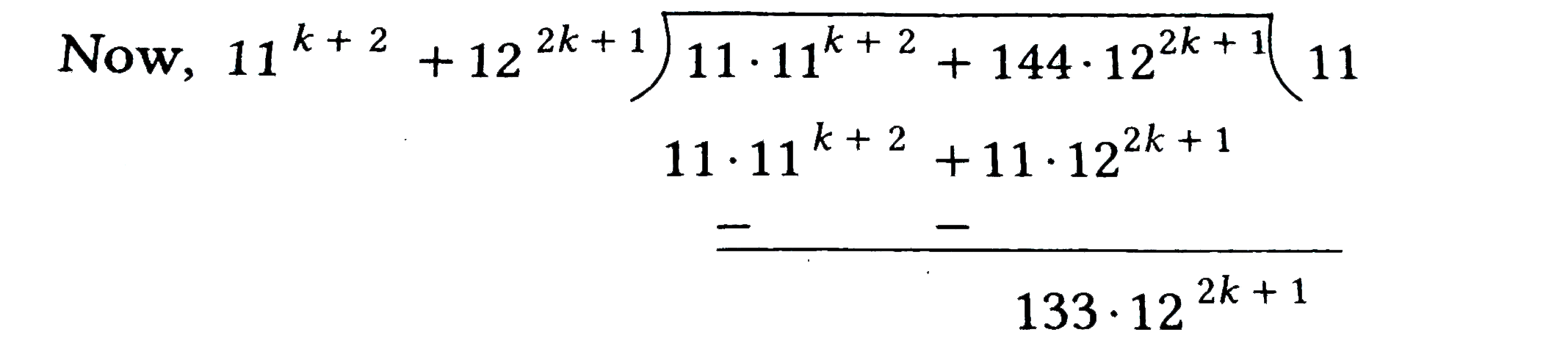
`therefore P(k+1)=11^((k+1)+2)+12^(2(k+1)+1)=11^(k+3)+12^(2k+3)`
`=11^((k+1)+1).11+12^(2k+1).12^2`
`=11.11^(k+2)+144.12^(2k+1)`

`therefore 11.11^((k+2))+144.12^(2k+1)=11(11^(k+2)+12^(2k+1))+133.12^(2k+1)`
i.e., `P(k+1)=11P(k)+133.12^(2k+1)`
But we know that , P(k) is divsible by 133. Also , `133.12^(2k+1)` is divisible by 133.
Hence , `P(k+1)` is divisible by 133. This shows that , the result is true for `n=k+1`.
Hence , by the principle of mathematical induction , the result is true for all . `n in N`.
Promotional Banner

Similar Questions

Explore conceptually related problems

Prove the following by the principle of mathematical induction: \ x^(2n-1)+y^(2n-1) is divisible by x+y for all n in Ndot

Prove the following by the principle of mathematical induction: 1^2+2^2+3^2++n^2=(n(n+1)(2n+1))/6

Prove that by using the principle of mathematical induction for all n in N : 10^(2n-1)+1 is divisible by 11

Prove by mathematical induction that 10^(2n-1)+1 is divisible by 11

Prove by the mathematical induction x^(2n)-y^(2n) is divisible by x+y

Prove that by using the principle of mathematical induction for all n in N : x^(2n)-y^(2n) is divisible by x+y

Prove that by using the principle of mathematical induction for all n in N : 3^(2n+2)-8n-9 is divisible by 8

Prove the following by the principle of mathematical induction: \ 1. 3+2. 4+3. 5++(2n-1)(2n+1)=(n(4n^2+6n-1))/3

Use the principle of mathematical induction to show that 5^(2n+1)+3^(n+2).2^(n-1) divisible by 19 for all natural numbers n.

10^(2n-1)+1 is divisible by 11.

