Home
Class 12
MATHS
Let A = {x: -1lexle1} = B for each of th...

Let `A = {x: -1lexle1} = B` for each of the following functions from `A` to `B`. Find whether it is surjective, injective or bijective
(i) `f(x) = (x)/(2)`
(ii) `g(x) = |x|`

Text Solution

Verified by Experts

The correct Answer is:

B, C

`A={x:-1lexle}`
`B={x:-1lexle}`
(i) `f(x)=(x)/(2)`
Let `x_(1), x_(2) inA`
`therefore f(x_(1))=f(x_(2))implies(x_(1))/(2)=(x_(2))/(2)`
`implies x_(1) = x_(2)`
`therefore` f is one-one function
Now, let `y=(x)/(2)impliesx=2y`
`implies -1leyle1`
`implies -2le2yle2implies-2lexle2`
Let `x in [-1,1]`
`therefore` There are some value of y for which x does not exist. So, f not onto.
(ii) g(x) = |x|
For x=-1, g(-1) = 1
and for x = 1, g(1) = 1
`therefore` f is not one-one function
Let y = |x|, then `y ge 0`
`therefore` f is not onto.
(iii) h(x) = x|x| = `{{:(x^(2),,xge0),(-x^(2),,xlt0):}`

From figure, it is clear tat h is one-one and onto i.e., bijective.
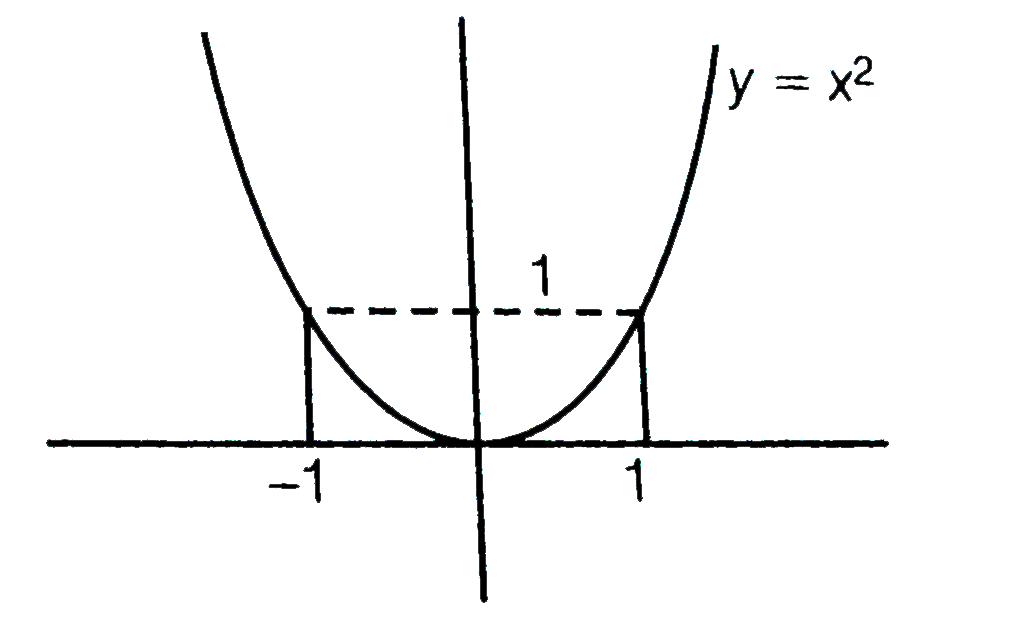
(iv) `k(x) = x^(2)`

k(1) = 1
and k(-1) = 1
So, k is many-one function.
From figure, `y in (0, 1)`
`therefore` y is not onto function.
(v) `y = l(x) = sin pi x`
for x = 1, `l(1) = sin pi = 0`
for x = - 1, l(-1) = sin `(-pi)` = 0
`therefore l` is not one-one.
Now, `-1lexle1`
`implies-pilepixlepi`
`implies -1lesinpixle1`
`therefore` y is onto function.
Hence, l is surjective function.
Promotional Banner

Similar Questions

Explore conceptually related problems

Which of the following functions from A={x:-1lexle1} to itself is a bijection ?

Which of the following function from Z to itself are bijections? f(x)=x^3 (b) f(x)=x+2 f(x)=2x+1 (d) f(x)=x^2+x

In each of the following cases, use factor theorem to find whether g(x) is a factor of the polynomial p(x) or not. p(x)= x^(3)-3x^(2)+6x-20 g(x)= x-2

Find the domain and range of the following real functions: (i) f(x) = -|x| , (ii) f(x) = sqrt(9-x^(2))

Find the range of each of the following functions. (i) f(x)=2-3x, x in R, x gt 0 (ii) f(x)=x^(2)+2, x is a real number. (iii) f(x) = x, x is a real number

Prove that the function f : R to R defined by f(x) = 2x , AA x in R is bijective.

Show that the function f : N to N defined by f(x) = x^(2), AA x in N is injective but not surjective.

Show that the function f : Z to Z defined by f(x) = x^(3), AA x in Z is injective but not surjective.

Show that the function f : N to N defined by f(x) = x^(3), AA x in N is injective but not surjective.