Home
Class 12
MATHS
ABC is an isosceles triangle right angle...

ABC is an isosceles triangle right angled at A. forces of magnitude `2sqrt(2),5 and 6` act along BC, CA and AB respectively. The magnitude of their resultant force is

A

4

B

5

C

`11+2sqrt(2)`

D

30

Text Solution

Verified by Experts

The correct Answer is:
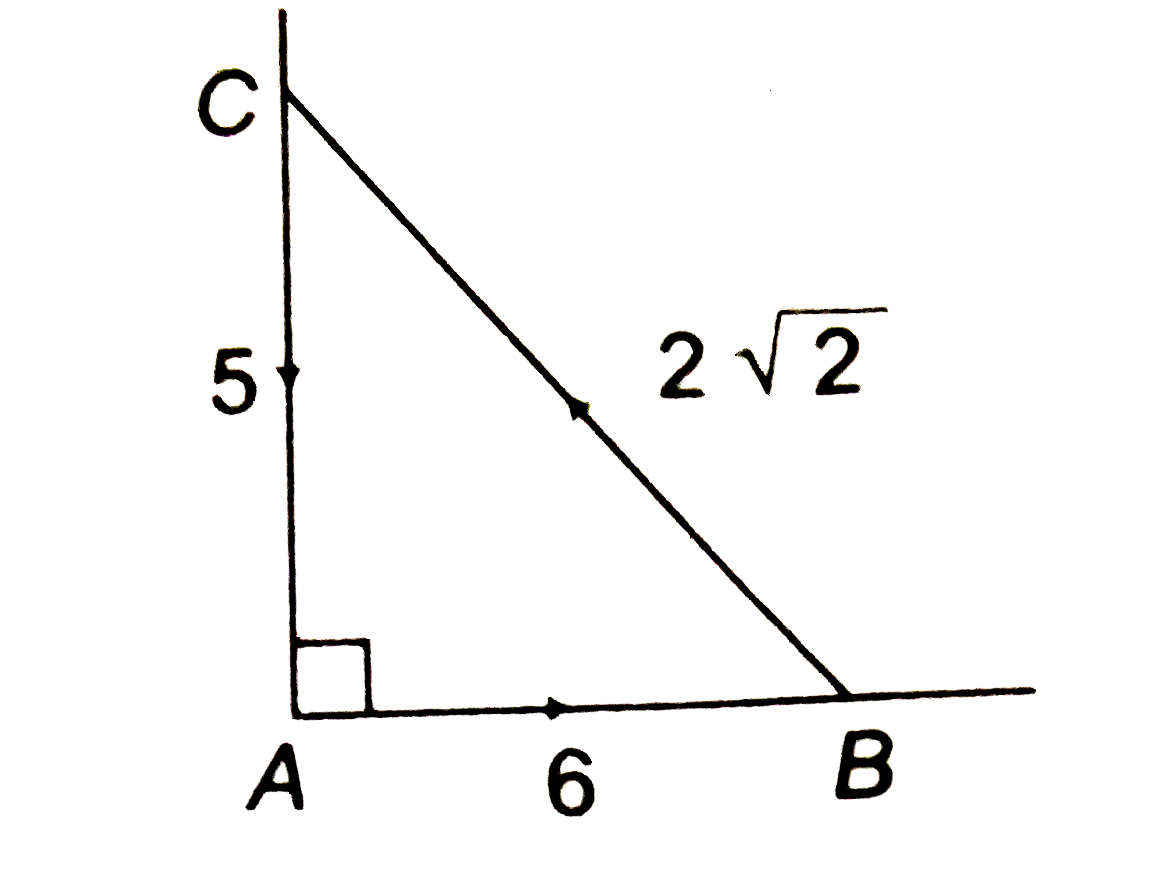
B

R `costheta=6cos0^(@)+2sqrt(2)cos(180^(@)-B)+5sin270^(@)`
`Rcostheta=6-2sqrt(2)cosB` . . (i)
`Rsintheta=6sin0^(@)+2sqrt(2)sin(180^(@)-B)+5sin270^(@)`

`Rsintheta=2sqrt(2)sinB-5` . . . (ii)
From Eqs. (i) and (ii), we get
`R^(2)=36+8cos^(2)B-24sqrt(2)cosB+8sin^(2)B+25-20sqrt(2)sinB`
`=61+8(cos^(2)B+sin^(2)B)-24sqrt(2)cosB-20sqrt(2)sinB`
`because` ABC is a right angled isosceles triangle.
i.e., `angleB=angleC=45^(@)`
`thereforeR^(2)=61+8(1)-24sqrt(2)(1)/(sqrt(2))-20sqrt(2)*(1)/(sqrt(2))=25`
`thereforeR=5`.
Promotional Banner

Similar Questions

Explore conceptually related problems

ABC is an isosceles triangle right angled at C . Prove that AB^(2)=2AC^(2) .

ABC is a triangle, right angled at C. If AB=25cm and AC=7cm, find BC.

The magnitudes of mutually perpendicular forces a,b and c are 2,10 and 11 respectively. Then the magnitude of its resultant is

Two forces 12N and 5N are acting at right angles to each other. Find the magnitude and direction of the resultant force.

The incircle of an isosceles triangle ABC in which AB=AC , touches the sides BC, CA, and AB at D, E, and F respectively. Prove that BD=DC .

In right angle triangle ABC, 8cm ,15 cm and 17 cm are the length of AB,BC and CA respectively , Then find sin A , cos A and tan A .

If P and Q are two force vectors acting at right angle to each other from a single point on a body then express the magnitude of their resultant.

Two equal forces (P each) act at a point inclined to cach other at an angle of 120^(@) . The magnitude of their resultant is

In Fig , ABD is a triangle right angled at A and AC bot BD. show that AB^(2)=BC.BD

