Home
Class 12
MATHS
a and b form the consecutive sides of a ...

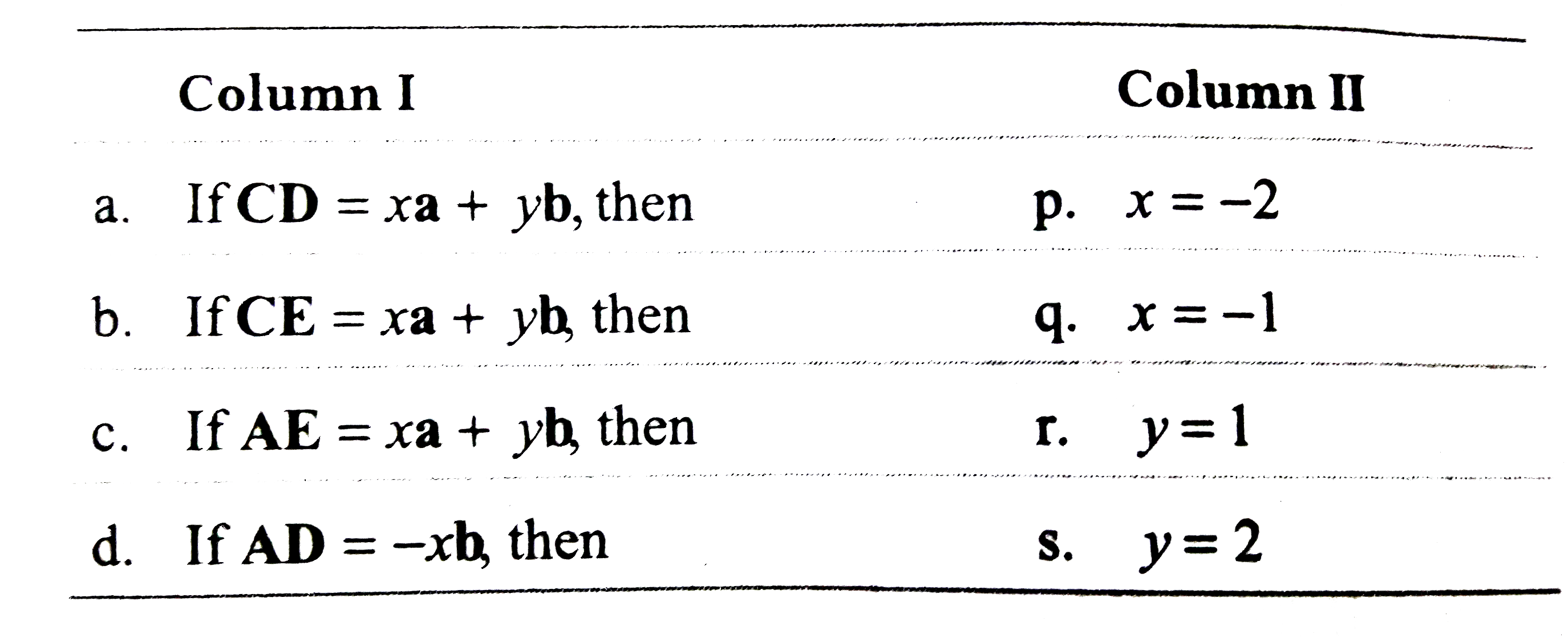
a and b form the consecutive sides of a regular hexagon ABCDEF.

Text Solution

Verified by Experts

The correct Answer is:
A, B


`AB=a,BC=b`
`thereforeAC=AB+BC=a+b` . . (i)
`AD=2BC=2b` . . (ii)
(because AD is parallel to BC and twice is length)
`CD=AD-AC=2b-(a+b)=b-a`
`FA=-CD=a-b` . . (iii)
`DE=-AB=-a` . . . (iv)
`EF=-BC=-b` . . (v)
`AE=AD+DE=2b-a` . . .(vi)
`CE=CD+DE=b-a-a=b-2a`. . . (vii).
Promotional Banner

Similar Questions

Explore conceptually related problems

Let A_(0),A_(1),A_(2),A_(3),A_(4) and A_(5) be the consecutive vertices of a regular hexagon inscribed in a circle of radius 1 unit. Then the product of the lengths of A_(0)A_(1) , A_(0)A_(2) and A_(0)A_(4) is

A uniform wire of resistance 24 Omega is bent in form of a regular hexagon ABCDEF . A cell of e.m.f. 4 volt having negligible internal resistance is connected across the side AB of the hexagon. The field at its centre will be

Consider the regular hexagon ABCDEF with centre at O (origin). Q. Five forces AB,AC,AD,AE,AF act at the vertex A of a regular hexagon ABCDEF. Then, their resultant is (a)3AO (b)2AO (c)4AO (d)6AO

Find the number of diagonals of a regular hexagon.

If the lines y=4-3 x, a y=x+10 and 2 y+b x+9=0 represent the three consecutive sides of a rectangle, then a b=

Let T_n denote the number of triangles which can be formed using the vertices of a regular polygon of n sides . If T_(n+1)-T_n=21 , then n equals :

Let A,B,C,D,E represent vertices of a regular pentangon ABCDE. Given the position vector of these vertices be a,a+b,b, lamda a and lamdab respectively. Q. AD divides EC in the ratio

Let A,B,C,D,E represent vertices of a regular pentangon ABCDE. Given the position vector of these vertices be a,a+b,b, lamda a and lamdab respectively. Q. AD divides EC in the ratio

Three of the six vertices of a regular hexagon are chosen at random . What is probability that the triangle with these vertices is equilateral ?

