Home
Class 12
MATHS
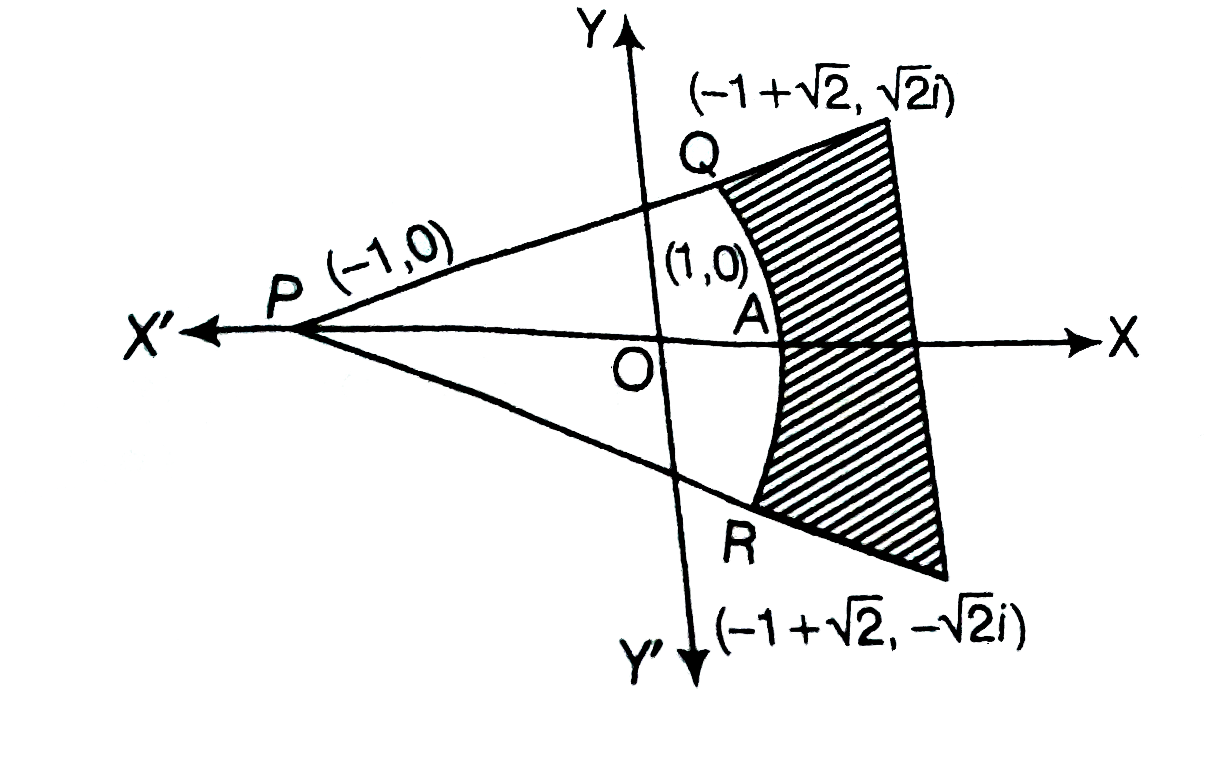
PQ and PR are two infinite rays. QAR is ...

PQ and PR are two infinite rays. QAR is an arc. Point lying in the shaded region excluding the boundary satisfies.

A

`abs(z-1) ge 2 , abs(arg(z-1)) lt (pi)/(4)`

B

`abs(z-1) ge 2 , abs(arg(z-1)) lt (pi)/(2)`

C

`abs(z+1) ge 2 , abs(arg(z+1)) lt (pi)/(4)`

D

`abs(z=1) ge 2 , abs(arg(z+1)) lt (pi)/(3)`

Text Solution

Verified by Experts

The correct Answer is:

C
Promotional Banner

Similar Questions

Explore conceptually related problems

In fig, arcs are drawn by taking vertices A, B and C of an equilateral triangle of side 10 cm, to intersect the sides BC, CA and AB at their respective mid-points D, E and F. Find the area of the shaded region. ("Use " pi = 3.14) .

Which of the following statements are true and which are false? Give reasons for your answer. (i) Only one line can pass through a single point. (ii) There are infinite number of lines which pass through two distinct points. (iii) A terminated line can be produced indefinitely on both the sides. (iv) If two circles are equal, then their radii are equal. (v) In given fig., AB=PQ and PQ=XY , then AB=XY .

Draw a circle of radius 2 cm with centre O and take a point P outside the circle such that OP = 4.5 cm. From P, draw two tangents to the circle. Given below are the steps of constructing the tangents from P. Find which of the following steps is wrong. Step 1: Draw a circle with O as centre and radius 2 cm. Step 2: Mark a point P outside the circle such that OP = 4.5 cm. Step 3: Join OP and bisect it at M. Step 4: Draw a circle with P as centre and radius = MP to intersect the given circle .at the points R and Q. Step 5: Join PR and PQ.

Unless stated otherwise, use pi=(22)/(7). Find the area of the shaded region in Fig. 5.19, if PQ = 24 cm, PR = 7 cm and O is the centre of the circle.

AB and CD are respectively arcs of two concentric circle of 21 cm and 7 cm radii and centre O (see Fig). If angleAOB=30^(@), find the area of the shaded region.
