Home
Class 12
PHYSICS
Derive an expression for electrostatic p...

Derive an expression for electrostatic potential due to a point charge .

Text Solution

Verified by Experts
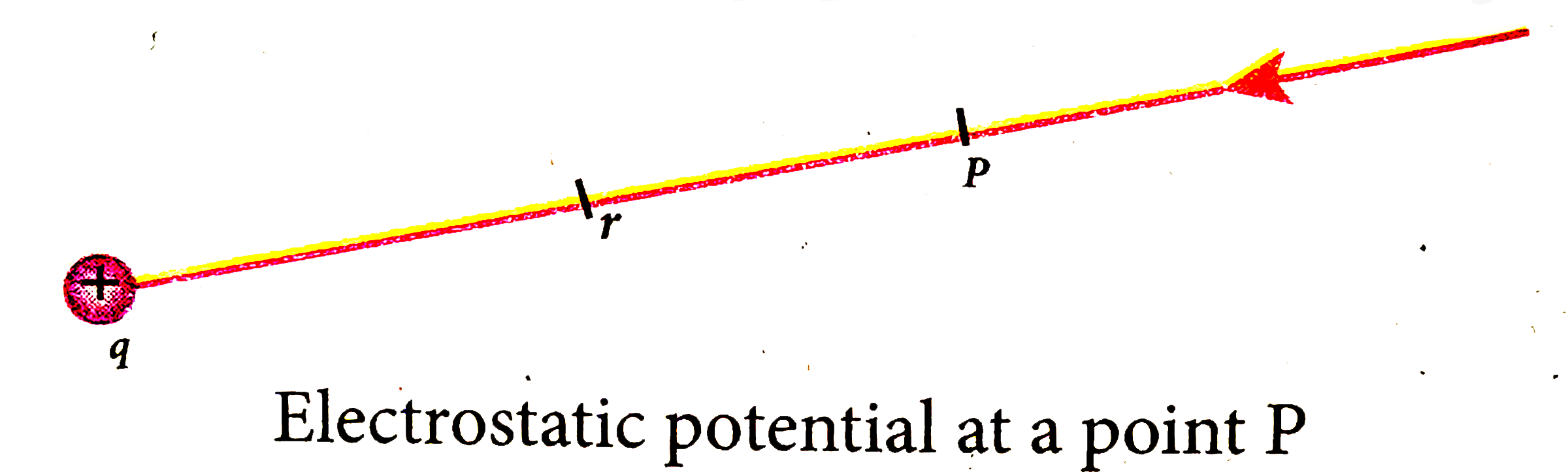
Consider a positive charge q kept fixed at the origin. Let P be a point at distance r from the charge q. This is shown in Figure.

Electrostatic potential at a point P
(ii) The electric potential at the point P is
`V=underset(oo)overset(r)int(-vec(E)).dvecr=-underset(oo)overset(r)intvec(E).dvecr" "......(1)`
Electric field due to positive point charge q is
`vec(E)=(1)/(4piepsi_(0))(q)/(r^(2))hatr`
`V=(-1)/(4piepsi_(0))underset(oo)overset(r)int(q)/(r^(2))hatr.dvecr`
The infinitesimal displacement vector `dvecr=drhatr` and using `hatr.hatr=1`, we have
`V=(1)/(4piepsi_(0))underset(oo)overset(r)int(q)/(r^(2))hatr.drhatr=(1)/(4piepsi_(0))underset(oo)overset(r)int(q)/(r^(2))dr`
After the intergration,
`V=(1)/(4piepsi_(0))q{-(1)/(r)}_(oo)^(r)=(1)/(4piepsi_(0))(q)/(r)`
Henece the electric potential due to a point charge q at a distance r is
`V=(1)/(4piepsi_(0))(q)/(r)" ".......(2)`
Important points :
If the source charge q is positive, `Vgt0`. If q is negative, then V is negative and equal to `v=(1)/(4piepsi_(0))(q)/(r)`
(ii) It is clear that the potential due to positive charge decreases as the distance increases, but for a negative charge the potential increases as the distance is increased. At infinity, r= electrostatic potential is zero (V=0).
(iii) A positive charge moves from a point of higher electrostatic potential to higher electrostatic potential.
(iv) The electric potential at a point P due to a collection of charges `q_(1),q_(2),q_(3).......q_(n)` is equal to sum of the electric potentials due to individual charges.
Promotional Banner

Similar Questions

Explore conceptually related problems

Derive an expression for electrostatic potential due to an electric dipole.

Derive an expression for electrostatic potential energy of the dipole in a uniform electric field .

Derive an expression for Nernst equation.

Define 'electrostatic potential".

