(i) Consider two equal and opposite charges separated by a small distance 2a as shown in Figure. The point P is located at a distance r from the midpoint of the dipole. Let `theta` be the anlge between the line OP and dipole axis AB.
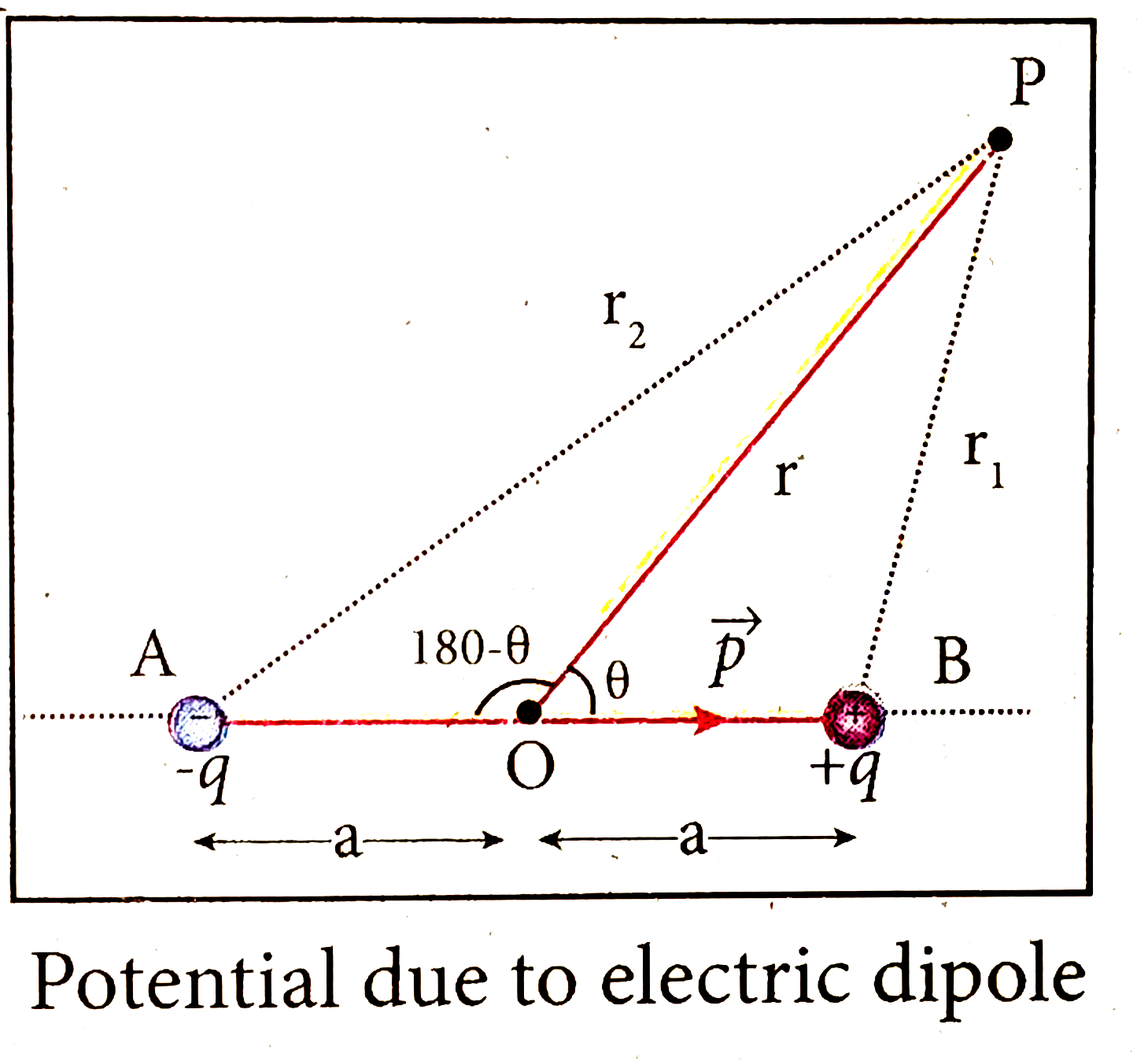
(ii) Let `r_(1)` be the distance of point P from +q and `r_(2)` be the distance of point P from -q.
Potential at P due to charge `+q=(1)/(4piepsi_(0))(q)/(r_(1))`
Potential at P due to charge `-q=-(1)/(4piepsi_(0))(q)/(r_(2))`
Total potential at the point P,
`V=(1)/(4piepsi_(0))q((1)/(r_(1))-(1)/(r_(2)))" ".........(1)`
(iii) Suppse if the point P is far away from the dipole, such that `altltr`, then equation (1) can be expressed in terms of r.
By the cosine law for triangle BOP,
`r_(1)^(2)=r^(2)+a^(2)-2racostheta`
`r_(1)^(2)=r^(2)(1+(a^(2))/(r^(2))-(2a)/(r)costheta)`
Since the point P is very far from dipole, then `altltr`. The term `(a^(2))/(r^(2))` is very small and can be neglected. Therefore
`r_(1)^(2)=r^(2)(1-2a(costheta)/(r))`
(or) `r_(1)=r(1-(2a)/(r)costheta)^(1/2)`
`(1)/(r_(1))=(1)/(r)(1-(2a)/(r)costheta)^(1/2)`
(iv) Since `(a)/(r)rltlt1`, we can use binomial theorem and retain the terms up to first order
`(1)/(r_(1))=(1)/(r)(1+(a)/(r)costheta)" "......(2)`
Similarly applying the cosine law for triangle AOP,
`r_(2)^(2)=r^(2)+a^(2)-2racos(180-theta)`
Since `cos(180-theta)=-costheta` we get
`r_(2)^(2)=r^(2)+a^(2)+2racostheta`
Neglecting `(a^(2))/(r^(2))` (because `rgtgta`)
`r_(2)^(2)=r^(2)(1+(2acostheta)/(r))`
`r_(2)=r(1+(2acostheta)/(r))^(1/2)`
Using Binomial theorem, we get
`(1)/(r_(2))=(1)/(r)(1-a(costheta)/(r))" ".......(3)`
Substituting equation (3) and (2) in equation (1),
`V=(1)/(4piepsi_(0))q((1)/(r)(1+a(costheta)/(r))-(1)/(r)(1-a(costheta)/(r)))`
`V=(q)/(4piepsi_(0))((1)/(r)(1+a(costheta)/(r)-1+a(costheta)/(r)))`
`V=(1)/(4piepsi_(0))(2aq)/(r^(2))costheta`
(v) But the electric dipole moment p=2qa and we get,
`V=(1)/(4piepsi_(0))((pcostheta)/(r^(2)))`
Now we can write `pcostheta=vec(p).hatr`, where `hatr` is the unit vector from the point O to point P. Hence the electric potential at a point P due to an electric dipole is given by
`V=(1)/(4piepsi_(0))(vec(p).hatr)/(r^(2))" "(rgtgta)" ".......(4)`
Equation (4) is valid for distances very large compared to the size of the dipole. But for a point dipole, the equation (4) is valid for any distance.
Case (i) If the point P lies on the axial line of the dipole on the side of +q, then `theta=0`. Then the electric potential becomes
`V=(1)/(4piepsi_(0))(p)/(r^(2))" "......(5)`
Case (ii) If the point P lies on the axial line of the dipole on the side of -q, then `theta=180^(@)`, then
Case (ii) If the point P lies on the equatorial line of the dipole, then `theta=90^(@)`. Hence
`V=0" "......(6)`


