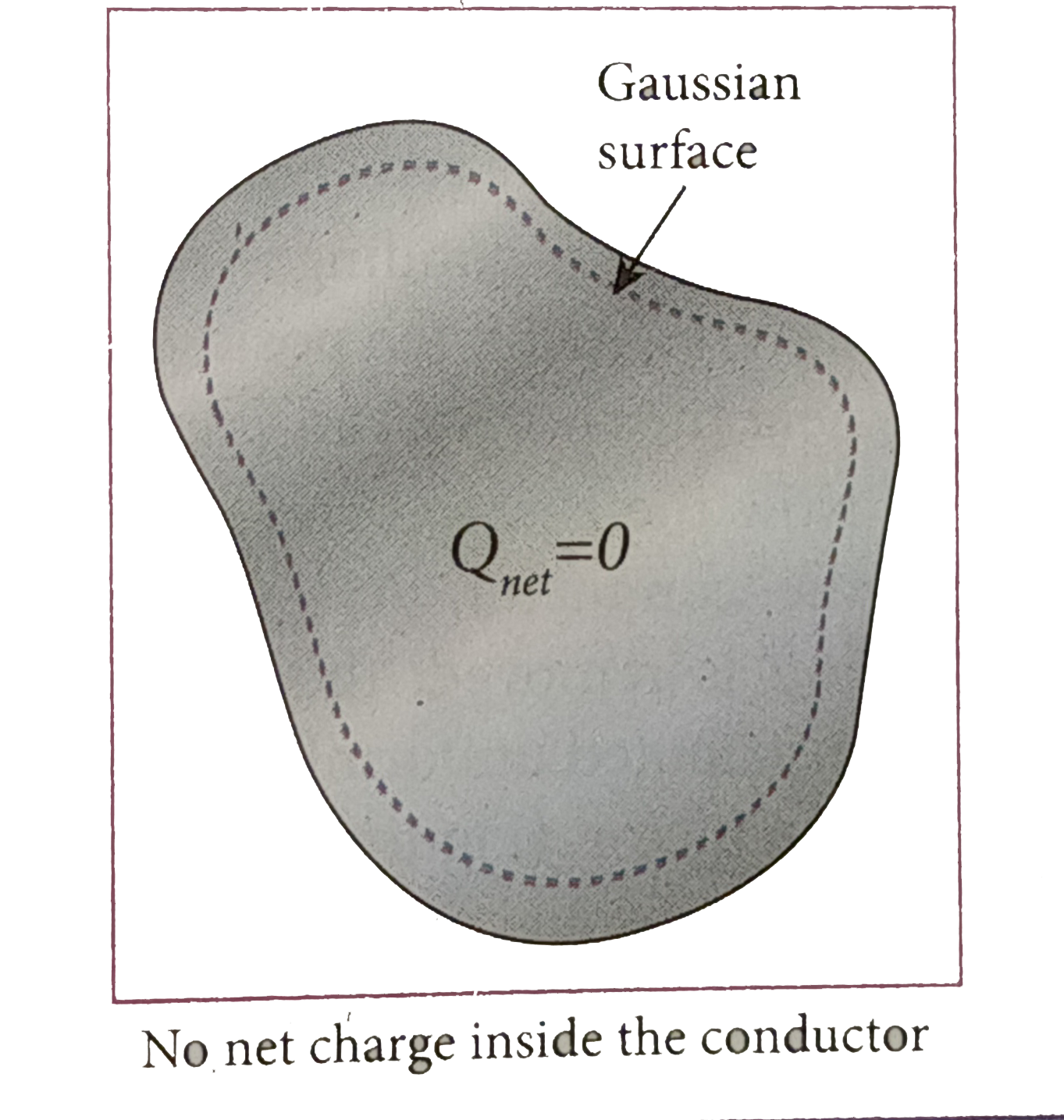
The electric field is zero everywhere inside the conductor. This is true reagrdless of whether the conductor is solid or hollow.
(ii) Since the electric field is zero everywhere inside the conductor, the net electric flux is also zero over this Gaussian surface. From Gauss.s law this implies that there is no net charge inside the conductor. Even if some charge is introduced inside the conductor, it immediately reaches the surface of the conductor.
(iii) (a) The electric field outside the conductor is perpendicular to the surface of the conductor and has a magnitude of `(sigma)/(epsi_(0))`
where `sigma` is the surface charge density at that so it is in electrostatic equilibrium point.
If the electric field has components parallel to the surface of the conductor, then free electrons on the surface of the conductor would experience acceleration (Figure). This means that the conductor is not in equilibrium.
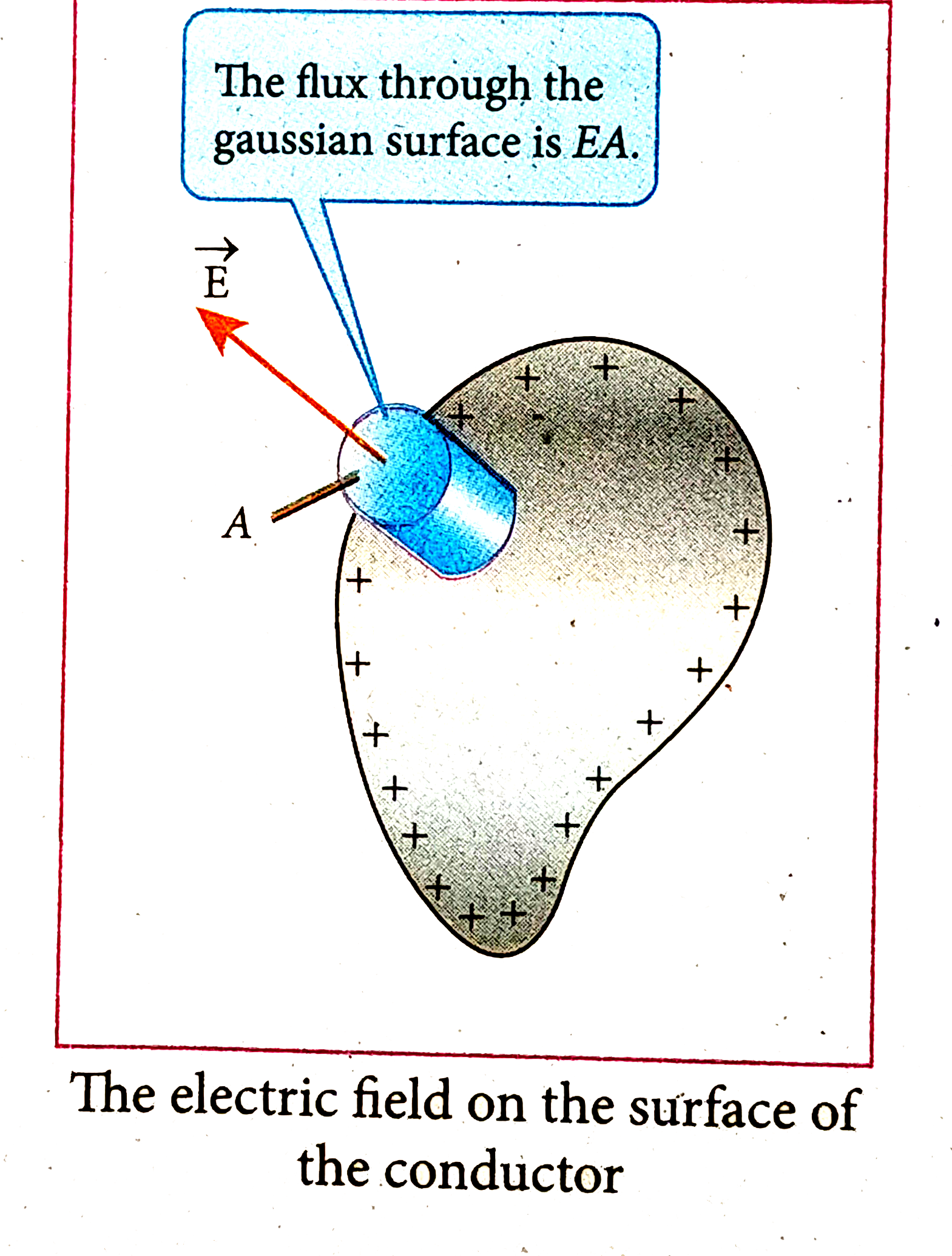
We now prove that the electric field has magnitude `(sigma)/(epsi_(0))` just outside the conductor.s surface. Consider a small cylindrical Gaussian surface, as shown in the Figure. One half of this cylinder is embedded inside the conductor.
Since electric field is normal to the surface of the conductor the curved part of the cylinder has zero electric flux. Also inside the conductor the electric field is zero. Hence the bottom flat part of the Gaussian surface has no electric flux.
Therefore the top flat surface alone contributes to the electric flux. The electric field is parallel to the area vector and the total charge inside the surface is `sigmaA.` By applying Gaus.s law,
`EA=(sigmaA)/(epsi_(0))`
In vector form, `vec(E)=(sigma)/(epsi_(0))hatn" ".........(1)`
Here `hatn` represents the unit vector outward normal to the surface of the conductor. Suppose `sigmalt0`, then electric field points inward perpendicular to the surface.
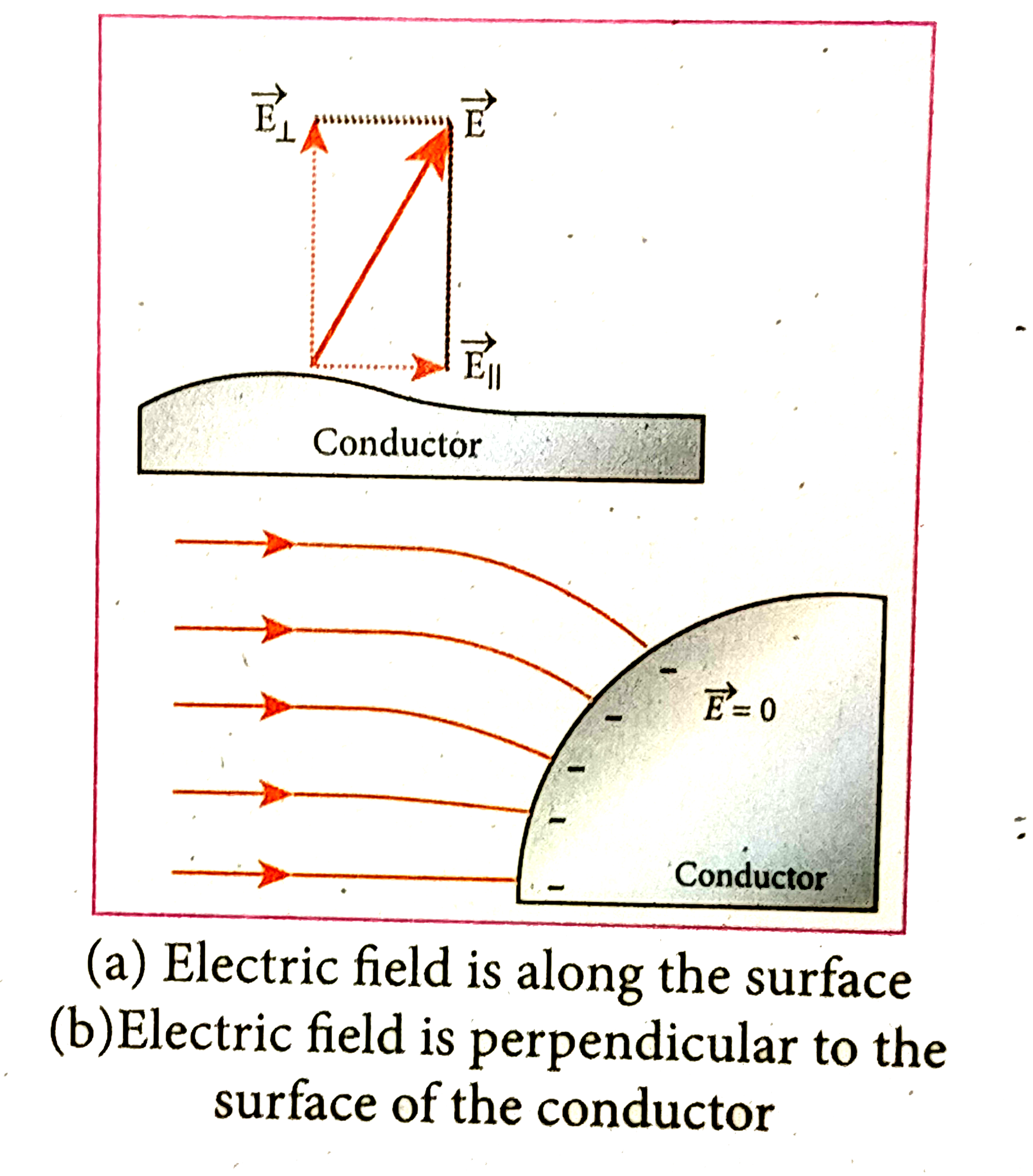
(a) Electric field is along the surface
(b) Electric field is perpendicular to the surface of the conductor
(iv) The electrostatic potential has the same value on the surface and inside of the coductor, the potential is the same as the surface of the conductor. Thus at electrostatic equilibrium , the conductor is always at equipotential.