Home
Class 12
PHYSICS
The figure showsn tow parallel equipoten...

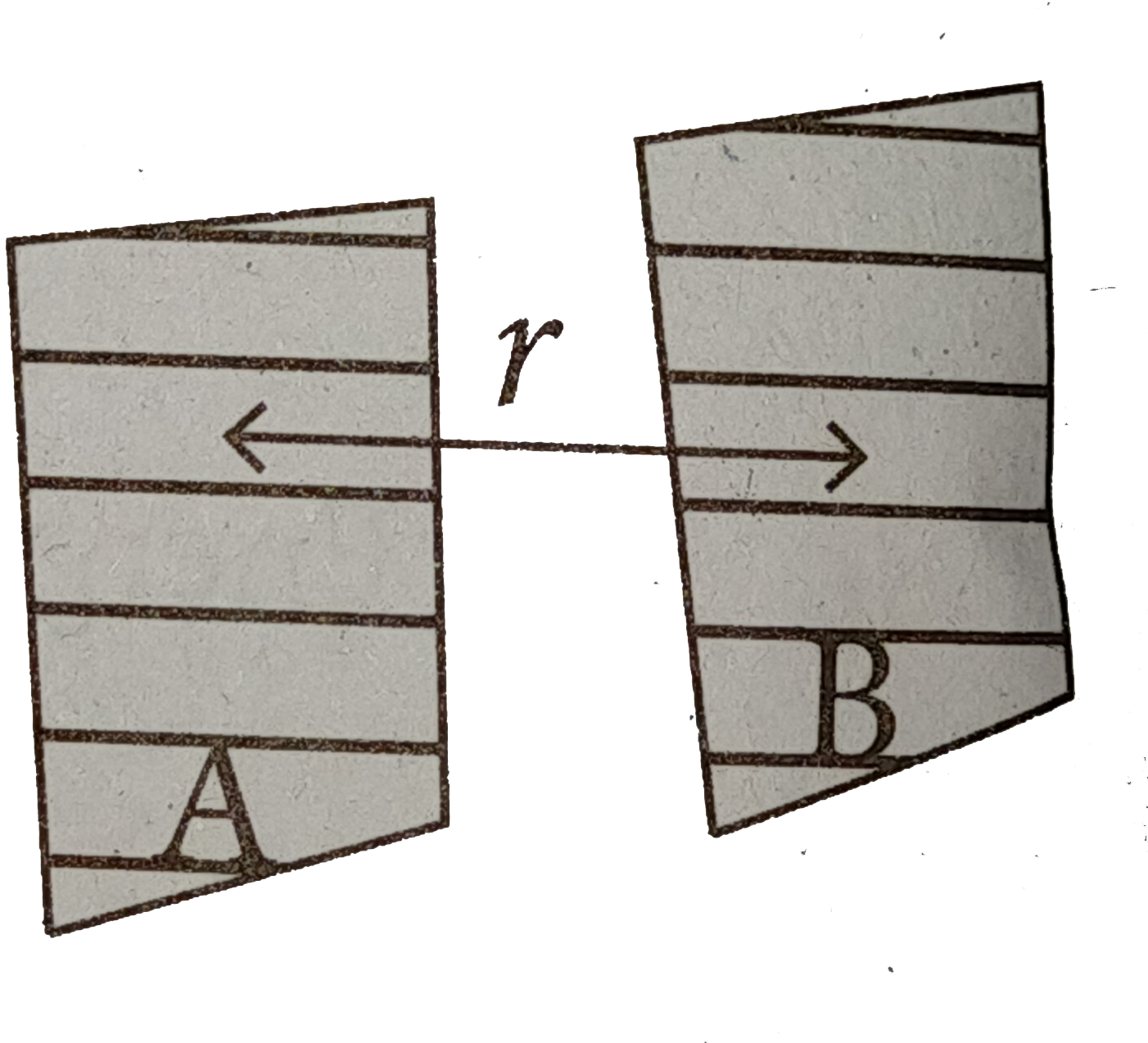
The figure showsn tow parallel equipotential surface A and B kept at a small distance 'r' a part from each other. A point chang of Q coumomb is taken from the surface A to B. The amount of net work done will be

A

`W=(-1)/(4pi epsi_(0)) (q)/(r)`

B

`W=(1)/(4pi epsi_(0)) (q)/(r^(2))`

C

`W=(-1)/(4pi epsi_(0)) (q)/(r^(2))`

D

zero

Text Solution

Verified by Experts

The correct Answer is:

D

`W=(V_(A)-V_(B))q`
`:. V_(A)=V_(B)` for equipotential suface `W=Oxxq=0`
Promotional Banner

Similar Questions

Explore conceptually related problems

Two small balls A and B each of mass m, are joined rigidly to the ends of a light rod of length L figure. The system translates on a frictionless horizontal surface with a velocity v_0 in a direction perpendicular to the rod. A particle P of mass kept at rest on the surface sticks to the ball A as the ball collides with it . Find a. the linear speeds of the balls A and B after the collision, b. the velocity of the centre of mass C of the system A+B+P and c. the angular speed of the system about C after the collision.

A circle is drawn with centre as charge +q. a. What is the work done in moving a charge +q from B to C along the circumference of the circle? If the charge +q is first taken from B to A and then from A to C, on which path work done will be more?

shows three paths through which a gas can be taken from the state A to the state B. calculate the work done by the gas in each of the three paths.

A rod of weight W is supported by two parallel knife edges A and B and is in equilibrium in a horizontal position.The knives are at a distance d from each other The centre of mass of the rod is at distance x from A.The normal reaction on A is

a solid sphere of mass m and radius r is placed inside a hollow thin spherical shell of mass M and radius R as shown in figure. A particle of mass m is placed on the line joining the two centers as a distance x from the point of contact of the sphere and the shell. Find the magnitude of the resultant gravitational force on this particle due to the sphere and the shell if a). rltxlt2r , b). 2rltxlt2R and c). xgt2R .

Two conducting plates A and B are placed parallel to each other. A is given a charge. Q_1 and B a charge Q_2 . Find the distribution of charges on the four surface.

The distance between the two parallel lines is 1 unit. A point A is chosen to lie between the lines at a distance 'd' from one of them Triangle ABC is equilateral with B on one line and C on the other parallel line. The length of the side of the equilateral triangle is

consider the cyclic process ABCA on a sample of 2.0 mol of an ideal gas as shown in the fig. temperature of the gas at A and B are 300 K and 500 k respectively. A total of 1200 J heat is withdrawn from the sample in the process. Find the work done by the gas in part BC. take R=8.3 JK^(-1) mol^(-1)

Figure shows a small diffused plane source S placed over a horizontal table-top at a distance of 2.4 m with its plane parallel to the table-top. The illuminance at the point A directly below the source is 25 lux. Find the illuminance at a point B of the table at a distance of 1.8 m from A.

Show that the normal component of electrostatic field has a discontinuity from one side of a charged surface to another given by (E_(2)-E_(1)).hatn=sigma/epsi_(0) where hatn is a unit vector normal to the surface at a point and sigma is the surface charge density at that point. (The direction of hatn is from side 1 to side 2). Hence show that just outside a conductor, the electric field is (sigma hatn)/(epsi_(0)) . (b) Show that the tangetial component of electrostatic field field is continuous from one side of a charged surface to another. [Hint: For (a), use Gauss law. For (b) use the fact that work done by electrostatic field on a a closed loop is zero].
