Home
Class 12
PHYSICS
Three point A, B & C lie in a uniform el...

Three point A, B & C lie in a uniform electric field (E) of `5xx10^(3)NC^(-1)`. Find the potential difference between A & C.

Text Solution

Verified by Experts
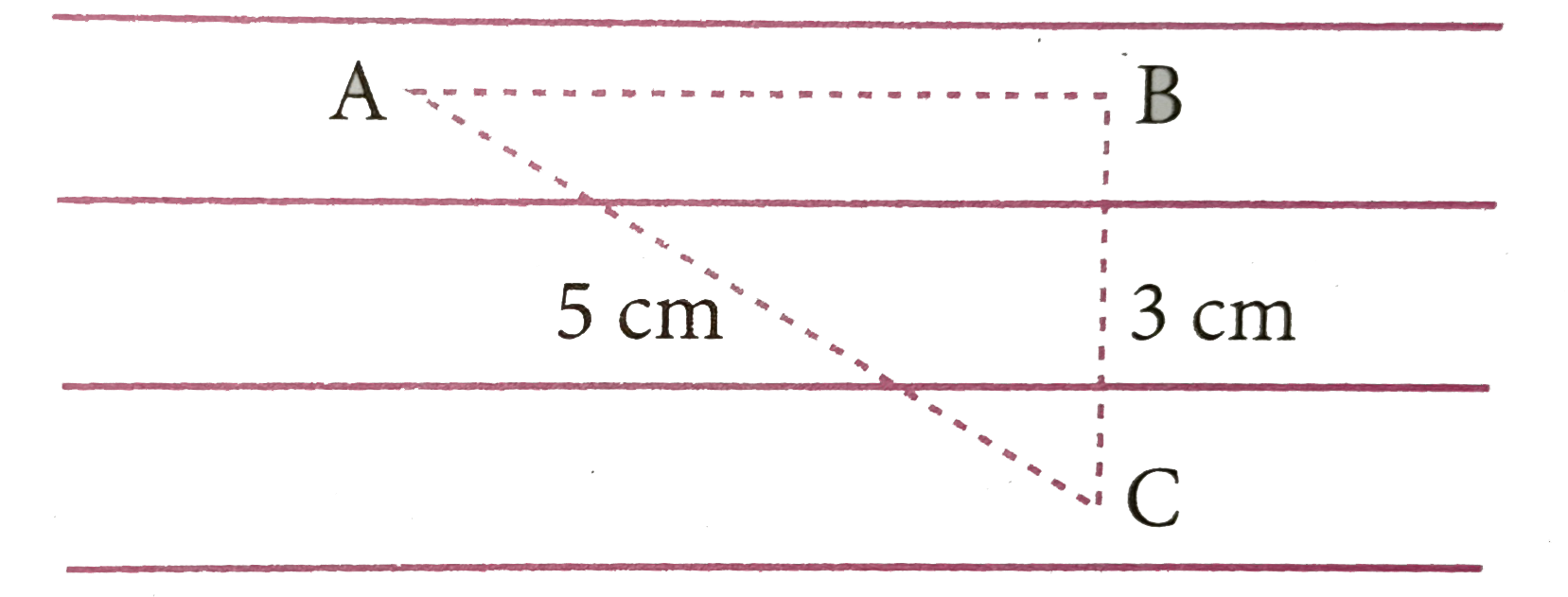
The line joining B to C is perpendicular to electric field

So potential of B= potential of C
i.e., `V_(B)=V_(C)`
Distance difference between A & C `=ExxAB=5xx10^(3)xx(4xx10^(-2))`
=200 volt.
`AC^(2)=AB^(2)+B^(2)`
`AB^(2)=AC^(2)-BC^(2)`
`=25-9=16`
`AB=4cm`
Promotional Banner

Similar Questions

Explore conceptually related problems

The workdone in moving 4 mu C charge from one point to another in an electric field is 0.012 J. The potential difference between them is

When a point charge of 6 mu C is moved between two points in an electric field, the work done is 1.8 xx 10^(-5) J . The potential difference between the two points is :

A point charge of 2 C experiences a constant force of 1000 N when moved between two points separated by a distance of 2 cm in a uniform electric field. The potential difference between the two points is

A sample of HCI gas is placed in a uniform electric field of magnitude 3xx10^(4)N.C^(-1) . The dipole moment of each HCI molecule is 3.4xx10^(-39) Cm. Calculate the maximum torque experienced each HCI molecule.

A spark plug in a bike or a car is used to ignite the air - fuel mixture in the engine. It consists of two electrodes separated by a gap of around 0.6 mm gap as shown in the figure. To create the spark an electric field of magnitude 3xx10^(6)Vm^(-1) is required. (a) What potential difference must be applied to produce the spark ? ( b) If the gap is increased , does the potential defference increase decrease or remains the same the same ? ( c) find the potential difference if the gap is 1 mm .

A , B and C are three points in a uniform electric field. The electric potential is

A pendulum bob of mass 80mg and carrying a charge of 2xx 10^(-8)C is at rest in a uniform, horizontal electric field of 20k Vm^-1. Find the tension in the thread.

A particle of mass 1 g and charge 2. 5 xx10^(-4) C is released from rest in an electric field of 1.2 xx 10^4 NC^(-1) (a) Find the electric force and the force of gravity acting on this particle. Can one of these forces be neglected in comparison with the other for approximate analysis? (b) How long will it take for the particle to travel a distance of 40 cm? (c) What will be the speed of the particle after travelling this destance? (d) how much is the work done by electric force on the particle during this period?

