Home
Class 12
PHYSICS
A particle of mass m and charge (-q) ent...

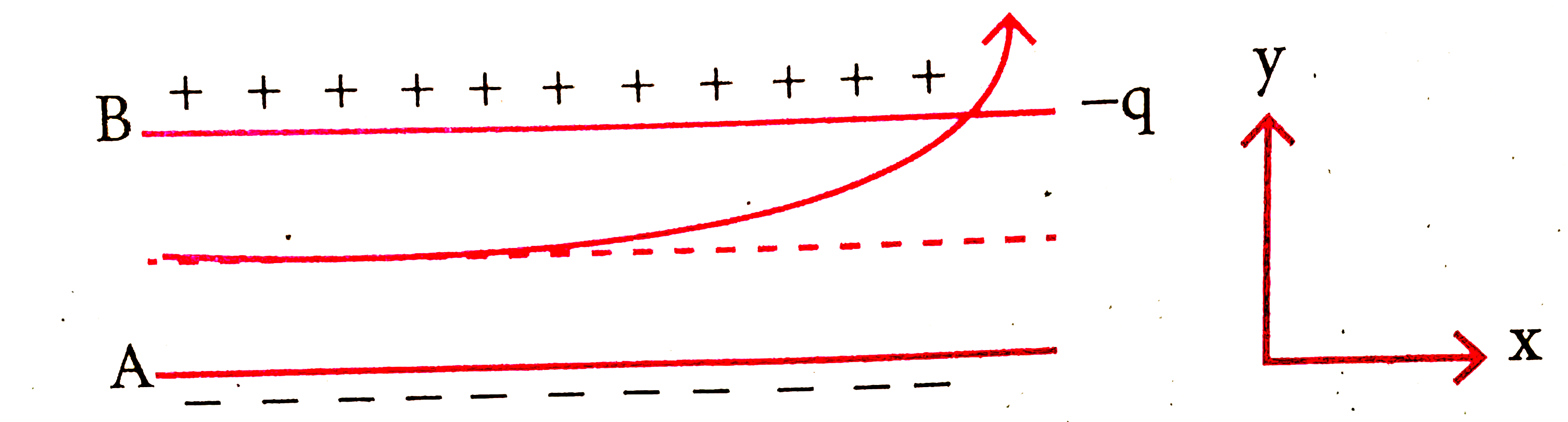
A particle of mass m and charge (-q) enters the region between the two charged plates initrally moving along X-axis with speed `V_(x)` as shown in figure. The length of plate is L and an uniform electric field E is maintained between the plates. S.T. vertical deflection of the particle at the edge of the plate is `(qEL^(2))/(2mV_(x)^(2))`.

Text Solution

Verified by Experts

Force on particle towards upper plate `B,F_(y)^(-)=qE`
Vertical acceleration of particle `a_(y)=(qE)/(m)`
Initial vertical velocity `V_(y)=0`
Time taken by praticle between the plates `t=(L)/(V_(x))`
From equation of motion `s=ut+(1)/(2)at^(2)`
Vertical deflection `y=0+(1)/(2)a_(y)t^(2)`
`=0+(1)/(2)((qE)/(m))((L)/(V_(x)))^(2)`
`y=(qEL^(2))/(2mV_(x)^(2))`
Promotional Banner

Similar Questions

Explore conceptually related problems

A particle of mass m and charge enters the region between the two charged plates initally moving along x axis with speed v_(x) the length of plate is l and an uniform electric field E is maintained between the plates. Show that the vertical deflection of the particle at the far edge of the plate is qEL^(2)//2mv_(x)^(2) compare this motion with motion of a projectile in gravitational field

Two plates are 2 cm apart. If a potential difference of 10 V is applied between them. The electric field between the plates will be

A parallel plate condenser has a uniform electric field E (V//m) in the space between the plates. If the distance between the plates is d (m) and area of each plate is A (m^2) the energy (joules) stored in the condenser is:

Two large conducting plates X and Y. each having large surface area A (on one side), are placed parallel to each other as shown in figure (30-E7). The plate X is given a charge Q whereas the other is neutral. Find (a) the surface charge density at the inner surface of the plates X, (b) the electric field at a point to the left of the plates, (c) the electric field at a point in between the plates and (d) the electric field at a point to the right of the plates.

Two large conducting plates are placed parallel to each other and they carry equal and opposite charges with surface density sigma as shown in figure (30-E6). Find the electric field (a) at the left of the plates, (b) in between the plates and © at the right of the plates.

A particle moves along the X-axis as x=u(t-2 s)+a(t-2 s)^2 .

A small ball of conducting material having a charge +q and mass m is thrown upward at and angle theta to horizontal surface with an initial speed nu_(0) as shown in the figure. There exists an uniform electric field E downward along with the gravitational field g . Calculate the range maximum height and time of flight in the motion of this charged ball. Neglect the effect of air and treat the ball as a point mass .

Two thin dielectric slabs of dielectric constants K_1 and K_2 (K_1ltK_2) are inserted between plates of a parallel plate capacitor, as shown in the figure. The variation of electric field E between the plates with distance d as measured from plate P is correctly shown by

A particle of mass m = 1.6 X 10^(-27) kg and charge q = 1.6 X 10^(-19) C moves at a speed of 1.0 X10^7 ms^(-7) . It enters a region of uniform magnetic field at a point E, as shown in The field has a strength of 1.0 T. (a) The magnetic field is directed into the plane of the paper. The particle leaves the region of the filed at the point F. Find the distance EF and the angle theta. (b) If the field is coming out of the paper, find the time spent by the particle in the regio the magnetic feld after entering it at E .

A uniform electric field E is created between two parallel ., charged plates as shown in figure . An electron . enters the field symmetrically between the plataes with a . speed v_0. The length of each plate is l. Find the angle of . deviation of the path of the electron as it comes out . of the field.
