Home
Class 12
PHYSICS
Two mutually perpendicular simple harmon...

Two mutually perpendicular simple harmonic vibrations have same amplitude, frequency and phase. When they superimpose, the resultant form of vibration will be

A

a circle

B

a straight line

C

a parabola

D

an ellipse

Text Solution

Verified by Experts

The correct Answer is:
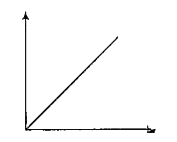
B

Two mutually perpendicular simple harmonic vibrations are combined. Let the equations be

`x = a sin omega t` and `y = a sin omega t`
`x^(2) + y^(2) = 2a^(2) sin^(2) omega t = 2 xx a sin omega t xx a sin omega t`
`x^(2) + y^(2) = 2xy`
`(x-y)^(2) = 0` or y = x
This equations represents a straight line.
Promotional Banner

Similar Questions

Explore conceptually related problems

When two mutually perpendicular simple harmonic motions of same frequency, amplitude and phase are susperimposed

In a simple harmonic mode of vibration, on a string

Find the phase different between two particles executing simple harmonic motion with the same amplitude and frequency when their phases at a certain moment are as shown in the figure.

Two simple harmonic motions with the same frequency act on a particle at right angles i.e., along X-axis and Y-axis. If the two amplitudes are equal and the phase difference is pi//2 , the resultant motion will be

Two particles execute simple harmonic motion of the same amplitude and frequency along close parallel lines. They pass each other moving in opposite directions each time their displacement is half their amplitude. Their phase difference is

When two simple harmonic motions of same periods, same amplitude, having phase difference of 3pi//2 , and at right angles to each other are super imposed, the resultant wave from is a

Two simple harmonic motion of angular frequency 100and 1000 rads^(-1) have the same displacement amplitude The ratio of their maximum acceleration is

The resultant of two rechangular simple harmonic motion of the same frequency and unequal amplitude but differing in phase by pi//2 is

