Home
Class 12
PHYSICS
Two metal rods are fixed end to end betw...

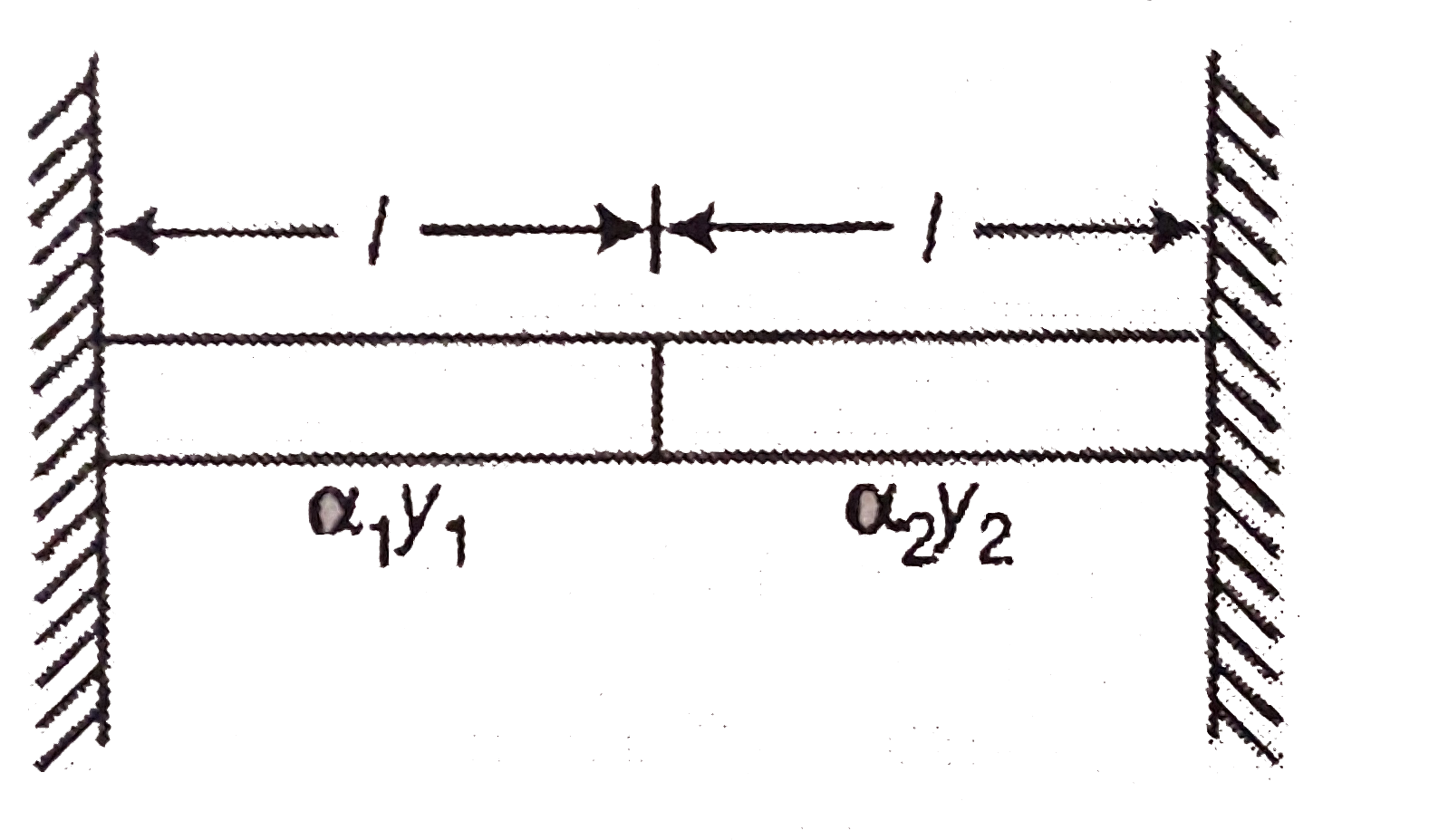
Two metal rods are fixed end to end between two rigid supports, as shown in figure. Each rod is of length 'l' and area of cross-section is A. When the system is heated up, determine the conditioin whenthe juction between rods does not shift.
[Given, `Y_(1)` and `Y_(2)` are Young's modulus of materials of the rods, `alpha_(1)` and `alpha_(2)` are coefficient at linear expansion.

A

`alpha_(1) Y_(2)= alpha_(2) Y_(1)`

B

`alpha_(1) Y_(1)= alpha_(2) Y_(2)`

C

`alpha_(1) = alpha_(2)`

D

`Y_(1) = Y_(2)`

Text Solution

Verified by Experts

The correct Answer is:

B

Since each rod is prevented from expansion, so they are under compression and mechanical strain. The net strain in each rod.
`epsi_(1) = alpha_(1)//Delta T- (Fl)/(AY_(1))`
and `epsi_(2)= alpha_(2)//Delta T- (Fl)/(AY_(2))`
When `epsi_(1)= epsi_(2)= 0`
`rArr alpha_(1)//Delta T- (Fl)/(A Y_(1))= 0 and alpha_(2)//Delta T- (Fl)/(AY_(2))`
Solving we get
`alpha_(1) Y_(1)= alpha_(2) Y_(2)`
Promotional Banner

Similar Questions

Explore conceptually related problems

Two metal rods are fixed end to end between two rigid supports as shown in figure. Each rod is of length l and area of cross-section is A . When the systeam is heated up,datermine the condition when the juncation between rods does not shift ? ( Y_(1) and Y_(2) are Young's modulus of materials of rods, alpha_(1) and alpha_(2) are coefficients of linear expansion)

Two rods having length l_(1) and l_(2) , made of materials with the linear coefficient of expansion alpha_(1) and alpha_(2) were welded togther. The equivalent coefficients of linear expansion for the obtained rod:-

A uniform rod of length (L) and area of cross-section (A) is subjected to tensil load (F). If sigma be the Poisson's ratio and Y be the Young's modulus of the material of the rod, then find the volumetric strain produced in the rod.

Two metal rods of the same length and area of cross-section are fixed end to end between rigid supports. The materials of the rods have Young module Y_(1) and Y_(2) , and coefficient of linear expansion alpha_(1) and alpha_(2) . The junction between the rod does not shift and the rods are cooled

Two rods of lengths L_(1) and L_(2) are welded together to make a composite rod of length (L_(1)+L_(2)) . If the coefficient of linear expansion of the materials of the rod are alpha_(1) and alpha_(2) respectively. The effective coefficient of linear expansion of the composite rod is

A thin rod of negligible mass and area of cross section S is suspended vertically from one end. Length of the rod is L_(0) at T^(@)C . A mass m is attached to the lower end of the rod so that when temperature of the rod is reduced to 0^(@)C its length remains L_(0) Y is the Young’s modulus of the rod and alpha is coefficient of linear expansion of rod. Value of m is :

Two rods are joined between fixed supports as shown in the figure. Condition for no change in the length of individual rods with the increase of temperature will be "(" alpha_(1), alpha_(2)= linear expansion coefficient A_(1), A_(2)= Area of rods Y_(1), Y_(2)= Young modulus ")"

Two same length rods of brass and steel of equal cross-sectional area are joined end to end as shown in figure and supported between two rigid vertical walls. Initially the rods are unstrained. If the temperature of system is raised by Deltat . Find the displacement of the junction of two rods. Given that the coefficient of linear expansion and young's modulus of brass and steel are apha_(b).alpha_(s)(alpha_(b)gtalpha_(s)),Y_(b) and Y_(s) respectively.
