Define Electric field .
Define Electric field .
Text Solution
Verified by Experts
Let us consider a source point charge q located at some point in space. Another point charge `q_0` (test charge) is placed at a point P which is at distance r from the charge q. The electrostatic force experienced by the charge `q_0` due to the q is given by Coulomb.s law.
`vecF = (kq)/r^2 hatr = 1/(4piepsilon_0)q/r^2hatr`
where. `k = 1/(4piepsilon_0)`
The charge q creates an electric field in the surrounding space. The electric field at the point P at a distance r from the point charge q is defined as the force experienced by a unit charge and is given by
`vecE = vecF/q_0 = (kq)/r^2 hatr`
`= 1/(3piepsilon_0)q/r^2 hatr` ...(1)
Here `hatr` is the unit pointing ffrom q to the point of interest P., the electric field is a vector quantity and its SI unit is Newton per Coulomb `(NC^-1)`.
Various aspects of the Electric field are-
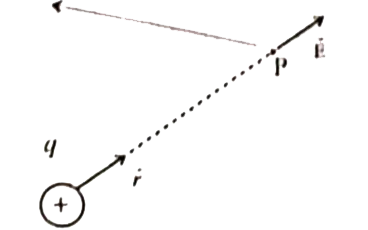
(i) If the charge q is positive then the electric field away from the source charge and if q is negative, the electric field points towards the source charge q.
For a positive source charge, the electric field at P points radially outward from q.
For a negative source charge, the electric field at P points radially inward toward q.
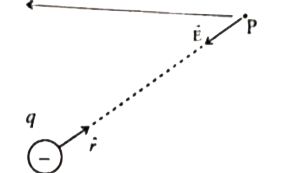
Electric field of positive and negative charges
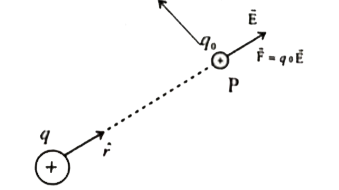
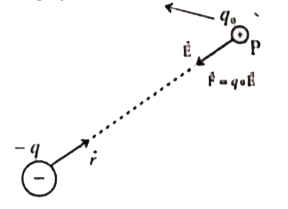
(ii) If the electric field at a point P is `vecE`, then the force experienced by the tast charge `q_0` palced at the point P is
`vecF = q_0.vecE` ...(2)
This is Coulomb.s law in terms of electric field. This is shown in following figure.
If q id positive, the force on the test charge `q_0` is directed away from q.
If q is negative, the force on the tast charge `q_0` is directed toward q.
(iii) It is implied from the equation (1) that the electric field is independent of the test charge `q_0` and depends only on the source charge q.
(iv) Since the electric field is a vector quantity, at every point in space, this field has unique direction and magnitude. as shown in following figures (a) an (b).
From equation (1), it is inferred that as distance increases, the electric field decreases in magnitude. The strength or magnitude of the electric field at point P is stronger than at the points Q and R because the point P is closer to the source charge.
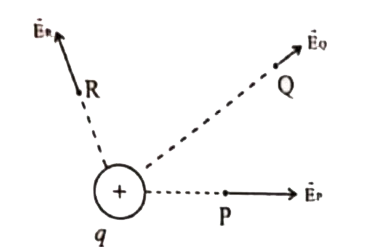
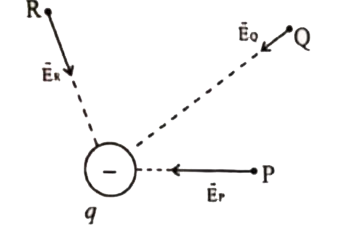
(v) In the definition of electric field, it is assumed that the test charge is taken sufficiently small, so that bringing this test charge will not move the source charge.
(v) The expression (1) is valid only for point charges.
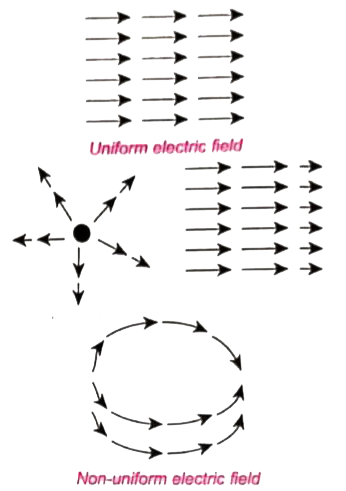
(vii) There are two kinds of the electric field: uniform or constant electric field and non-uniform electric field. The uniform electric field will have the same direction and constant magnitude at all points in space. The non-uniform electric field will have different directions or different magnitudes or both at different points in space. The electric field created by a point charge is basically a non uniform electric field. This non-unifirmity arises, both in direction and magnitude, with the direction being radually outward (or inward) and the magnitude changes as distance increases.
`vecF = (kq)/r^2 hatr = 1/(4piepsilon_0)q/r^2hatr`
where. `k = 1/(4piepsilon_0)`
The charge q creates an electric field in the surrounding space. The electric field at the point P at a distance r from the point charge q is defined as the force experienced by a unit charge and is given by
`vecE = vecF/q_0 = (kq)/r^2 hatr`
`= 1/(3piepsilon_0)q/r^2 hatr` ...(1)
Here `hatr` is the unit pointing ffrom q to the point of interest P., the electric field is a vector quantity and its SI unit is Newton per Coulomb `(NC^-1)`.
Various aspects of the Electric field are-
(i) If the charge q is positive then the electric field away from the source charge and if q is negative, the electric field points towards the source charge q.
For a positive source charge, the electric field at P points radially outward from q.
For a negative source charge, the electric field at P points radially inward toward q.
Electric field of positive and negative charges
(ii) If the electric field at a point P is `vecE`, then the force experienced by the tast charge `q_0` palced at the point P is
`vecF = q_0.vecE` ...(2)
This is Coulomb.s law in terms of electric field. This is shown in following figure.
If q id positive, the force on the test charge `q_0` is directed away from q.
If q is negative, the force on the tast charge `q_0` is directed toward q.
(iii) It is implied from the equation (1) that the electric field is independent of the test charge `q_0` and depends only on the source charge q.
(iv) Since the electric field is a vector quantity, at every point in space, this field has unique direction and magnitude. as shown in following figures (a) an (b).
From equation (1), it is inferred that as distance increases, the electric field decreases in magnitude. The strength or magnitude of the electric field at point P is stronger than at the points Q and R because the point P is closer to the source charge.
(v) In the definition of electric field, it is assumed that the test charge is taken sufficiently small, so that bringing this test charge will not move the source charge.
(v) The expression (1) is valid only for point charges.
(vii) There are two kinds of the electric field: uniform or constant electric field and non-uniform electric field. The uniform electric field will have the same direction and constant magnitude at all points in space. The non-uniform electric field will have different directions or different magnitudes or both at different points in space. The electric field created by a point charge is basically a non uniform electric field. This non-unifirmity arises, both in direction and magnitude, with the direction being radually outward (or inward) and the magnitude changes as distance increases.



Similar Questions
Explore conceptually related problems
The electric field can be studied in terms of electric field intensity. a. What is an electric field? Define electric field strength. Given its unit and dimensional formula. c. Who introduced the concept of electric field? d. Is electric field a scalar quantity or a vector quantity?
Define Electric dipole.
Define 'electric flux
Define electric ce1l. What is the direction of electric current in a cell?
Assertion : Electric lines of force cross each other. Reason: Electric field at a point supermpose to give one resultant electric field.
What is mean by Electric field lines ?
Define magnetic field.
Recommended Questions
- Define Electric field .
Text Solution
|
- Define electric field.
Text Solution
|
- विद्युत-क्षेत्र के किसी बिन्दु पर क्षेत्र की तीव्रता (intensity) को पर...
Text Solution
|
- Define an electric field.
Text Solution
|
- Define electric field lines.
Text Solution
|
- Define Electric field.
Text Solution
|
- Define electric intensity at a point in an electric field.
Text Solution
|
- किसी बिन्दु पर वैद्युत क्षेत्र की तीवरता की परिभाषा दीजिए।
Text Solution
|
- Define Electric field .
Text Solution
|