Home
Class 12
PHYSICS
Derive an expression for electrostatic p...

Derive an expression for electrostatic potential energy of the dipole in a uniform electric field .

Text Solution

Verified by Experts
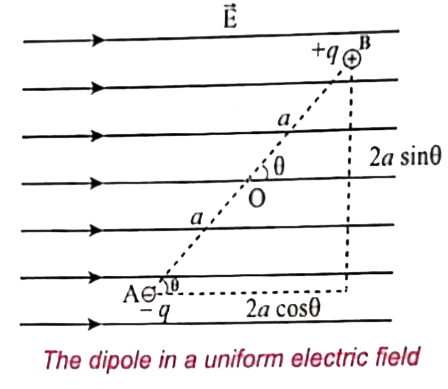
Let us consider a dipole placed in the uniform electric field `vecE` as shown in the figure.

A dipole experiences a troque when kept in an uniform electric field `vecE`. This torque rotates the dipole to align it with the direction of the electric field. In order to rotate the dipole ( at constant angular velocity) form its initial angle `theta.` to another angle`theta` against the torque exerted bt the electric field, an equal and opposite external torque must be applied on the dipole.
The work done by the external torque to rotate the dipole from angle `theta.` to `theta` at constant angular velocity is
`W = int_(theta.)^theta tau_(ext)d theta` ..(1)
since `vectau_(ext)` is equal and opposite to , `vectau_E = vecp xx vecE` , we have,
`|vectau_(ext)| = |vectau_E| = |vecp xx vecE|` ...(2)
Substituting equation (2) in equation (1), we get
`W = int_(theta.)^theta pEsinthetad theta`
`W = pE(costheta.-costheta)`
This work done is equal to the potential energy difference between the angular positions `theta` and `theta.`
`U(theta)- U(theta.) = DeltaU`
`-pEcostheta+pEcostheta.`
If the initial angle is `theta. = 90^@` and is taken as reference point, then
`U(theta.) = pEcos90^@ = 0`
The potentail energy stored in the system of dipole kept in the uniform field is given by
`U = -pEcostheta = -vecP.vecE`
In addition to p and E, the potential energy also depends on the orientation `theta` of the electric dipole with respect to the external electeic field.
The potential energy is maximum when the dipole is aligned anti-parallel `(theta=pi)` to the external electric field and the minimum when the dipole is laigned parallel `(theta = 0)` to the external electric field.
Promotional Banner

Similar Questions

Explore conceptually related problems

Define electrostatic potential energy.

Define 'electrostatic potential energy'.

Derive an expression for electrostatic potential due to an electric dipole.

