Let us consider a uniformly charged spherical shell of radius R and total charge Q. The electric field at points outside and inside the sphere is found using Gauss law.
Case (a): At a point outside the shell `(r gt R)`
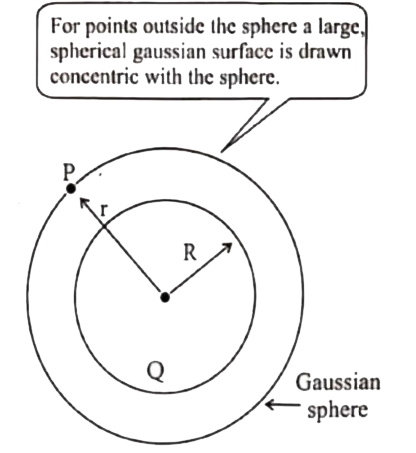
Let us select a point P outside the shell at a distance r from the center. The charge is uniformaly distributed on the surface of the sphere (spherical symmetry). Hence the electric field must point radially outward if `(Q gt 0)` and point radially inward if `Q lt 0`. Let us choose a spherical Gaussian surface of radius r is chosen and the total charge enclosed by this Gaussian surface is Q. Applying Gauss law
`oint vecE.dvecA = Q/epsilon_0`
The electric field `vecE` and `dvecA` point in the same direction (outward normal) at all the points on the Gaussian surface. The magnitude of `vecR` is also the same at all points due to the spherical symmetry of the charge distribution.
Hence,
`oint" "dvecA = Q/epsilon_0` ...(1)
But `oint" "dA` = total area of Gaussian surface
`= 4pir^2`
Sustituting this value in equation (1)
`E4pir^2 = Q/epsilon_0`
`E.4pir^2 = Q/epsilon_0 " (or) "E = 1/(4piepsilon_0)Q/r^2`
In vector form
`vecE = 1/(4piepsilon_0)Q/r^2hatr` ...(2)
The electric field is radiually outward if `Q gt 0` and rdially inward if `Q lt 0`. From equation (2), it is inferred that the electric field at a point outside the shelll will be same as if yhe entire charge Q is concentrated at the center of the spherical shell. (A similar result is observed in gravitation, for gravitational force due to a spherical shell with mass M)
Case (b): At a point on the surfaceof the spherical shell (r = R).
The electrical field at points on the spherical shell (r = R) is given by
`vecE = Q/(4piepsilon_0R^2)hatr`
Case (c): At a point inside the spherical shell `(r lt R)`
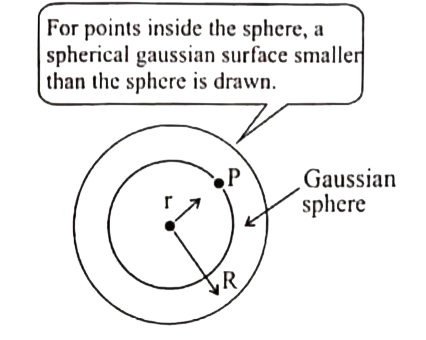
Consider a point P inside the shell at a point distance r from the center. A Gaussian sphere of radius r is constructed as shown in the Figure. Applying Gauss law
`oint vecE.dvecA = Q/epsilon_0`
`E.4pir^2 = Q/epsilon_0` ...(3)
Since surface encloses no charge, So Q = 0. The equation (3) becomes
`E = 0 (r lt R)`
The electric field due to the uniformly charged spherical shell is zero at all points inside the shell.


