A dielectric is a non-conducting material and has no free electrons. The electrons in a dielectric are bound within the atoms. Ebonite, glass and mica are some examples of dielectrics.
There are two types of dielectrics which are non-polar molecules and polar molecules.
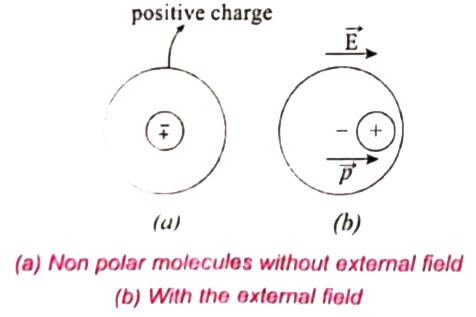
(i) Non-polar molecules: A non-polar molecule is one in which centers of positive and negative charges coincide. As a result, it has no permanent dipole moment. Examples of non-polar molecules are hydrogen `(H_2)`, oxygen `(O_2)`, and carbon dioxide `(CO_2)` etc.
When an external field is applied, the centers of positive and negative charges are separated by a small distance which induces dipole moment in the direction of the external electric field. Then the dielectric is said to be polarized by an external electric field.
Polar molecules: In polar molecules, the centers of the positive and negative charges even in the absence of an external electric field. They have a permanent dipole moment. Due to thermal motion, the direction of each dipole moment is oriented randomly (Figure (a)). Hence the net dipole moment is zero in the absence of an external electric field. Examples of polar molecules are `H_2O, N_2O, HCl, NH_3`.
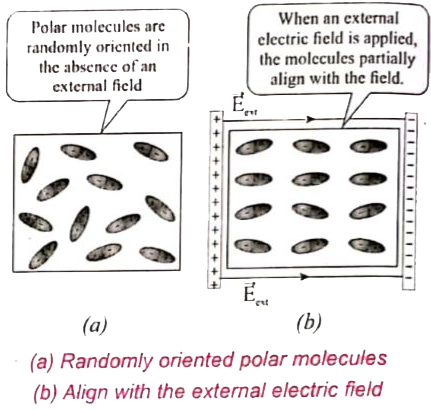
When an external electric fiels is applied, the dipoles inside the polar molecule tend to align in the direction of the electric field. Hence a net dipole moment is induced in it. Then the dielectric is said to be polarized by an external electric field (Fig. (b)).
Polarisation `vecP` is defined as the total dipole moment per unit volume of the dielectric. For most dielectrics (linear isotropic) the Polarisation is directly proportional to the strength of the external electric field. This is written as
`vecP = chi_evecE_(ext)`
where `chi_e` is a constant called the electric susceptibility which is a characteristics of each dielectric.
Induction of electric field inside the dielectric:
When an external electric field isapplied on a conductor, the charges are aligned in such a way that an internal electric field is created that cancels the external electric field. But in the case of a dielectric, which has no free
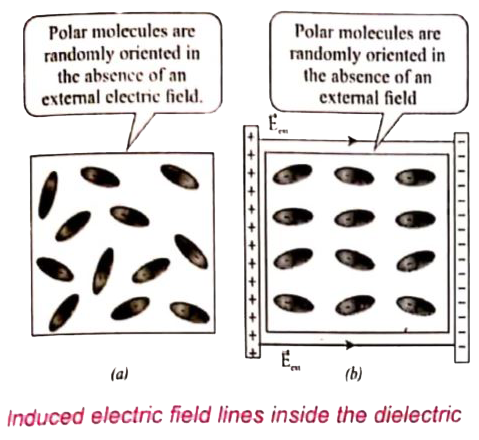
electrons, the external electric field ouly realigns field is produced. The magnitude electric field is produced. Hence the net electric field inside the dielectric is not zero but is parallel to an external electric field with magnitude less than that of the consider a rectangular dielectric slab placed between two oppsitely charged plates (capacitor).
The uniform electric field between the plates acts as an external electric field `vecE_(ext)` which polarizes the dielectric placed between plates. The positive charges are induced on the other side of surface.
But inside the dielectric, the net charge is zero even in a small volume. So the dielectric in the external field is equivalent to two oppositely cahrged sheets with the surface charge densities `+sigma_b` and `-sigma_b`. These charges are called boudnd charges. They are not free to move like free electrons in conductors. This is shown in the figure (b).


