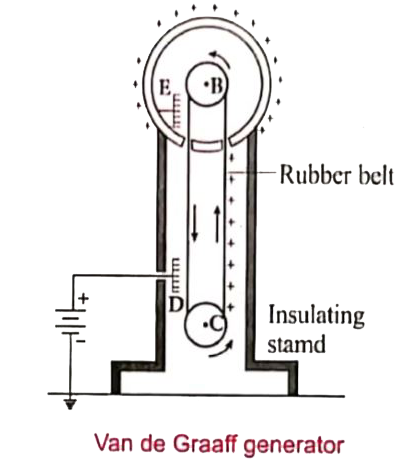
In the year 1929, Robert Van de Graaff designed a machine which produces a large amount of electrostatic potential difference, up to several million volts `(10^7 V)`.
Principle: This Van de Graaff generatorworks on the principle of electrostatic induction and action at points.
Construction: A large bollow spherical conductor is fixed on the insulating stand. A pulley C is fixed at the bottom. A belt made up of insulating materials like silk or rubber runs over both pulleys.
The pulley C is driven continuously by the electric motor. Two comb shaped metallic conductors E and D are fixed near the pulleys.
The comb D is maintained at a positive potential of `10^4` V by a power supply. The upper E is connected to the inner side of the hollow metal sphere.
Working: Because of the high electric field near comb D, air between the belt and comb D gets ionized. The positive charges stick to the belt and negative charges are attracted towards the comb D. The positive charges stick to the belt and move up. When the positive charges reach the comb E, a large amount of negative and positive charges are induced on either side of comb E due to electrostatic induction.
As a result, the positive charges are pushed away from the comb E and they reach the outer surface of the sphere. Since the sphere is a conductor, the uniformly on the outer surface of the hollow sphere. At the same time, the negative charges nulliify the positive charges in the belt due to corona ischarge before it passes over the pulley.
When the belt descends, it has almost no net charge. At the bottom, it again gains a large positive charge. The belt goes up and delivers the positive charges to the outer surface of the sphere. This process continues until the outer surface produces the potential difference of the order of `10^7` V which is the limiting value. Charges cannot be stored beyond this limit since the extra charge starts leaking to the surroundigs due to ionization of air. The leakage of charges can be reduced by enclosing the machine in a gas filled steel chamber at very high pressure.
Applications: The high voltage produced in Van de Graaff generator is used to accelerate positive ions (protons and deuterons) for nuclear disintegrations and other applications.