Home
Class 12
PHYSICS
A Charged particle of mass 1.0 g is susp...

A Charged particle of mass 1.0 g is suspended through a silk thread of length 40 cm in a horizantal electric field of `4.0 xx 10 ^4 NC ^(-1)` . If the particle stays aty a distance of 24 cm from the wall in equilibrium, find the charge on the particle.

Text Solution

Verified by Experts
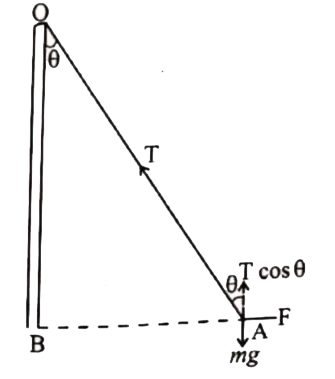

Mass of the particle m `= 10^-3` kg
Length of a silk thread OA = 40 cm = 0.4 m,
Electric field `E = 4xx10^4` N/C
Distance AB = 0.24 m
In equilibrium,
`F = Tsintheta` …(1)
`mg = T costheta` ...(2)
Dividing equation (1) by (2) we get
`F/(mg)=(Tsintheta)/(Tcontheta)= tantheta`
`F = mg tan theta`
`qE = mg tan theta`
`q = (mg tantheta)/E`
`(10^-3xx9.8xx3)/(4xx10^4xx4)=1.8xx10^-7C`
Charge `q = 1.8xx10^-7C`
Promotional Banner

Similar Questions

Explore conceptually related problems

A vertical electric field of magnitude 4.00xx 10^5 NC^(-1) . just prevents a water droplet of mass 1.000xx10^(-4) kg from. falling., find the charge on the droplet.

A ball of mass 100g and having a charge of 4.9xx 10^(-5) C is released from rest in a region where a horizontal electric field of 2.0 xx 10^4 NC^(-1) exists. (a) find the resultant force acting on the ball. (b) What will be the path of the ball ? (c ) Where will the ball be at the end of 2 s?

A particle of mass 1 g and charge 2. 5 xx10^(-4) C is released from rest in an electric field of 1.2 xx 10^4 NC^(-1) (a) Find the electric force and the force of gravity acting on this particle. Can one of these forces be neglected in comparison with the other for approximate analysis? (b) How long will it take for the particle to travel a distance of 40 cm? (c) What will be the speed of the particle after travelling this destance? (d) how much is the work done by electric force on the particle during this period?

An electric dipole consists of charges pm 2.0 xx 10^(8) C separated by a distance of 2.0 xx 10^(-3) m. It is placed near a long ilne charge of linear charge density 4.0 xx 10^(-4) C m^(-1) as shown in figure (30-W4), Such thet the negative charge is at a distance of 2.0 cm from the line charge. Find the force acting on the dipole.

A particle a having a charge of 5.0 xx 10 ^(-7) C is fixed in. a vertical wall. A second particle B of mass 100 g and. having equal charge is supended by a silk thread. of length 30 cm form the wall. The point of suspension is. 30 cm above the particle A. Find the angle of the thread. with the vertical when it stays in equilibrium.

A particle moves in a circle of diamater 1.0 cm under the action of magnetic field of 0.40 T, An electric field of 200 V m^(-1) makes the path straight. Find the charges/mass ratio of the particle.

An infinite line charge produces a field of 9 xx 10^(4)N//C at a distance of 2cm. Calculate the linear charge density.

Shows a convex lens of focal length 12 cm lying in a uniform magnetic field B of magnitude 1.2 T parallel to its principal axis. A particle having a charge 2.0X 10^(-3) C and mass 2.0 X 10^(-5) kg is projected perpendiucular to the plane of the diagram with a speed of 4.8 ms ^(-1). The particle moves along a circle with its centre on the principal axis at a distance of 18 cm from the lens. Show that the image of the particle goes along a circle end find the radius of thet circle.

An electron moves a distance of 8cm when accelerated from rest by an electric field of strength 3 xx 10^(4) NC^(-1). Calculate the tme of travel.

A pendulum bob of mass 80mg and carrying a charge of 2xx 10^(-8)C is at rest in a uniform, horizontal electric field of 20k Vm^-1. Find the tension in the thread.

